Let’s talk Inherited IRAs. After all, the majority of retirement money across America is sitting in tax-deferred vehicles like IRAs and 401ks. And that means much of the wealth that will be passed to a saver’s heir will come through tax-deferred vehicles.
It makes sense why. My daughter just graduated from the University of Kentucky. And on day one of her first job, the questions started coming…What is this 401k and should I do it? Of course, my first question back was “Do they have a Roth option?”. They did. And that’s what she went with.
But not every saver has that choice. And certainly those of us who started in our 401(k) decades ago did not have that option. We went to our first job. We signed up for the 401(k). And we started deferring taxes. Those accounts started to grow. We left our first job, and we rolled over the 401(k) balance to an IRA. And then we started a new 401(k) at our new job.
Stop me if you’ve heard this before.
Now, the good news from this pattern is that many savers have amassed a very healthy nest egg. In fact, for many of our clients, there’s a portion of that tax-deferred balance they won’t need for income. Which means there is a very high likelihood that those assets are going to a surviving spouse. And then the kids and grandkids.
Believe it or not, the reality of that – IRA money going to the spouse and then to the kids and grandkids – presents a big opportunity to financial advisors.
These days I’m hearing from more and more experts in our industry that inherited IRAs are the worst possible instrument to pass on wealth to heirs.
Why? Let’s narrow in on two reasons.
The first and most prominent is what the industry is calling “The Widow’s Penalty”.
Married Filing Joint filers enjoy wide tax brackets and higher standard deductions. But after one spouse dies, the surviving spouse must now file as single, usually the next year, unless they qualify for Qualifying Widow(er) status. Many times, the surviving spouse must live on similar income levels. That similar income level, now applied to a very different single filer tax bracket, can mean more income is taxed at higher rates.
Perhaps you’ve heard of the widow’s penalty. But have you ever actually quantified it for your clients?
We have. And the potential impact can be massive.
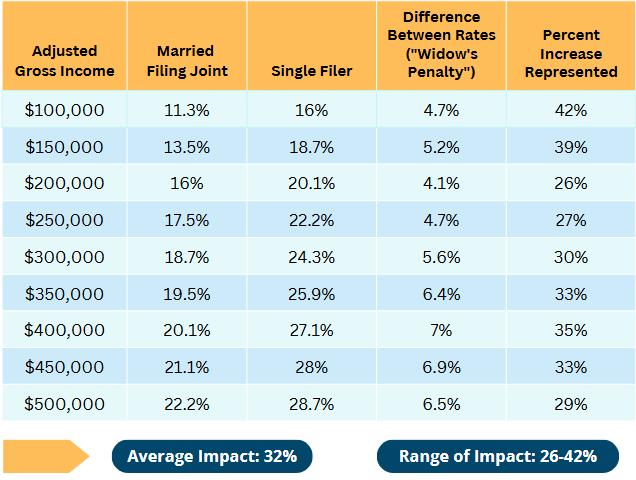
Let’s look at a couple with an AGI of $100,000. When filing their taxes MFJ, assuming the standard deduction for a married couple, they would have an effective tax rate of 11.3%. If one spouse were to pass away, and the surviving spouse still lived off that $100,000 AGI, the surviving spouse would then be faced with a 16% effective tax rate.The difference between the two, in this case 4.7%, is what we call the Widow’s Penalty. And that represents a 42% increase in the effective tax rate.
Stop the press.
Has anyone considered modeling a 40% tax increase for their MFJ clients? The risk is real. And it’s significant.
And looking at the chart, the highest increase is for the lower incomes represented.
If, as an advisor, you have never thought to quantify the Widow’s Penalty, there is an easy way. Just use Stonewood Financial’s Roth Done Right software. Run a report on their current situation. Then run an alternate scenario, this time with the same (or similar) income levels. But as a single filer. This will quantify the Widow’s Penalty for you and your client.
Now, the widow’s penalty obviously only applies to a spouse.
But what about when the money goes to the kids?
This is a different, albeit equally significant, tax risk for the heirs.
The Secure Act changed things for non-spousal inherited IRAs. Those beneficiaries, unless they meet unique circumstances, are now forced to pay taxes on IRA money inherited within 10 years. Former IRA laws allowed for that tax bill to be “stretched” over their lifetime. But that all changed with the Secure Act. Here is complete guide for provisional income
I’m going to take what seems like a left turn here. But trust me, it’s related.
I’ve been using the term “Effective Tax Rate” when discussing the impact of IRA money on a tax situation. And for married couples, I think the effective tax rate is the rate to use. It’s their IRA money, and the taxation of that money is “lumped in” with all income. So I like to use the effective rate.
But for non-spousal beneficiaries, it’s a little different. Those beneficiaries have their own tax situation established. The inherited money is all extra. Which means for tax impact calculations, the taxes on that money are at the marginal rate. Or even higher if the beneficiary moves into a higher tax bracket because of the inherited assets.
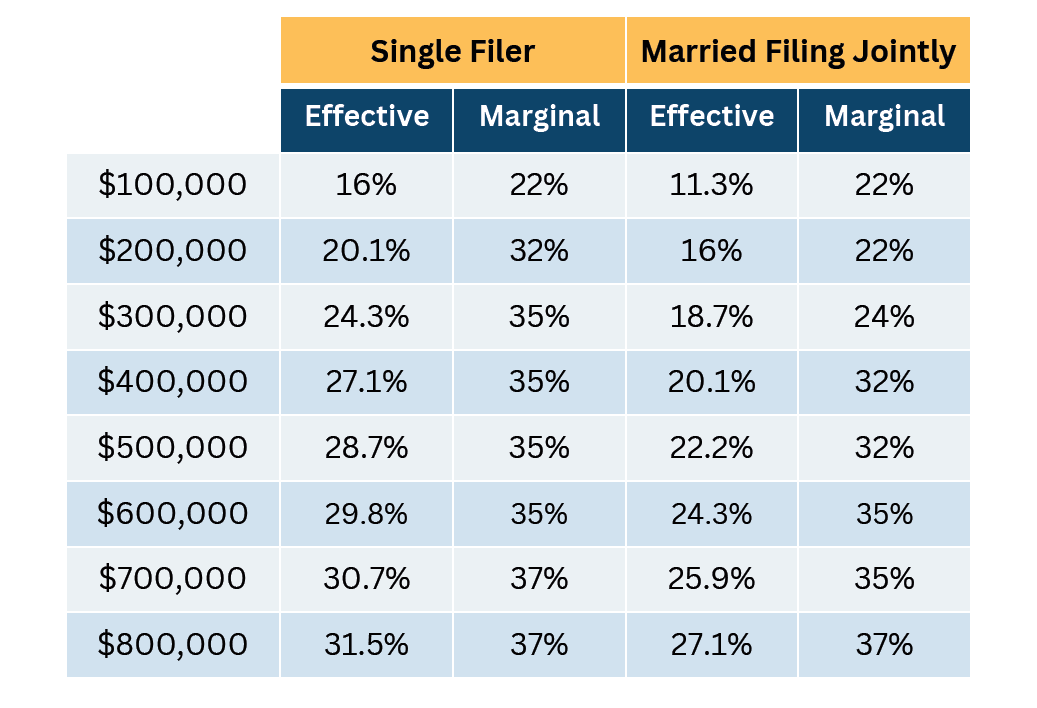
This chart shows the difference between effective and marginal tax rates at various income levels.
Let’s take a 50-year-old couple at the peak of their respective careers. Let’s say they have a combined taxable income of $400,000. And they inherit a $500,000 IRA from a parent who passed away. That means $50,000 of income per year, which they would need to claim over the next 10 years. Their current effective tax rate would be just over 20%. But that high of an income puts them in the 32% tax bracket. Which means the inherited money is all taxed at the margin. Potentially 12% more than what you would think if you’re only looking at their previous year’s effective tax rate.
Or perhaps another couple with a husband earning $100,000, whose wife stays at home. That couple inherits a $500,000 IRA from a parent who passed away. That couple who has a current effective tax rate of 11% would pay double that at the 22% tax bracket marginal rate.
These aren’t small risks – they’re silent tax traps that can devastate a family’s financial legacy.
One thing’s for certain: When it comes to inherited IRAs, it’s important for all parties involved to understand the tax implications and impacts.
Free Study Group Replay
How Stonewood Advisors Stay Ahead of the Next Planning Conversation.
Watch a recent Stonewood Study Group focused on the legacy planning conversation. You’ll see how Stonewood helps advisors break down timely planning topics, client conversation angles, and practical strategies you can put to use immediately.
Strategy expertise and training that actually moves the needle. Neil sees the big opportunities coming - and develops tools to let you take advantage of them.
Real Advisors. Real Results.
See how advisors are using Stonewood software to win larger cases and deliver better
outcomes for their clients.
An advisor was working with a prospect who was a real "do-it-yourselfer" when it came to Roth conversions.
The client was converting assets up their existing tax bracket – and hadn't considered any impact to
IRMAA.
With Roth Done Right, the advisor was able to show an alternate pattern that sped up the conversion to
6 years. The new structure offered $30,000 savings in conversion taxes – a 20% reduction on the
prospect's conversion tax bill. The report also showed hundreds of thousands of dollars in long-term
tax and IRMAA savings from the converted assets – an amount the prospect hadn't been able to quantify
on his own.
Outcome
A new client with $1M in new AUM, and a $1M FIA sale to fund the conversion process.
An advisor was working with a prospect who already had assets with Ken Fisher. Fisher's team presented a
5% systematic withdrawal projection, so the advisor needed a stronger way to frame the income
conversation.
Using the Annuity Alpha report, the advisor showed how an annuity could deliver over 8% in annual cash
flow with lifetime income, plus a long-term care doubler. The contrast was clear enough that the prospect
moved forward.
Outcome
$1.5M placed and a $100K in new business revenue.
An advisor was working with a 58-year-old couple with an established, well-funded retirement income plan,
leaving an additional $3M IRA to build out a legacy for the kids. The couple's existing advisor had no
real additional plan for this money, other than to keep it in their managed account and grow that money as
much as possible for the kids.
Using the Legacy Done Right report, the advisor showed the need for tax planning on this $3M IRA.
According to the advisor, the simple analysis "opened up the wallet" to the Roth conversion story. The
advisor then used the blended Roth/Life feature in the report to show a blend of Roth Conversion assets
with some Life Insurance to help maximize the client’s legacy.
Outcome
$3M in motion. The advisor picked up a $1.5M FIA sale that will be converted to Roth. And the advisor
also sold a 5-Pay Protection focused IUL policy at $225,000 of premium per year.
An advisor group incorporated the Total Tax Burden report into the strategy presentation for all new
prospects. They ran the tax snapshot for every new client as part of their first meeting conversation,
quantifying the growing tax burden of IRA money – and illustrating the kinds of tax savings possible
when working with their firm.
Starting in January of 2023, this simple analysis was presented to every single prospect who walked in
the door. The goal was to differentiate their practice and drive overall revenue growth through various
Roth conversion strategies.
Outcome
From 2022 to 2025, new annual AUM rose from $5M to $50M. Annual FIA sales rose from $3M to $35M.
And annual life premium rose from $50K to $1M.