Pop Quiz: What’s a big risk of retirement that doesn’t matter much while you’re saving… but can matter a LOT once you’re retired?
If you answered “Sequence of Returns Risk,” you’re right.
Sequence of Returns Risk is one of those risks that most savers have never considered as they enter retirement. And it’s easy to see why: It’s a risk that just doesn’t have an impact during someone’s saving years.
However, it’s a risk that can rear its ugly head in retirement, so it’s important that American savers understand the risk, its potential impact, and how to protect against it. With all the market volatility we’ve witnessed this month, it’s a good time to take a closer look at this risk and how we can help clients prepare.
What is Sequence of Returns Risk?
Sequence of returns is the name given to the pattern of returns an account, index, or market experiences. If we’re looking at the S&P 500®, for example, there is a pattern of returns that has occurred over the past few years: In 2021, the market was up 28%. In 2022, it was down 18%. In 2023, it was up 26%.
For most savers, the sequence in which their returns come in doesn’t matter much while they’re saving. Here’s a quick example to show you why.
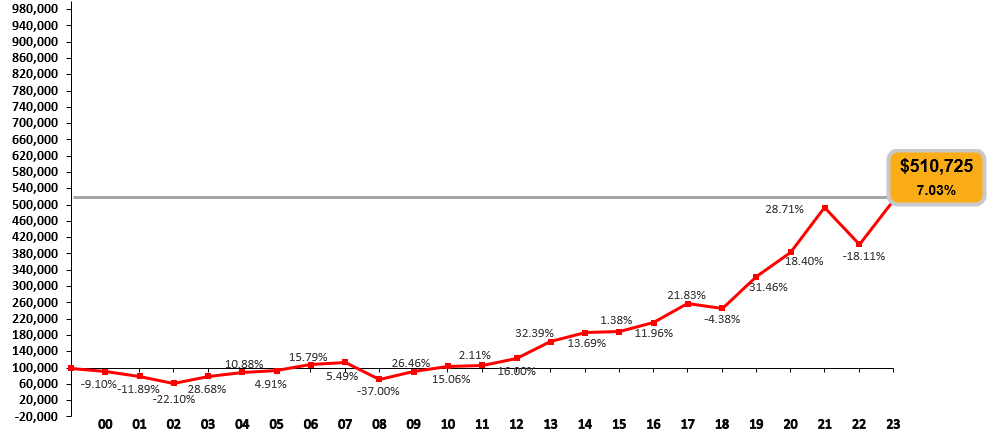
Let’s say a saver has $100,000 in an IRA growing at the rate of the S&P 500®. In real life, here’s the growth those funds would have seen so far this century:
At the end of last year, the $100,000 would have grown to $510,000, despite some ups and downs in the index.
But now let’s see what would happen if the S&P 500® experienced those returns in reverse.
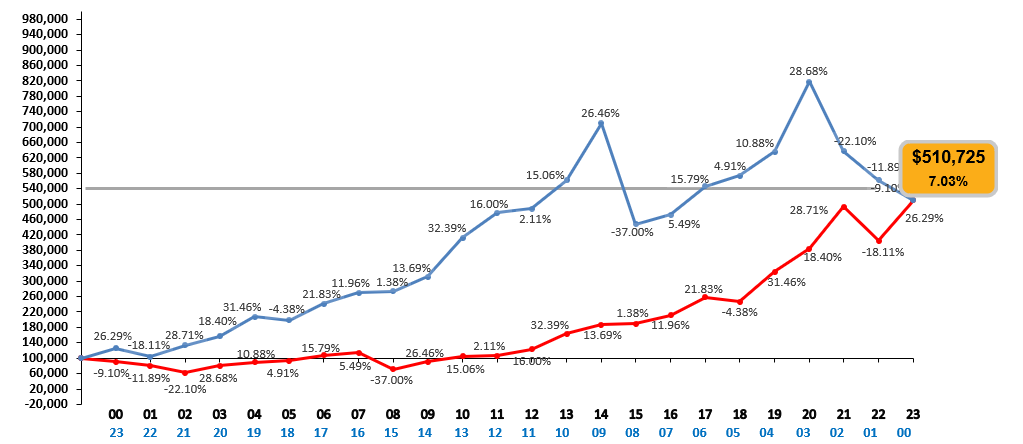
To be clear: We’re not changing the returns. We’re just projecting what would happen if those returns happened in the opposite order: If 2000’s return happened in 2023, and 2001’s return happened in 2022, etc.
The blue line is the result if we had experienced this decade’s returns in reverse:
As you can see, the pattern is very different, but the funds in the account end up in the exact same place – having grown to about $510,000.
This is why most savers have not considered Sequence of Returns Risk in their retirement approach: while all the money in your account is rising and falling with the returns, it doesn’t matter what order those returns come in.
Suddenly, they are withdrawing money from the account each year to use as income. And that’s when Sequence of Returns Risk can rear its ugly head.
The “Risk” comes when you need to access your funds, because suddenly you don’t have all of your money recovering from market losses. In retirement, savers often need to withdraw money for living expenses regardless of whether the market is up or down – which means that in a down market, they are withdrawing funds at a potential loss.
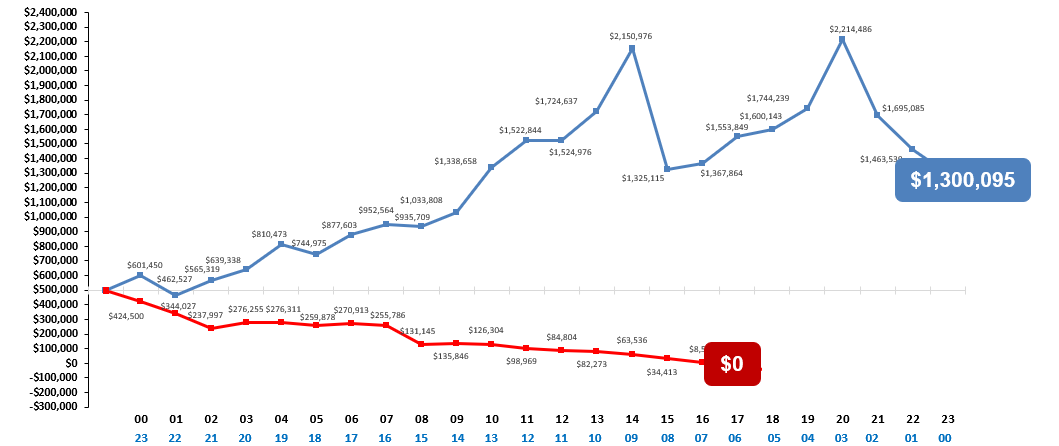
So let’s run our example again, but this time assume the saver is retired and needs to access retirement income from the account. Let’s say this saver has a $500,000 IRA growing at the rate of the S&P 500®. She retires in 2000 and takes $30,000 a year out of the account for income.
In real life, this is what would have happened:
That’s right: She runs out of money in 2017.
Unfortunately, she had to withdraw money in 2000, 2001, and 2002 (not to mention 2008) – all while the market was down and there were fewer funds in her account. That means she has less money available to participate in the market’s recovery in the following years.
Now let’s look at what would happen if we reversed the sequence of those returns. Again, we’re not changing the returns of the market; we’re just projecting what would happen if those returns happened in reverse, with the 2000’s return coming in 2023 and so on.
If we experienced this decade in reverse, here are the results:
Not only does this saver not run out of money, she actually has over $1 million left at the end of this period.
Now you can see that Sequence of Returns Risk doesn’t matter much to your clients while they’re saving for retirement – but it can become a big headache for them in retirement.
How You Can Help
There’s no shortageofadvice on helping your clients address Sequence of Returns Risk.
But one strategy you might not know about is leveraging certain product designs to address this risk.
We’ve talked in this blog before about leveraging Index Universal Life insurance in the retirement income space. But the product design of IUL can also help savers address sequence of returns risk. This is thanks to the interplay of both indexing and participating loans available in many IUL products, features that allow interest credits to both funds in the cash value of the policy and funds borrowed through policy loans to use as supplemental retirement income.
Regardless of how you plan to address Sequence of Returns Risk for your clients, it’s a risk they need to understand.
We’ll see if the rest of 2024 is as rocky as the past few weeks have been. But one thing is for certain: Over your client’s lifetime, there will be up-market years and down-market years. While we can’t control the market or the pattern of those returns, we can help protect their assets from the impact of these changes.
Looking for a powerful way to explain Sequence of Returns Risk to your clients and prospects? Stonewood Financial has a suite of market tools – from seminar presentations to client handouts – that can help. Check them out here.
Free Study Group Replay
How Stonewood Advisors Stay Ahead of the Next Planning Conversation.
Watch a recent Stonewood Study Group focused on the legacy planning conversation. You’ll see how Stonewood helps advisors break down timely planning topics, client conversation angles, and practical strategies you can put to use immediately.
Expert insights. Real strategies.
Study Group Replay
Timely planning topics
Real client conversation angles
Practical strategies you can use
Real Advisors. Real Results.
See how advisors are using Stonewood software to win larger cases and deliver better
outcomes for their clients.
An advisor was working with a prospect who was a real "do-it-yourselfer" when it came to Roth conversions.
The client was converting assets up their existing tax bracket – and hadn't considered any impact to
IRMAA.
With Roth Done Right, the advisor was able to show an alternate pattern that sped up the conversion to
6 years. The new structure offered $30,000 savings in conversion taxes – a 20% reduction on the
prospect's conversion tax bill. The report also showed hundreds of thousands of dollars in long-term
tax and IRMAA savings from the converted assets – an amount the prospect hadn't been able to quantify
on his own.
Outcome
A new client with $1M in new AUM, and a $1M FIA sale to fund the conversion process.
An advisor was working with a prospect who already had assets with Ken Fisher. Fisher's team presented a
5% systematic withdrawal projection, so the advisor needed a stronger way to frame the income
conversation.
Using the Annuity Alpha report, the advisor showed how an annuity could deliver over 8% in annual cash
flow with lifetime income, plus a long-term care doubler. The contrast was clear enough that the prospect
moved forward.
Outcome
$1.5M placed and a $100K in new business revenue.
An advisor was working with a 58-year-old couple with an established, well-funded retirement income plan,
leaving an additional $3M IRA to build out a legacy for the kids. The couple's existing advisor had no
real additional plan for this money, other than to keep it in their managed account and grow that money as
much as possible for the kids.
Using the Legacy Done Right report, the advisor showed the need for tax planning on this $3M IRA.
According to the advisor, the simple analysis "opened up the wallet" to the Roth conversion story. The
advisor then used the blended Roth/Life feature in the report to show a blend of Roth Conversion assets
with some Life Insurance to help maximize the client’s legacy.
Outcome
$3M in motion. The advisor picked up a $1.5M FIA sale that will be converted to Roth. And the advisor
also sold a 5-Pay Protection focused IUL policy at $225,000 of premium per year.
An advisor group incorporated the Total Tax Burden report into the strategy presentation for all new
prospects. They ran the tax snapshot for every new client as part of their first meeting conversation,
quantifying the growing tax burden of IRA money – and illustrating the kinds of tax savings possible
when working with their firm.
Starting in January of 2023, this simple analysis was presented to every single prospect who walked in
the door. The goal was to differentiate their practice and drive overall revenue growth through various
Roth conversion strategies.
Outcome
From 2022 to 2025, new annual AUM rose from $5M to $50M. Annual FIA sales rose from $3M to $35M.
And annual life premium rose from $50K to $1M.