In a way, taxes are the final frontier of retirement planning.
As an industry, financial advisors have helped U.S. savers address market risk through asset allocation; income risk through guaranteed income products; and health risk through long-term care.
But that leaves one big risk unaddressed: the risk of rising taxes.
What is Tax Risk?
U.S. savers collectively have trillions of dollars in tax-deferred retirement accounts – like 401(k)s and IRAs.
And because they’ve deferred taxes on all those assets, those savers have a tax bill coming due in retirement.
If their taxes are lower in retirement than they are today, they’ll be fine; after all, the promise of tax-deferred savings is that you can access your funds at a lower tax rate in the future.
But if their taxes in the future are the same or even higher, they have a problem. And that’s where tax risk comes in.
Tax risk is the risk a saver’s taxes are higher in the future than planned, leaving them with less income in retirement to spend because more of it is going to the IRS in the form of taxes.
So how could taxes rise for your clients in the future… and is it a risk worth addressing?
Below are five ways taxes could change for your client in retirement.
1. Your Client’s Tax Bracket Changes
Even if your client’s income needs don’t change, their tax brackets still can.
One way many savers don’t realize their taxes could go up in retirement? When one spouse passes away, the surviving spouse might move from filing jointly to filing as a single filer. Single-filer tax brackets apply to significantly less income than joint-filer brackets, potentially leading to higher taxes.
2. Tax Brackets Changing Around Your Client
Moreover, even if your client’s filing status stays the same, tax brackets could change around them.
Today, most of us pay individual income taxes at reduced bracket rates, thanks to the 2017 Tax Cuts and Jobs Act (a.k.a. the Trump Tax Cuts). However, those bracket reductions are set to expire next year. That means that unless Congress passes an extension or new set of tax cuts, all of our client’s brackets are reverting to their older, higher rates come 2026.
3. Deductions are Reduced or Eliminated
Tax brackets aren’t the only factor influencing taxes. The amount of income subject to taxation can also change if deductions are reduced or eliminated – something Congress often adjusts. For instance, if a client currently deducts $20,000 from their taxable income but in the future can only deduct $10,000, they’ll end up paying taxes on a higher amount of income, even if their tax bracket remains unchanged.
4. How Assets Are Taxed is Changed
The government could also alter how retirement assets are taxed. This is a “stealth” way the government can generate more tax revenue, simply by changing what is taxed, when it’s taxed, how it’s taxed, or who it’s taxed for.
Take Social Security benefits, for example. Before 1984, these benefits were not taxable. In the 1980s, Congress passed a law that made your Social Security benefit taxable by up to 50% of the benefit. Then, in the 1990s, Congress passed another law making it taxable up to the current 85% of the benefit. But there’s nothing to stop Congress from passing a new law making 90% or even 100% of your client’s Social Security benefits taxable.
These “stealth” changes don’t impact your client’s tax bracket, but they do impact how much of their income will go to the IRS to pay taxes.
5. New Taxes Are Enacted
Finally, new taxes on retirement assets could be introduced.
With our nation’s rising debt and Congressional spending continuing to grow, new tax revenue is needed to fund our government. And over the past few years, retirement accounts have consistently been one place Congress has looked to generate that revenue.
For example, one proposal debated as part of the 2021 Build Back Better Act and included in the President’s 2025 Budget Proposal would add a new annual Required Minimum Distribution (RMD) on retirement accounts once a saver’s total retirement assets reach a certain limit.
This is an area of increased legislative activity in Washington and one that could have a big impact on Americans who have done a good job saving for the future.
Addressing the Risk of Rising Taxes
The bad news is our government needs more tax revenue, and that revenue could come from your client’s IRAs and 401(k)s. But the good news is there are ways to address this tax risk as part of a complete retirement approach.
It all comes down to diversification.
As advisors, we’ve helped clients diversify their assets to protect against market risk (by, say, splitting funds between equities and fixed income). We’ve helped clients diversify their assets against income risk (by, say, allocating some of their funds to guaranteed income vehicles like FIAs).
Now, we need to help them diversify their retirement assets against tax risk. And we do that by helping them allocate a portion of their retirement funds to tax-free vehicles.
Whether your clients are interested in Roth accounts, cash value life insurance, Roth annuities, or other tax-free vehicles, the key is making sure a portion of their assets are protected against the risk of higher taxes in retirement.
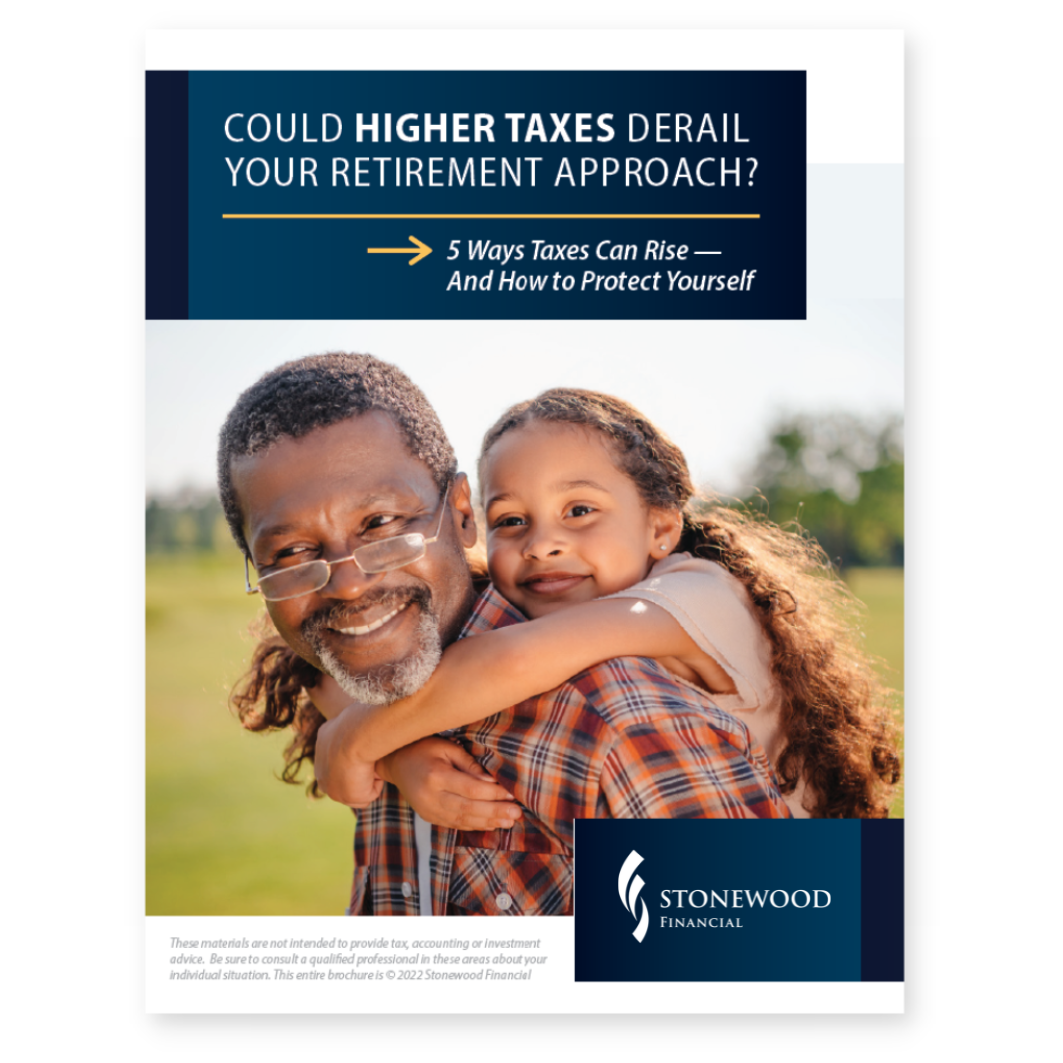 Interested in learning more about these risks, how they could impact your clients, and how to address them? Download Stonewood Financial’s white paper 5 Ways Taxes Can Rise in Retirement.