The Complete Growth Platform for Independent Advisors — Unlimited Reports, Lead Gen, Support, Training & More|
Trusted by 8,000+ Advisors with 214,000+ Reports Generated
|See Stonewood in Action|
The Complete Growth Platform for Independent Advisors — Unlimited Reports, Lead Gen, Support, Training & More|
Trusted by 8,000+ Advisors with 214,000+ Reports Generated
|See Stonewood in Action|
You just completed a retirement tax seminar. Forty people signed up, 28 showed up, and 18 booked appointments. What should you do with the remaining households? Who will you call first Monday morning?
While it’s tempting to pick on gut feeling (“that guy in the grey sweater seemed really interested”), there’s another layer that can help. Lead scoring ranks your prospects on how well they match your practice and how much they have engaged, helping you prioritize outreach to the prospects most ready to talk.
Lead scoring for financial advisors doesn’t need fancy software or a data team. You can get started with just a simple scorecard and the CRM you already use. Here’s how to choose your criteria, build the scorecard, and know when (and if) it’s time to leverage AI to help.
Close More Business with Stonewood Reports
Easy to run. Easy to present. Pick the report that fits your next client conversation and we'll send a sample to your inbox immediately.
Roth Done RightTax & IRMAA Analysis
Annuity AlphaFIA vs. Managed Account
Legacy Done RightLife Insurance Analysis
Total Tax BurdenRetirement Tax Snapshot
What is a lead score?
A lead score is a number you assign to each prospect to indicate their likelihood of turning into a client. The higher the score, the more likely they are to convert from prospect to client.
The score is based on two types of signals:
Fit: Does this person look like your best client(s)? Think about their age, closeness to retirement and how much they have saved.
Engagement: Are they listening to you? Examples are seminar attendance, content downloads, and email clicks.
Lead scoring criteria for financial services
Good lead scoring criteria will help you predict who is most likely to become a new client in your own practice. So look at your last 10 or 20 new clients. What did they do before they said yes? What did they have in common?
These are criteria that are often talked about by advisors who focus on retirement income and tax planning.
Fit criteria
Years until retirement. Someone who is retiring in the next few years is usually more urgent than someone retiring in 20.
Tax-deferred savings. Those prospects who have most of their savings in IRAs and 401(k)s have the most to gain from a tax conversation.
Entry point. If you get a referral from a happy client, it carries more trust than a cold lead that converted on social media.
Geography. Distance matters if you meet clients in person.
If you work with high-net-worth prospects, you might want to place extra weight on savings and referral sources over the other criteria.
Engagement criteria
Attended a live seminar or webinar. The strong signal is either appearing in person or staying for most of a webinar. If you’re using seminar marketing or automated webinars in your mix, place real weight on attendance.
Ran a calculator on your site. If you’re using an online lead capture calculator, like the Retirement Tax Bill calculator, you can score based on prospects completing the form. Calculator engagement can help signal that a prospect cares about taxes in retirement and that they’ve seen a number they may want to talk about.
Downloaded guide. Downloads on specific topics, such as IRMAA brackets or Social Security taxes, indicate what’s on the prospect’s mind.
Email opens and clicks. Clicks are more important than opens, because many email applications automatically trigger opens. If a prospect has clicked on a link in your email, it shows they’ve engaged with your content.
Asked for a meeting/review. This is the biggest engagement signal in the list. Any outreach for appointment scheduling or interest – even if the prospect did not follow through – shows strong desire to meet.
Some of the most useful signals for higher net worth savers tend to be around tax topics. Why? We discuss that in our post on tax planning leads.
Lead scoring criteria for the insurance industry
Many advisors also sell annuities and life insurance. The same approach works, with a few additional signals you can add to the options above:
Indicated interest about lifetime income or annuity review
Engaged with content around legacy or estate goals
Has a policy or contract out of its surrender period
Indicated interest about long-term care
Negative scores
Some signals can indicate a prospect is not the right fit for your practice. Negative scores keep your list honest, so a prospect that was hot six months ago doesn’t stay at the top forever if they’re not actively engaging in interest signals.
Common reasons for lead score point deduction:
Unsubscribed from your email
Several follow-ups, no response
90+ days without activity or engagement
Outside of your service area or not a match for the services you provide
Wealth or savings not at the level you serve
How to build a lead scorecard
A lead scorecard is simply a table of your criteria and points. The point values aren’t very important. What counts is that your strongest signals get the most points and the rest stay in proportion.
Here’s a hypothetical example for a retirement-oriented practice:
Signal
Points
Review or meeting request
+20
Retirement Tax Bill analysis done
+15
Attended a seminar/webinar
+10
Within 5 years of retirement
+10
Referred by an existing client
+10
Downloaded a guide
+5
Clicked through an email
+2
Checked your site
+1
Email unsubscribe
-10
No reply after 3 follow-ups
-15
Hypothetical example for illustration purposes only. Create your own values based on what has created new clients for your practice.
Set your thresholds
Then, tier the scores so your team knows what to do with each lead:
Available to speak (50+ points): Call or email to propose a meeting.
Warming up (20 to 49 points): Continue to teach. Give them something useful and invite them to your next event.
Early stage (less than 20 points): Add them to your list and check back soon.
Watch this complimentary training to learn how leading advisors use retirement tax concerns to create urgency, open Roth conversion conversations, and uncover valuable new planning opportunities.
Video Training
Create urgency around tax planning
Open more Roth conversion conversations
Uncover new planning opportunities
A lead scoring model for wealth management
There are two popular lead scoring models:
The scorecard above is a rules-based model. You pick the points and the signals. It’s easy to understand, easy to alter and it works fine with a few hundred leads or less. This is where a lot of practices begin.
A predictive model is a piece of software that looks at your past leads and figures out what patterns predicted a new customer. It can find signals you wouldn’t think of. These models require a lot of historical data across many access points for your clients.
Looking to get started? Run a rules-based model for 6 months or so and then see what your data says. A predictive tool may be worth a look if you begin ramping up and generate substantial leads yearly.
Set up lead scoring in your CRM
Once you set the rules, many CRMs can automatically update scores. That’s the real time saver. A prospect clicks an email, or signs up for a webinar, and the score changes without anyone typing a word.
The steps are similar across CRMs:
Add a score field to each contact record.
Add your rules, one per signal to your scorecard.
Integrate your sources such as your email platform, event registration, website forms, and calculators.
Create a view or alert for your ‘ready to talk’ tier so those leads get to someone the same day.
Test with a few known contacts to check the math.
Both HubSpot and Salesforce offer lead scoring. Advisor CRMs like Redtail and Wealthbox may do this using tags and workflows instead of a score field, so check your CRM’s help center for a lead scoring guide. Our review of marketing automation for financial advisors is a good place to start if you’re shopping around for systems.
AI lead scoring for financial advisors
AI lead scoring is a predictive model that works with larger data sets. These tools can integrate your CRM activity with external data such as life events or estimated wealth to rank your leads.
For example, Catchlight is an organic growth platform for wealth management, banking and insurance companies. Lead prioritization is one of its core use cases. It works well for larger firms wanting data-driven scoring across many advisors. (Source: catchlight.ai, accessed 10/12/2026.)
If you pay for a lead scoring tool, it’s important to ask three questions. What data does it use? Can it tell me why a lead scored high? Does it integrate with my current CRM? To get a broader view of the options, check out our guide to AI tools for financial advisors.
Review and adjust your scores
Lead scoring is not a set-it-and-forget-it process. Plan to check your scorecard every quarter.
Look at the leads that became clients. What did they score when they met? If the people who completed your Retirement Tax Bill calculator are still clients, add more points for the action. If webinar attendees don’t book, reduce those points or change your webinar follow-up.
The same review can help you identify gaps in your marketing. Perhaps one channel provided your best leads. That’s a good reason to put more effort into events, marketing your book, or your website. For more tips on converting scored leads into clients, see our client conversion ideas.
Give your top leads a reason to talk
A high score tells you who to call. It doesn’t tell you what to say.
Be sure that your outbound messages match the content a prospect has engaged with. For example, if your client converted from a tax-focused webinar, offer them an analysis of their Total Tax Burden in retirement. This quick calculation estimates the taxes a prospect might owe on their retirement savings – no tax return needed. For a prospect that already has a high score on tax signals it turns interest into a real conversation.
Lead scoring is part of a larger system. For all the rest, from building your list to filling your calendar, head over to our guide to lead generation for financial advisors.
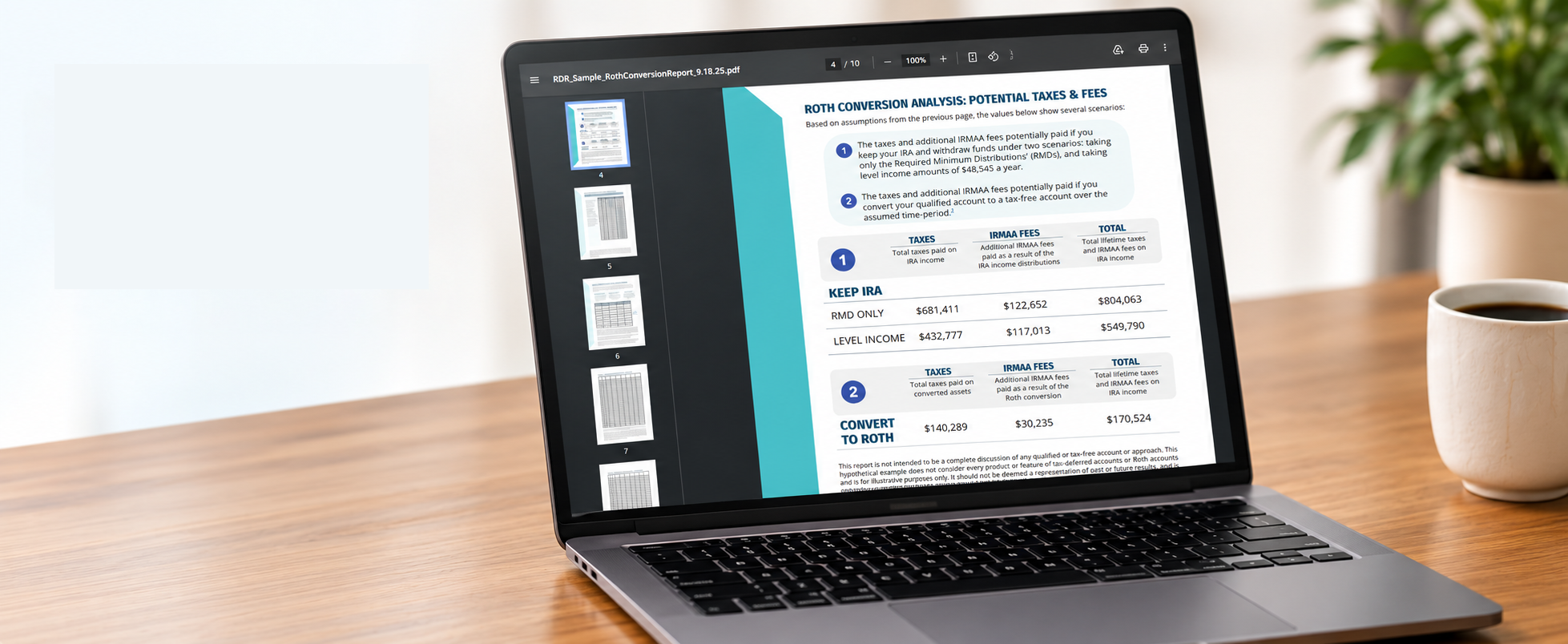
Want to see the industry’s top tax analysis reports in action? Request a free sample report or book a demo and we will walk you through how Stonewood tax software turns tax prospects into income planning clients.
Lead scoring FAQs
What is lead scoring for financial advisors?
Lead scoring is a way to rank prospects based on how well they fit your practice and how engaged they are. Each signal, whether it’s attending a seminar or downloading a guide, earns points or loses them. The total score helps you decide who to approach first.
How do you calculate a lead score?
List the signals that typically precede a new client. Assign a point value to each signal and total the points for each prospect. Deduct points for negative signals such as unsubscribes. Once you set the rules, many CRMs will do the math for you.
What are good lead scoring criteria for financial services?
The typical criteria include years until retirement, amounts in tax-deferred accounts, how the prospect heard about you, if they attended your seminar or webinar, if they used your calculator, downloaded your content, clicked on your email or requested a meeting. The right mix is driven by the signals that have brought clients into your own practice.
What are lead scoring criteria for the insurance industry?
Often, insurance-focused criteria are accompanied by questions on lifetime income, annuity reviews, life insurance for legacy goals and long-term care. These help you plan the conversation and show an interest in a topic.
Is AI lead scoring worth it for a small practice?
It is contingent upon how many leads you have. AI and predictive tools learn from your history, so they tend to perform better with thousands of leads. For a small practice, the simple rules-based scorecard that comes with your CRM may be just right.
Free Study Group Replay
How Stonewood Advisors Stay Ahead of the Next Planning Conversation.
Watch a recent Stonewood Study Group focused on the legacy planning conversation. You’ll see how Stonewood helps advisors break down timely planning topics, client conversation angles, and practical strategies you can put to use immediately.
Expert insights. Real strategies.
Study Group Replay
Timely planning topics
Real client conversation angles
Practical strategies you can use
Real Advisors. Real Results.
See how advisors are using Stonewood software to win larger cases and deliver better
outcomes for their clients.
An advisor was working with a prospect who was a real "do-it-yourselfer" when it came to Roth conversions.
The client was converting assets up their existing tax bracket – and hadn't considered any impact to
IRMAA.
With Roth Done Right, the advisor was able to show an alternate pattern that sped up the conversion to
6 years. The new structure offered $30,000 savings in conversion taxes – a 20% reduction on the
prospect's conversion tax bill. The report also showed hundreds of thousands of dollars in long-term
tax and IRMAA savings from the converted assets – an amount the prospect hadn't been able to quantify
on his own.
Outcome
A new client with $1M in new AUM, and a $1M FIA sale to fund the conversion process.
An advisor was working with a prospect who already had assets with Ken Fisher. Fisher's team presented a
5% systematic withdrawal projection, so the advisor needed a stronger way to frame the income
conversation.
Using the Annuity Alpha report, the advisor showed how an annuity could deliver over 8% in annual cash
flow with lifetime income, plus a long-term care doubler. The contrast was clear enough that the prospect
moved forward.
Outcome
$1.5M placed and a $100K in new business revenue.
An advisor was working with a 58-year-old couple with an established, well-funded retirement income plan,
leaving an additional $3M IRA to build out a legacy for the kids. The couple's existing advisor had no
real additional plan for this money, other than to keep it in their managed account and grow that money as
much as possible for the kids.
Using the Legacy Done Right report, the advisor showed the need for tax planning on this $3M IRA.
According to the advisor, the simple analysis "opened up the wallet" to the Roth conversion story. The
advisor then used the blended Roth/Life feature in the report to show a blend of Roth Conversion assets
with some Life Insurance to help maximize the client’s legacy.
Outcome
$3M in motion. The advisor picked up a $1.5M FIA sale that will be converted to Roth. And the advisor
also sold a 5-Pay Protection focused IUL policy at $225,000 of premium per year.
An advisor group incorporated the Total Tax Burden report into the strategy presentation for all new
prospects. They ran the tax snapshot for every new client as part of their first meeting conversation,
quantifying the growing tax burden of IRA money – and illustrating the kinds of tax savings possible
when working with their firm.
Starting in January of 2023, this simple analysis was presented to every single prospect who walked in
the door. The goal was to differentiate their practice and drive overall revenue growth through various
Roth conversion strategies.
Outcome
From 2022 to 2025, new annual AUM rose from $5M to $50M. Annual FIA sales rose from $3M to $35M.
And annual life premium rose from $50K to $1M.
8 Ways to Turn a Book Into a Lead-Generation Machine
Discover how advisors can use books to warm up cold prospects, create more meaningful follow-up, boost event conversions, and open stronger retirement planning conversations.
Your guide is on its way
Check your inbox for 8 Ways to Turn a Book Into a Lead-Generation Machine. If it isn't there in a few minutes, look in your spam or promotions folder.
Turn books into conversations
Build trust before the first meeting
Create a stronger advisor follow-up system
Close More Business with Stonewood Reports
Easy to run. Easy to present. Pick the report that fits your next client conversation and we'll send a sample to your inbox immediately.
Pick a report. We'll email a sample instantly.
Roth Done RightTax & IRMAA Analysis
Annuity AlphaFIA vs. Managed Account
Legacy Done RightLife Insurance Analysis
Total Tax BurdenRetirement Tax Snapshot
Real insights Practical strategies Easy to present.