Quick Answer: What Are the Best AI Tools for Financial Advisors?
The best AI tools for financial advisors in 2026 fall into a few categories: meeting assistants that draft notes and follow-ups, CRM platforms with AI layered in, and general-purpose assistants like ChatGPT or Claude used for drafting and research. These tools save time on admin work, but must be compliant with an advisor’s licensing. AI tools can help advisors optimize basic tasks, so they have more time to focus on client meetings and analysis like the tools at Stonewood Financial provide.
An advisor wraps a meeting with a prospect who has a $600,000 IRA and no real plan for what happens to it once required minimum distributions kick in. The meeting notes are done in a couple of minutes. The follow-up email drafts itself. The CRM updates without anyone typing.
AI tools are changing how many independent advisors manage their practice: transcribing meetings, drafting emails, summarizing notes, pulling together a first pass at a client update. This guide walks through the main categories of AI tools advisors are adopting in 2026, what the data says about how widely they’re actually used, and where the limits of that adoption tend to show up.
It also covers where AI isn’t taking over: client-facing analysis and conversations made simple with tools like Stonewood’s Roth Done Right, Annuity Alpha, Legacy Done Right, and Total Tax Burden. More on the importance of human touch later on. .
Keep in mind, any AI tools you use in your practice must be compliant with your licensure.This guide is intended only as a broad overview of how independent financial advisors are leveraging AI in 2026.
Close More Business with Stonewood Reports
Easy to run. Easy to present. Pick the report that fits your next client conversation and we'll send a sample to your inbox immediately.
Roth Done RightTax & IRMAA Analysis
Annuity AlphaFIA vs. Managed Account
Legacy Done RightLife Insurance Analysis
Total Tax BurdenRetirement Tax Snapshot
What “AI Tools for Financial Advisors” Actually Covers
It seems every marketing email you get touts some kind of AI tool for financial advisors. It’s a lot to digest, so it helps to sort the categories of AI tools before looking at specific options. Four AI categories cover most of the tools independent advisors are using today:
Meeting assistants and notetakers: These tools are built to record a client meeting, transcribe it, and generate a summary. They can create follow-up task lists, and update your CRM automatically with key information.
AI-enabled CRM platforms. Both traditional and new CRMs are building AI features into their platforms making it easy to generate client summaries, analyze data and draft recommendations
General-purpose assistants: AI tools like ChatGPT, Claude and Microsoft Copilot offer easy ways to draft client emails, communications, document summaries and brainstorming sessions.
Planning and risk-analysis AI tools Many risk-tolerance and financial-planning platforms have added AI features on top of their existing modeling engines to assist in client analysis.
Each category solves a different problem, and most advisors end up using more than one at a time rather than picking a single all-purpose tool. How Many Advisors Are Actually Using AI Right Now
Adoption has moved fast. AI use among independent RIAs, for example, has more than doubled since 2023, with 63% of RIAs now using AI tools in some capacity, according to a 2026 research study conducted for Charles Schwab & Co. by Logica Research (Schwab Advisor Services, January 2026). Of the advisors already using AI, 82% report relying on generative tools like ChatGPT or Gemini, most often through individual experimentation rather than a firm-wide rollout.
The same study found that adoption and strategy are two different things. Only about 1 in 10 advisors using AI report fully integrating it into their business strategy, and only about 1 in 5 say their firm has a clear vision for what AI should accomplish. Most usage is still concentrated on notetaking and email drafting rather than deeper planning work.
Advisor sentiment about where AI use heads next is generally positive: 59% of those surveyed believe AI will have a direct, measurable impact on client relationships within the next year, and 68% expect AI to be transformative to the future of financial advice within three years (Schwab Advisor Services, January 2026). Those are expectations, not outcomes, and the study itself notes that most firms remain in an early, experimental stage.
AI Tools Advisors Are Using in 2026, by Category
No single list captures every tool on the market, and this space changes by the quarter. The categories below reflect where independent advisor adoption is concentrated right now.
Category
What It’s Built For
AI meeting assistants (e.g. Jump, Zocks)
Transcribe client meetings, draft summaries, push follow-up tasks into the CRM
Planning and risk-analysis AI layers (e.g. Nitrogen, RightCapital)
Add AI-assisted commentary on top of existing risk or planning models
Where These Tools Can Fall Short
Where These Tools Tend to Fall Short For most independent advisors, AI tools are not yet able to replace many parts of the client acquisition and service process. Particularly for retirement-focused advisors, clients want human interaction, and strategy analysis is often about more than just running the numbers. AI tools still often lack the “story selling” approach many advisors depend on to connect with clients and build confidence in their approach. Compliance can also be a concern. . The SEC’s Division of Examinations listed artificial intelligence and automated advisory tools as an FY2026 examination priority, focusing on whether a firm’s actual use of AI is consistent with its representations to clients and regulators (U.S. Securities and Exchange Commission, Division of Examinations, FY2026 Examination Priorities, November 2025). So compliance concerns may limit how advisors can leverage AI tools.
Common Mistakes Advisors Make Adopting AI Tools
Along with the limitations of AI tools in 2026, there are some common mistakes advisors can make when implementing AI into their practices. The most common are:
Treating a notetaker like a planning tool. A meeting summary is not a client-facing analysis, and prospects can tell the difference between the two.
Letting AI draft numbers without a source. A generative tool can produce a confident-sounding figure that isn’t tied to real, current brackets, laws and policies, , which creates real compliance exposure.
Adopting tools one at a time with no connected workflow. The Schwab data above suggests most advisors are experimenting at the individual level rather than building a firm-wide system, which is part of why so few report AI as strategically integrated.
Assuming faster admin work automatically means more closed business. Time saved on notes only turns into production if the freed-up hours go toward better prospect conversations, not just fewer hours worked.
Skipping a dedicated planning tool entirely. Advisors who rely only on general AI for the numbers side of a meeting often find prospects have questions a chatbot summary can’t answer with real specificity.
Free Advisor Training
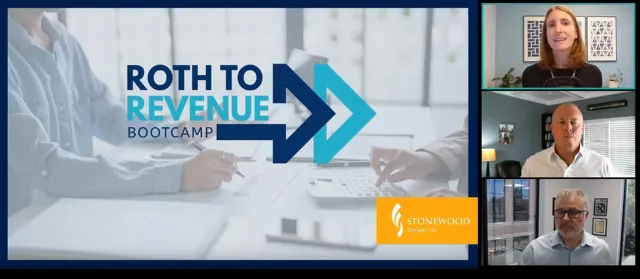
Turn Roth Conversations Into Revenue
Watch this complimentary training to learn how leading advisors use retirement tax concerns to create urgency, open Roth conversion conversations, and uncover valuable new planning opportunities.
Video Training
Create urgency around tax planning
Open more Roth conversion conversations
Uncover new planning opportunities
Where Stonewood Fits In
AI tools are useful for the admin side of a practice: notes, drafts, and follow-ups. Turning a tax or income conversation into a decision a client actually makes still comes down to proper planning and execution, walking through the client’s specific numbers and giving them something concrete to evaluate.
That’s the part of the practice Stonewood builds software for. The suite includes four client-facing tools, each built around a different conversation, and each designed to be shown live in a meeting rather than prepared afterward as a back-office report.
1.Roth Done Right
Multi-year Roth conversion and IRMAA analysis, built for the prospect meeting.
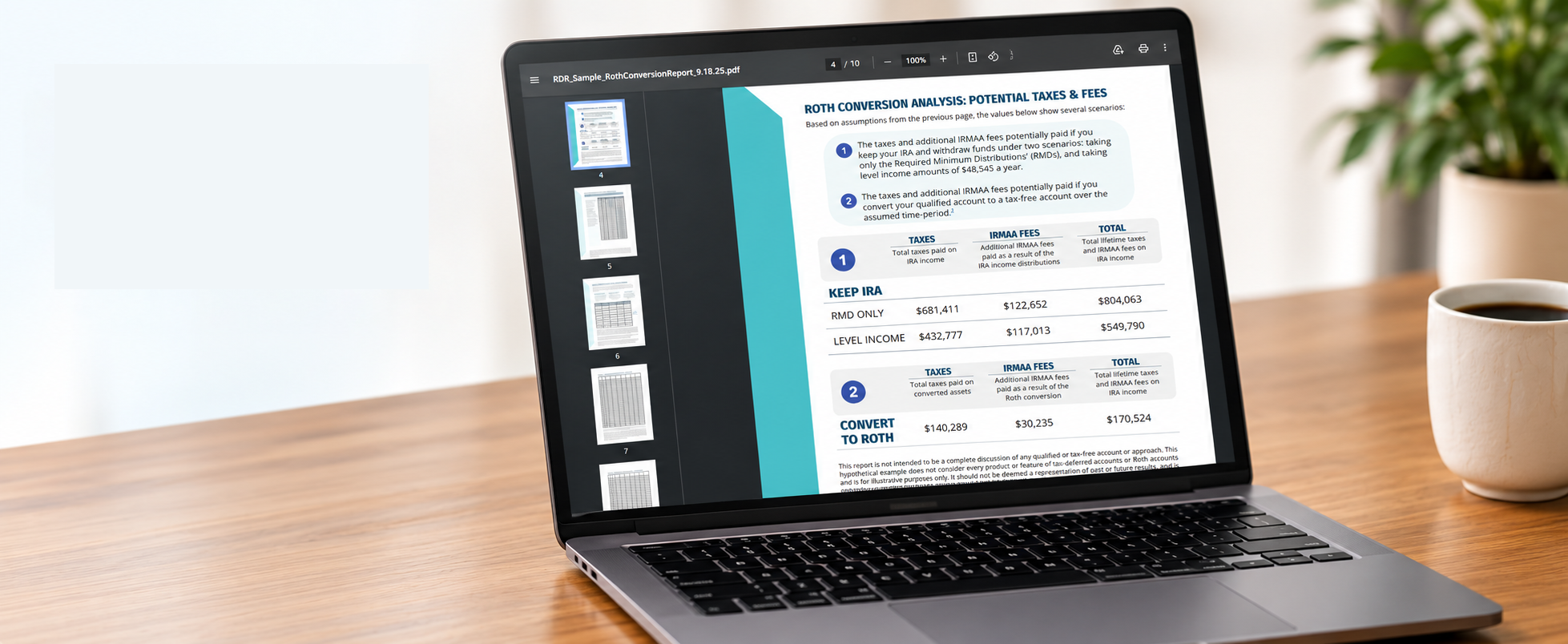
Models a client’s Roth conversion decision over a multi-year horizon and accounts for both the short-term and long-term Medicare IRMAA cost of converting, since Medicare uses a two-year lookback on modified adjusted gross income to set premium surcharges. A conversion that looks efficient on a bracket basis can look different once that cost is factored in, and showing that trade-off visually is often what moves a planning conversation from abstract to actionable.
FIA vs. brokerage income comparison for the retirement income conversation.
Gives advisors a side-by-side comparison of a fixed indexed annuity against a brokerage account alternative, for prospects asking whether they can secure guaranteed income without moving everything out of the market. The output is built to make that trade-off, guaranteed income versus market participation, visible in a format a client can follow without a finance background.
Estate and legacy analysis that opens a conversation many advisors never start.
Shows a family the after-tax picture of an inheritance, comparing what heirs may keep if assets stay as they sit today versus a repositioned, often life-insurance-based, wealth-transfer strategy. It’s an analysis and conversation tool, not a document-drafting platform. A qualified estate attorney still prepares the wills and trusts; Legacy Done Right helps the family decide what those documents should accomplish.
A 60-second tax snapshot that creates urgency before the first appointment is over.
Generates a snapshot of a prospect’s projected taxes paid and potential taxes saved without requiring a tax return, giving a saver with a meaningful IRA balance a concrete look at what a different approach could mean for their retirement in about a minute. Advisors often use it as an early-meeting trust builder before moving into a deeper Roth Done Right analysis.
The four tools work as a suite or independently, depending on an advisor’s practice focus. A common pattern: Total Tax Burden opens the meeting with a fast snapshot, Roth Done Right goes deeper on the multi-year conversion and IRMAA math, and Legacy Done Right or Annuity Alpha extends the conversation into estate or income planning once the tax question is on the table.
See What Stonewood’s Software and Tools Can Do for Your Practice
Become a Stonewood Member
Stonewood’s software and tools help advisors bring planning and execution into the client conversation, not just the admin work around it. Membership includes the full suite (Roth Done Right, Annuity Alpha, Legacy Done Right, and Total Tax Burden), training, and licenses for your whole team.
What are the best AI tools for financial advisors in 2026?
The most widely adopted categories are AI meeting assistants (Jump, Zocks) for notetaking and follow-ups, AI-enabled CRM platforms, general-purpose assistants like ChatGPT and Claude for drafting, and planning platforms adding AI layers on top of existing risk and financial-planning models.
How many financial advisors are actually using AI?
AI adoption among independent RIAs has more than doubled since 2023, with 63% now using AI tools in some capacity, according to a 2026 study conducted for Charles Schwab by Logica Research. Most usage remains concentrated on administrative tasks rather than firm-wide strategy.
What do financial advisors use AI for most often?
The 2026 Schwab Advisor Services study found that the two most common uses were taking meeting notes and drafting emails. Today, only 1 in 10 advisors who use AI say they fully embed it into their broader business strategy.
Is using AI in a financial advisory practice a compliance risk?
Depends on the use case. The SEC’s Division of Examinations has said AI and automated advisory tools will be a focus for examinations in fiscal year 2026, including whether a firm’s disclosures about its use of AI are consistent with how it is actually used.
Can AI replace financial planning software?
General-purpose AI tools are designed for drafting and summarising, not for modelling a specific client’s multi-year Roth conversion or IRMAA exposure. That’s how planning platforms that add AI capabilities on top of an existing modelling engine do that differently than a standalone chatbot would.
What does Stonewood offer alongside AI tools advisors already use?
Stonewood builds client-facing analysis software, including Roth Done Right, Annuity Alpha, Legacy Done Right, and Total Tax Burden, for the planning and client-conversation side of the practice rather than the admin side AI tools typically cover.
What is Stonewood’s Roth Done Right software used for?
Roth Done Right models a client’s Roth conversion decision over a multi-year horizon and accounts for both the short-term and long-term Medicare IRMAA cost of converting. The output is a client-facing report built to be shown live in a prospect meeting.
Is Stonewood an IMO?
No. Stonewood is a tools and enablement partner for independent financial advisors. It doesn’t take commission cuts or push a specific carrier, and its software works with any carrier, through any IMO.
Sources and References
All information in this article is general knowledge and widely available.
How Stonewood Advisors Stay Ahead of the Next Planning Conversation.
Watch a recent Stonewood Study Group focused on the legacy planning conversation. You’ll see how Stonewood helps advisors break down timely planning topics, client conversation angles, and practical strategies you can put to use immediately.
Expert insights. Real strategies.
Study Group Replay
Timely planning topics
Real client conversation angles
Practical strategies you can use
Real Advisors. Real Results.
See how advisors are using Stonewood software to win larger cases and deliver better
outcomes for their clients.
An advisor was working with a prospect who was a real "do-it-yourselfer" when it came to Roth conversions.
The client was converting assets up their existing tax bracket – and hadn't considered any impact to
IRMAA.
With Roth Done Right, the advisor was able to show an alternate pattern that sped up the conversion to
6 years. The new structure offered $30,000 savings in conversion taxes – a 20% reduction on the
prospect's conversion tax bill. The report also showed hundreds of thousands of dollars in long-term
tax and IRMAA savings from the converted assets – an amount the prospect hadn't been able to quantify
on his own.
Outcome
A new client with $1M in new AUM, and a $1M FIA sale to fund the conversion process.
An advisor was working with a prospect who already had assets with Ken Fisher. Fisher's team presented a
5% systematic withdrawal projection, so the advisor needed a stronger way to frame the income
conversation.
Using the Annuity Alpha report, the advisor showed how an annuity could deliver over 8% in annual cash
flow with lifetime income, plus a long-term care doubler. The contrast was clear enough that the prospect
moved forward.
Outcome
$1.5M placed and a $100K in new business revenue.
An advisor was working with a 58-year-old couple with an established, well-funded retirement income plan,
leaving an additional $3M IRA to build out a legacy for the kids. The couple's existing advisor had no
real additional plan for this money, other than to keep it in their managed account and grow that money as
much as possible for the kids.
Using the Legacy Done Right report, the advisor showed the need for tax planning on this $3M IRA.
According to the advisor, the simple analysis "opened up the wallet" to the Roth conversion story. The
advisor then used the blended Roth/Life feature in the report to show a blend of Roth Conversion assets
with some Life Insurance to help maximize the client’s legacy.
Outcome
$3M in motion. The advisor picked up a $1.5M FIA sale that will be converted to Roth. And the advisor
also sold a 5-Pay Protection focused IUL policy at $225,000 of premium per year.
An advisor group incorporated the Total Tax Burden report into the strategy presentation for all new
prospects. They ran the tax snapshot for every new client as part of their first meeting conversation,
quantifying the growing tax burden of IRA money – and illustrating the kinds of tax savings possible
when working with their firm.
Starting in January of 2023, this simple analysis was presented to every single prospect who walked in
the door. The goal was to differentiate their practice and drive overall revenue growth through various
Roth conversion strategies.
Outcome
From 2022 to 2025, new annual AUM rose from $5M to $50M. Annual FIA sales rose from $3M to $35M.
And annual life premium rose from $50K to $1M.