When it comes to financial advisor marketing, “branding” used to mean a good practice name, a nice practice logo, and a quality practice website.
While those brand components are still important, in today’s digital-driven world financial advisors have to differentiate themselves through a new set of approaches.
That doesn’t mean brand isn’t important to financial advisor marketing. In fact, your brand plays a bigger role today as savers can more easily research and compare your practice to your competitors’.
So, what does it take to develop, and maintain, a truly effective brand?
Creating a modern brand can take some new tactics. Yes, you still need a website and likely a logo, too. But let’s look into some next-level brand-building activity worthy of your time in the months ahead.
Quick Answer: How Should Financial Advisors Market Themselves?
Financial advisor marketing works best when it combines a personal brand backed by real expertise, educational content that builds trust before the first meeting, and a defined niche. Advisors who add structured lead generation and client-facing software to that foundation tend to convert prospects faster than those relying on branding alone, since the software lets a prospect see the value of working with the advisor rather than just hear about it.
Close More Business with Stonewood Reports
Easy to run. Easy to present. Pick the report that fits your next client conversation and we'll send a sample to your inbox immediately.
Roth Done RightTax & IRMAA Analysis
Annuity AlphaFIA vs. Managed Account
Legacy Done RightLife Insurance Analysis
Total Tax BurdenRetirement Tax Snapshot
How to Create a Powerful Brand
First things first: What do we mean by brand?
Your brand is how people in the outside world, your prospects, your clients, your competitors, experience your practice. And it’s a key piece of financial advisor marketing.
The world of financial advice is largely built on brand. A good, effective brand must resonate with your prospective clients, instill trust, and create a positive, memorable impression. A brand helps a prospect say, “This is the advisor for me.” Or sometimes, “This advisor isn’t the right fit for my needs.”
First things first: It’s important to spend some time thinking about what qualities define you as a financial advisor. These qualities will make up the core of your brand. For example, the qualities that define me in my work are insightful, unique, actionable, and connective. Other advisors I know have included authoritative, helpful, caring, and trustworthy.
Once you know what qualities you’re trying to convey, you’re ready to establish ways to convey them through your financial advisor marketing. Here are seven ways you can build a next-level brand for your practice, including two ways to put Stonewood’s marketing tools and client-facing software behind that brand.
#1 | Prioritize Personal Branding
Remember, people aren’t coming to you for financial advice; they’re coming to you for YOUR financial advice. Part of branding is creating a genuine and persuasive story around your passion as an advisor. Make sure you can articulate your journey, your passion for the job, and your daily “why” for helping savers.
And remember: your personal branding isn’t just about accreditation and years in the industry. Prospective clients want to connect with you as a human. Don’t be afraid to showcase your life outside work, and the things that are important to you as a person. (Do you coach your daughter’s soccer team? Volunteer with highway clean up? Support disabled veterans? Prospective clients also want to know what drives you outside the office.)
#2 | Curate Educational Resources
The modern saver is knowledge-hungry. With unlimited access to the internet, Americans have plenty of ways to gather information. But savers want information they can trust, and that’s your opportunity to stand out.
Think of yourself as a curator of educational resources. Create a content hub where prospects and clients can learn about the financial and retirement topics that matter most. This hub can include blog posts, webinars, podcasts, and ebooks. (As a bonus, these resources can be a central part of your financial advisor marketing strategy, more on that below.)
You might develop some of these resources yourself, find articles and resources through news publications, or work with a content creator who specializes in retirement savings (shout out to my team at Stonewood Financial, who develops resources like an educational brochure on how taxes can rise for retirees).
Why is content curation so important to your brand? Savers largely don’t want salespeople as their financial advice-givers. They want trusted experts. Content curation is one way you can develop yourself into an industry expert and a trusted resource. Besides, savers can’t make informed decisions without information. So, let’s get them the information they need.
Once you’ve created a content hub, you can push out those resources through your marketing channels, reminding prospects and clients alike that your practice is committed to their education.
#3 | Cultivate Niche Expertise
I live in a 100-year-old home. That comes with both joys (the ornate crown molding!) and headaches (the antiquated wiring!). So, when I was searching for a plumber recently, I chose one who specializes in older homes.
It’s the same for your practice. No financial advisor is the best financial advisor for every type of saver. So, who do you most want as a client? Is it savers within ten years of retirement? Teachers or employees of a specific large employer? Entrepreneurs? Highlight your expertise as it pertains to this group.
Maybe you’re an expert in tax-efficient retirement plans for higher-net-worth savers who are worried about taxes. Or maybe you like to help parents save for retirement and for their kids’ college education. Specializing allows you to deeply understand the unique needs of a specific audience, and position yourself as the go-to expert.
Free Advisor Training
Turn Roth Conversations Into Revenue
Watch this complimentary training to learn how leading advisors use retirement tax concerns to create urgency, open Roth conversion conversations, and uncover valuable new planning opportunities.
Get Instant Access to the Training
#4 | Engage with Video Content
There’s no better way for prospects to get a sense of who you are, and what your practice is about, than through seeing you in action. Video can be an important part of your brand and overall financial advisor marketing strategy.
Video content is increasingly central to brand building as platforms like YouTube and Vimeo make it easy to post content and reach audiences. According to HubSpot research, about a third of YouTube viewers are age 45+, and over a quarter of all Baby Boomers say they discover new products on YouTube.
Video builds a deeper connection and can be a powerful tool to humanize your brand.
#5 | Solicit and Showcase Testimonials
Happy clients are your brand’s best ambassadors. So, make soliciting testimonials part of your client lifecycle process. (Just be sure you know any advertising restrictions your licensure may impose when it comes to using client testimonials.)
I know, asking for testimonials can be awkward, and it’s hard to coax a good soundbite from clients. So, keep a wireless mic handy in your office, and when a client has something nice to say, simply ask them if you can share their kind words with others considering your practice. Here’s one prompt I like to use: I’m talking to a prospect who’s on the fence about working with me. What would you tell her?
Nothing adds authenticity to your brand like hearing someone else reinforce the experience you promise.
#6 | Put Marketing Tools Behind Your Brand
A strong brand needs a system that gets it in front of prospects consistently, not just a good story sitting on your website. This is where financial advisor marketing tools come in, and it’s a piece many advisors leave to chance.
Stonewood’s Retirement Tax Bill Lead Generator brings the same brand message covered above (the tax-aware, trusted-expert positioning) directly to prospects through a digital lead funnel, combining landing pages, calculators, and follow-up sequences. Advisors who build their pipeline around this message often find prospects arrive at the first meeting already primed for the retirement tax conversation, which shortens the trust-building phase your brand is working to establish in the first place.
Seminar and webinar programs extend the same idea into a live setting. Stonewood’s presentations, including The Rising Tax Risk in Retirement and Washington’s Impact on Your Retirement, are built around the retirement tax topics that resonate most with the mass affluent retiree market, so the brand you’re building on your website and in your content hub shows up consistently in the room, too.
Marketing toolkits, including brochures, email sequences, and social media resources, round this out by keeping your messaging consistent across every channel rather than reinventing it each time you need a new piece of content. You can review Stonewood’s full marketing and lead generation library at stonewoodfinancial.com/marketing.
#7 | Prove Your Expertise Live With Client-Facing Software
Everything above helps a prospect believe you’re the trusted expert before they sit down with you. What happens in that first meeting is where the brand either gets confirmed or falls flat.
Free Study Group Replay
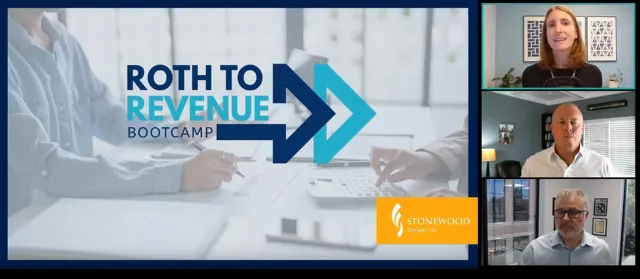
Watch How Stonewood Advisors Stay Ahead of the Next Planning Conversation
Get a free look inside a recent Stonewood Study Group session and see how our team breaks down timely planning topics, client conversation angles, and practical strategies advisors can use right away.
Free Advisor Training
Turn Roth Conversations Into Revenue
Watch this complimentary training to learn how leading advisors use retirement tax concerns to create urgency, open Roth conversion conversations, and uncover valuable new planning opportunities.
Video Training
Create urgency around tax planning
Open more Roth conversion conversations
Uncover new planning opportunities
Get the Free Replay
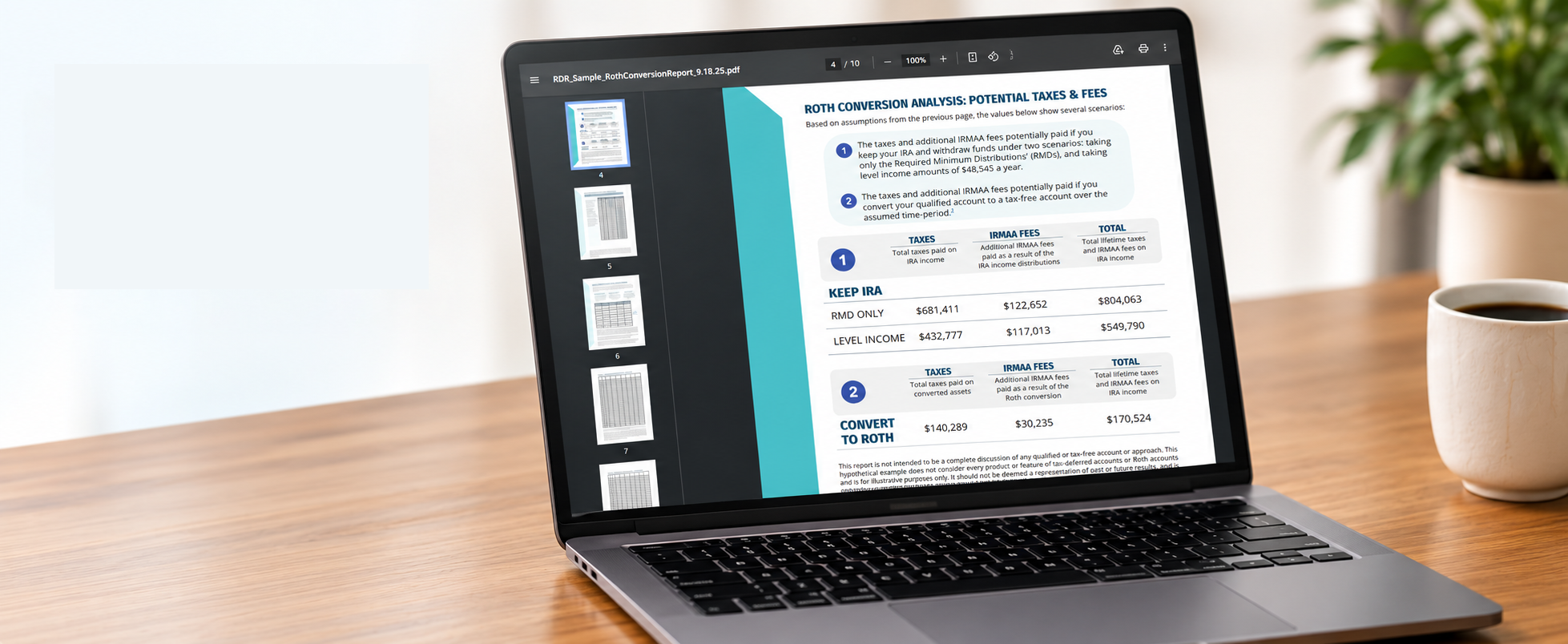
Stonewood’s client-facing software gives advisors a way to demonstrate expertise in the room instead of just describing it. Roth Done Right models multi-year Roth conversion scenarios and the short-term and long-term Medicare IRMAA cost of converting, so a prospect sees the trade-off rather than just hearing about it. Annuity Alpha gives a side-by-side comparison of a fixed indexed annuity’s guaranteed income, subject to the claims-paying ability of the issuer, against a brokerage account alternative. Legacy Done Right shows a family the after-tax picture of a wealth-transfer strategy, and Total Tax Burden produces a fast tax snapshot without requiring a tax return.
Advisors using this software as part of their brand-building approach have reported specific case outcomes on Stonewood’s site, including new assets in motion and closed annuity and life cases, when the report was used to make the planning conversation visible rather than theoretical. The software works as a suite, and each tool is available at stonewoodfinancial.com/software. Get your sample report for our software.
Stonewood is not an IMO. We don’t distribute products, take a commission cut, or push advisors toward a specific carrier. The tools work with any carrier through any IMO, on the advisor’s terms.
Creating, and cultivating, your brand takes time and attention. But an authentic and articulated brand makes the rest of your financial advisor marketing easier, from lead generation to client acquisition. After all, at its core, a brand’s job is to build trust. And as fantasy writer George MacDonald once quipped, “To be trusted is an even greater compliment than to be loved.”
Financial advisors market themselves most effectively by pairing a personal brand with educational content, a defined niche, and a consistent lead generation system. Advisors who also bring client-facing software into the prospect meeting tend to convert faster, since the software shows a strategy’s trade-offs rather than just describing them.
What marketing tools do financial advisors use to generate leads?
Many advisors combine a digital lead funnel with seminars or webinars built around a specific planning topic. Stonewood’s Retirement Tax Bill Lead Generator and seminar programs are built around the retirement tax message, helping bring prospects into a first meeting already interested in the conversation.
What is the difference between financial advisor marketing and financial advisor branding?
Branding is how a practice is perceived, the story, the qualities, and the trust it conveys. Marketing is the system that gets that brand in front of prospects consistently, through content, lead generation, and tools. A strong practice needs both working together.
Does Stonewood offer marketing tools for financial advisors?
Yes. Stonewood offers a Retirement Tax Bill Lead Generator, seminar and webinar programs, and marketing toolkits including brochures and email sequences. These tools are built around the same retirement tax message used across Stonewood’s software and training, available at stonewoodfinancial.com/marketing.
How does client-facing software help a financial advisor’s brand?
Client-facing software lets an advisor show a prospect a strategy’s trade-offs live, in the meeting, rather than describing them verbally. That visible proof of expertise reinforces the trust a personal brand is trying to build, and tends to move a prospect toward a decision faster.
See Your Brand and Software Work Together
Review how Stonewood’s marketing tools and client-facing software support the brand-building approach above, from the first piece of content a prospect sees to the report you run in the meeting.
How have you worked to develop and maintain your brand as an advisor? Here are some top marketing tools for advisors
Free Study Group Replay
How Stonewood Advisors Stay Ahead of the Next Planning Conversation.
Watch a recent Stonewood Study Group focused on the legacy planning conversation. You’ll see how Stonewood helps advisors break down timely planning topics, client conversation angles, and practical strategies you can put to use immediately.
Expert insights. Real strategies.
Study Group Replay
Timely planning topics
Real client conversation angles
Practical strategies you can use
Real Advisors. Real Results.
See how advisors are using Stonewood software to win larger cases and deliver better
outcomes for their clients.
An advisor was working with a prospect who was a real "do-it-yourselfer" when it came to Roth conversions.
The client was converting assets up their existing tax bracket – and hadn't considered any impact to
IRMAA.
With Roth Done Right, the advisor was able to show an alternate pattern that sped up the conversion to
6 years. The new structure offered $30,000 savings in conversion taxes – a 20% reduction on the
prospect's conversion tax bill. The report also showed hundreds of thousands of dollars in long-term
tax and IRMAA savings from the converted assets – an amount the prospect hadn't been able to quantify
on his own.
Outcome
A new client with $1M in new AUM, and a $1M FIA sale to fund the conversion process.
An advisor was working with a prospect who already had assets with Ken Fisher. Fisher's team presented a
5% systematic withdrawal projection, so the advisor needed a stronger way to frame the income
conversation.
Using the Annuity Alpha report, the advisor showed how an annuity could deliver over 8% in annual cash
flow with lifetime income, plus a long-term care doubler. The contrast was clear enough that the prospect
moved forward.
Outcome
$1.5M placed and a $100K in new business revenue.
An advisor was working with a 58-year-old couple with an established, well-funded retirement income plan,
leaving an additional $3M IRA to build out a legacy for the kids. The couple's existing advisor had no
real additional plan for this money, other than to keep it in their managed account and grow that money as
much as possible for the kids.
Using the Legacy Done Right report, the advisor showed the need for tax planning on this $3M IRA.
According to the advisor, the simple analysis "opened up the wallet" to the Roth conversion story. The
advisor then used the blended Roth/Life feature in the report to show a blend of Roth Conversion assets
with some Life Insurance to help maximize the client’s legacy.
Outcome
$3M in motion. The advisor picked up a $1.5M FIA sale that will be converted to Roth. And the advisor
also sold a 5-Pay Protection focused IUL policy at $225,000 of premium per year.
An advisor group incorporated the Total Tax Burden report into the strategy presentation for all new
prospects. They ran the tax snapshot for every new client as part of their first meeting conversation,
quantifying the growing tax burden of IRA money – and illustrating the kinds of tax savings possible
when working with their firm.
Starting in January of 2023, this simple analysis was presented to every single prospect who walked in
the door. The goal was to differentiate their practice and drive overall revenue growth through various
Roth conversion strategies.
Outcome
From 2022 to 2025, new annual AUM rose from $5M to $50M. Annual FIA sales rose from $3M to $35M.
And annual life premium rose from $50K to $1M.