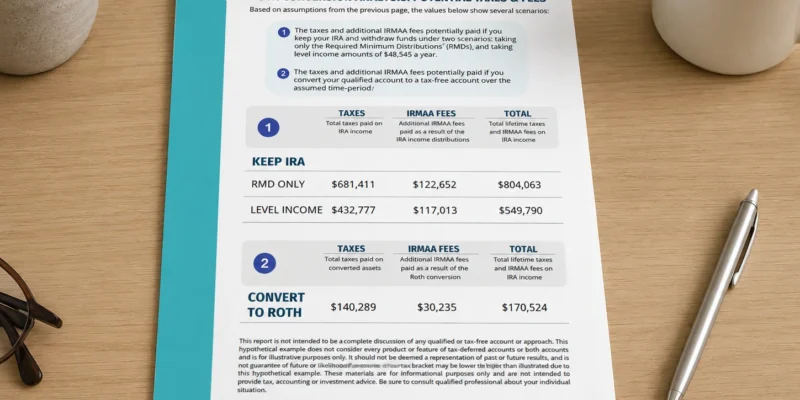
The best Roth conversion strategies for your clients depend on their age, income, bracket position, and future RMD obligations. Four strategies come up again and again in advisor conversations: staged conversions (spreading conversions over 5-10 years to stay below bracket jumps), bracket filling (converting up to the top of the current bracket), IRMAA-aware conversions (managing MAGI to protect Medicare premiums), and gap-year conversions (capturing the low-income years between retirement and RMDs). After the One Big Beautiful Bill Act of July 2025, the old “convert before the TCJA sunsets” pitch isn’t gone. It just has a longer runway. Today’s conversation pivots to bracket optimization and client-specific math.
A quick note before we dig in: Stonewood builds analysis software for financial advisors. We’re not CPAs, and nothing in this article is tax advice for an individual client. Every Roth conversion decision should be reviewed with a qualified tax professional who knows the client’s full situation.
Why the “Convert Before Rates Rise” Pitch Needs to Change
For years, the standard Roth pitch went like this. Tax rates are historically low. The Tax Cuts and Jobs Act sunsets at the end of 2025. Rates will spike. So convert now.
That urgency pitch made sense when Congress hadn’t acted. It stopped making sense on July 4, 2025, when the One Big Beautiful Bill Act (OBBBA) was signed into law. OBBBA made the TCJA individual tax brackets permanent, locked in the 37 percent top rate, and extended the standard deduction framework.
Here’s the nuance Stonewood advisors should hold onto. “Permanent” in tax law doesn’t mean “rates stay low forever.” It just means Congress has to vote to change them. With ongoing deficit pressure, rates can absolutely rise again within the decade, even without the TCJA sunset forcing the conversation.
That means the old Roth pitch loses its built-in deadline, but the underlying logic still holds. Your client is paying taxes today. The real question is whether you can help rearrange their income to pay at their lowest possible bracket while they still have some control over the timing. The conversation shifts from “rates are about to spike” to “let’s look at your lifetime tax picture and see where the bracket whitespace lives.”
Strategy 1: Staged Conversions Over 5 to 10 Years
Staged conversions are the workhorse strategy for clients with large traditional IRAs. The idea is simple. Instead of converting a big lump sum in a single year (and pushing the client into a much higher bracket), you convert a smaller amount each year over several years. Each year’s conversion lands in a lower bracket. Cumulative tax tends to come out lower than a single big conversion.
Consider a 62-year-old married couple filing jointly with a traditional IRA holding roughly $600,000 and a current combined income in the low six figures. Converting the entire IRA in one year would push their taxable income far above the 22 percent bracket for MFJ, potentially into the 24, 32, or even 35 percent brackets, and spike their MAGI enough to affect Medicare premiums and net investment income tax.
Instead, they convert around $100,000 per year over six years. Each conversion fits inside the 22 percent bracket (check current MFJ bracket limits on the IRS site). Cumulative taxes tend to come in meaningfully lower than the single-lump alternative. Along the way, their traditional IRA shrinks, future RMDs shrink, and a growing Roth balance sets up tax-free income later.
When Staging Works Less Well
Staging only works if the client has time and if tax brackets don’t move dramatically. For a 73-year-old who is already taking RMDs, the staging window is short. And if Congress does raise rates in the next few years, earlier conversions at lower brackets look even better in hindsight.
One way to quantify that advantage is through what we call the conversion delta: the difference in after-tax wealth between converting now versus waiting, expressed in today’s dollars. When the delta is positive, the math favors moving. When it’s close to zero, the decision often comes down to other factors like legacy goals or liquidity. Roth Done Right surfaces this comparison automatically, so the advisor doesn’t have to build the case from scratch in every meeting.
This is where the software earns its keep. You shouldn’t guess. Model both scenarios (convert now, wait and convert later) and let the apples-to-apples after-tax wealth comparison do the talking.
Strategy 2: Bracket Filling
Bracket filling is often the lowest-cost conversion approach. The idea is to identify the unused space in the client’s current tax bracket and fill that space with Roth conversions. The tax rate is known, the math is clean, and the client captures cheap conversion space that would otherwise go unused.
A client earning salary income at the low end of their current bracket may have tens of thousands of dollars in “whitespace” before the next bracket tier kicks in. Converting into that whitespace keeps every converted dollar at the current marginal rate. The moment conversions spill over into the next bracket, the effective tax cost jumps.
Worth noting: crossing a bracket line isn’t always a reason to stop. Only the portion of the conversion that spills into the higher bracket pays that higher rate. If a client converts $5,000 over the threshold, only that $5,000 faces the higher marginal rate. The rest of the conversion still lands at the lower rate. For many clients, a modest amount of bracket drift can still make long-term sense when the future tax picture is taken into account.
The “Gap Years” Opportunity
The strongest bracket filling window usually opens between the client’s retirement date and the start of RMDs. Depending on birth year, RMDs can start at age 73 or age 75 under SECURE 2.0. That gives some clients a decade or more of relatively low-income years to work with.
For a couple who retires at 62 with modest pension income and no RMDs yet, each year is a conversion opportunity. Many advisors model a steady annual conversion that fills the current bracket and stops before the next tier. Over 10 or more years, that can meaningfully shrink the traditional IRA and build the Roth balance.
Strategy 3: IRMAA-Aware Conversions
IRMAA (Income-Related Monthly Adjustment Amount) is the Medicare premium surcharge for higher-income beneficiaries. For 2026, the Part B IRMAA surcharge starts once MAGI crosses roughly $109,000 for single filers and roughly $218,000 for married filing jointly, per CMS. Verify the current brackets directly on CMS.gov before modeling any conversion that might nudge a client over a threshold.
Roth conversions count as income for MAGI purposes, so a large conversion can push a client from one IRMAA tier into the next. The catch is the two-year lookback. IRMAA for 2026 premiums is based on the tax return from 2024. So a 2024 conversion can affect a client’s 2026 Medicare premiums.
For clients approaching Medicare age or already on Medicare, IRMAA can initially look like a reason to pause. The idea of converting into a higher IRMAA tier during the conversion year gives some clients hesitation. But closer analysis often flips that concern on its head. A growing traditional IRA means growing RMDs, and growing RMDs push MAGI higher every year. That mounting drag from IRMAA surcharges down the road frequently becomes the clearest reason to convert sooner rather than later. The short-term premium bump may cost less than years of surcharges on an account that keeps compounding. The answer still depends on the client’s full tax picture, conversion size, and how long they’ll hold the Roth balance.
This is another place where the software comes in handy. Modeling an extra $1,500 to $3,000 per year in Medicare premiums on top of the conversion tax can change which conversion size actually delivers the best after-tax wealth outcome.
Strategy 4: Conversions to Reduce Future RMDs
For clients already taking RMDs or close to them, conversions serve a different purpose. Every dollar converted out of a traditional IRA permanently reduces the balance used to calculate future required distributions. Shrinking the IRA balance shrinks future RMDs.
RMDs are calculated as the prior-year account balance divided by an IRS life expectancy factor. Each dollar a client converts out of the traditional IRA is a dollar that never shows up in a future RMD calculation. For clients facing outsized required distributions, conversions can be one of the few levers that directly shrink mandatory income.
Under SECURE 2.0, RMDs now start at age 73 for clients born between 1951 and 1959, and at age 75 for clients born in 1960 or later. That creates a natural planning window for clients in their early 70s who are still working or still drawing modest income. Converting in that window can reduce the first few years of RMDs materially once distributions begin.
Free Advisor Training
Turn Roth Conversations Into Revenue
Watch this complimentary training to learn how leading advisors use retirement tax concerns to create urgency, open Roth conversion conversations, and uncover valuable new planning opportunities.
Get Instant Access to the Training
A Framework for the Client Conversation
Knowing the tactics is one thing. Framing the conversation so the client actually sees the value is another. Here’s a flow many Stonewood-trained advisors use.
Step 1: Show the Current Tax Trajectory
Start with what the client is actually paying today. Project out the next 10 years of taxable income, including RMDs at 73 or 75. Most clients have never seen this picture. The line almost always goes up. That visual sets the stage.
Step 2: Identify the Bracket Whitespace
Which bracket is the client in today? How much room sits between their current taxable income and the next bracket jump? That whitespace is the conversion target for the year. Conversions that stay inside the current bracket land at a known, predictable marginal rate. Conversions that spill over start costing more.
Step 3: Frame the Trade-Off as Apples-to-Apples After-Tax Wealth
The cleanest way to frame the conversion math is tax paid today at a known rate versus tax potentially owed later at an unknown rate, then compare the two in after-tax wealth terms. If the client converts and pays the tax now, what do they end up with 20 years from now? If they don’t convert, what do they end up with 20 years from now, factoring in RMDs and future bracket exposure?
Roth conversion software handles this comparison in a few minutes. The client can see side-by-side scenarios without having to squint at a spreadsheet.
Step 4: Model a Potential Tax Change
Once the baseline is set, run a second scenario that assumes rates increase. Congress hasn’t moved yet, but the direction is still expected to be higher over the next decade. What does the client’s after-tax picture look like if the 22% bracket becomes 25%? If the 24% bracket reverts closer to 28%? Most clients haven’t seen that comparison. When they do, the urgency often becomes obvious. This is where Roth Done Right earns the room. The software can layer in a rate assumption in seconds and show how the conversion math shifts under a changed tax environment.
Step 5: Talk About Control
The thing many clients miss is that Roth conversions give them control. Control over when the tax gets paid. Control over how much gets converted in a given year. Control over whether future RMDs are smaller or larger. That control tends to matter more to clients than the specific dollar amounts, and it’s worth naming explicitly in the conversation.
Side-by-Side: Staged vs. Bracket Filling vs. IRMAA-Aware
Three of the four strategies above overlap in practice. Here’s how they compare at a glance.
Approach
Best Fit
Typical Timeline
Main Risk
Staged conversions
Clients with $500K+ traditional IRA and 5-10 years before RMDs
5-10 years
Plan disrupted by health, death, or bracket changes
Bracket filling
Clients with unused current-bracket whitespace or low-income years
Annual, tied to income
Only works when bracket space exists
IRMAA-aware
Medicare-eligible clients near a MAGI threshold
Continuous, 2-year lookback
Missed timing triggers surcharge
The three are not mutually exclusive. A well-designed conversion plan often stacks all three at different points in a client’s retirement arc.
How Software Handles the Analysis Burden
The barrier to executing these strategies isn’t the math. It’s the analysis load. Running 10-year tax projections by hand, modeling bracket impacts, calculating RMD reductions, and comparing IRMAA exposure across multiple scenarios can take hours per client.
Roth Done Right is built to collapse that work into a client meeting. The advisor enters a handful of inputs (current age, IRA balance, projected income, marginal rate, expected return) and the software builds scenarios comparing no conversions, steady annual conversions, and staged conversions. Each scenario shows lifetime tax cost, projected RMDs, and an estimated final Roth balance. The client sees the comparison, not a spreadsheet.
Stonewood’s flagship software is used by more than 1,200 independent advisors across the country. The advisors who close the most Roth conversion cases tend to rely on the analysis to do the heavy lifting in the room, so the conversation can stay focused on what the numbers mean for the client.
If rates stay low after OBBBA, do conversions still make sense?
For many clients, yes. Conversions still eliminate future RMDs, create tax-free income, and give the client control over when to pay tax. The bet isn’t on specific future rate changes. The bet is on bracket optimization, RMD reduction, and flexibility. That logic holds even if today’s rates stay put.
Should clients convert from traditional IRAs or 401(k)s first?
Generally, traditional IRAs are easier and more flexible to convert. 401(k)s often offer better creditor protection and may not allow in-service conversions until the client separates from service. Start with the IRA side. If the client has a smaller IRA and a larger 401(k), pro-rata and asset protection considerations may shift the answer.
Can a client do a Roth conversion while already taking RMDs?
Yes. RMDs and conversions are separate transactions. A client can take the required distribution from the traditional IRA and then convert a separate amount to a Roth in the same year. The RMD itself is not eligible for conversion, but converting anything above the RMD is allowed. Roth conversion amounts do not count toward satisfying the RMD. A client cannot convert their RMD instead of taking it.
What if the market drops after a conversion?
If the market drops after a conversion, the Roth holds fewer dollars, but the tax bill is based on the value at conversion. Most advisors stick to the plan and convert the dollar amount they intended. Trying to time the market on conversions is rarely a winning strategy.
How does the pro-rata rule affect conversion planning?
Pro-rata applies across all traditional IRAs, SEP-IRAs, and SIMPLE IRAs. Any conversion is taxed on the pre-tax percentage of the total IRA balance. The workaround is to roll pre-tax IRA balances into an employer 401(k) before running the conversion, if the plan accepts incoming rollovers.
Should the client convert to a Roth IRA or a Roth 401(k)?
For most clients with the option, a Roth IRA tends to offer more investment flexibility and no lifetime RMDs. Roth 401(k)s may offer stronger creditor protection and can be useful during the contribution years. After separation from service, many clients eventually roll the Roth 401(k) into a Roth IRA anyway.
Key Takeaways
After OBBBA, the “convert before rates rise” pitch loses its deadline, but the core logic holds. Conversions still shrink future RMDs, create tax-free income, and give the client control over when tax gets paid. Staged conversions work best for clients with large IRAs and a multi-year runway. Bracket filling captures the lowest-cost conversion whitespace. IRMAA-aware conversions protect Medicare premiums. And the gap years between retirement and RMDs remain the single best window for meaningful Roth conversion activity.
Ready to run the numbers for a client? Try the free Roth Conversion Calculator, or schedule a demo to see how Roth Done Right builds the analysis during your next client meeting.
Sources and References
This article is educational and is not tax, legal, or investment advice. Stonewood Financial is not a CPA firm or registered investment advisor. Roth conversion decisions involve complex tax rules that vary by individual circumstance. Brackets, IRMAA thresholds, RMD rules, and contribution limits change. Confirm current numbers directly on irs.gov and cms.gov and review every client-specific strategy with a qualified tax professional.
H.R.1, One Big Beautiful Bill Act, signed July 4, 2025. Congress.gov.
IRS, Federal Income Tax Brackets. Current-year bracket thresholds: irs.gov.
SECURE 2.0 Act of 2022, RMD age changes. Under SECURE 2.0, RMDs begin at age 73 for individuals born 1951-1959 and at age 75 for individuals born in 1960 or later. IRS guidance.
Centers for Medicare & Medicaid Services (CMS), “2026 Medicare Parts A & B Premiums and Deductibles” and IRMAA brackets. Verify current IRMAA income thresholds directly on the CMS site.
IRS Publication 590-B, Distributions from Individual Retirement Arrangements. RMD calculation and life expectancy tables: irs.gov.
IRS Publication 590-A, pro-rata treatment of traditional IRA balances with non-deductible contributions: irs.gov.
Strategy expertise and training that actually moves the needle. Neil sees the big opportunities coming - and develops tools to let you take advantage of them.
Real Advisors. Real Results.
See how advisors are using Stonewood software to win larger cases and deliver better
outcomes for their clients.
An advisor was working with a prospect who was a real "do-it-yourselfer" when it came to Roth conversions.
The client was converting assets up their existing tax bracket – and hadn't considered any impact to
IRMAA.
With Roth Done Right, the advisor was able to show an alternate pattern that sped up the conversion to
6 years. The new structure offered $30,000 savings in conversion taxes – a 20% reduction on the
prospect's conversion tax bill. The report also showed hundreds of thousands of dollars in long-term
tax and IRMAA savings from the converted assets – an amount the prospect hadn't been able to quantify
on his own.
Outcome
A new client with $1M in new AUM, and a $1M FIA sale to fund the conversion process.
An advisor was working with a prospect who already had assets with Ken Fisher. Fisher's team presented a
5% systematic withdrawal projection, so the advisor needed a stronger way to frame the income
conversation.
Using the Annuity Alpha report, the advisor showed how an annuity could deliver over 8% in annual cash
flow with lifetime income, plus a long-term care doubler. The contrast was clear enough that the prospect
moved forward.
Outcome
$1.5M placed and a $100K in new business revenue.
An advisor was working with a 58-year-old couple with an established, well-funded retirement income plan,
leaving an additional $3M IRA to build out a legacy for the kids. The couple's existing advisor had no
real additional plan for this money, other than to keep it in their managed account and grow that money as
much as possible for the kids.
Using the Legacy Done Right report, the advisor showed the need for tax planning on this $3M IRA.
According to the advisor, the simple analysis "opened up the wallet" to the Roth conversion story. The
advisor then used the blended Roth/Life feature in the report to show a blend of Roth Conversion assets
with some Life Insurance to help maximize the client’s legacy.
Outcome
$3M in motion. The advisor picked up a $1.5M FIA sale that will be converted to Roth. And the advisor
also sold a 5-Pay Protection focused IUL policy at $225,000 of premium per year.
An advisor group incorporated the Total Tax Burden report into the strategy presentation for all new
prospects. They ran the tax snapshot for every new client as part of their first meeting conversation,
quantifying the growing tax burden of IRA money – and illustrating the kinds of tax savings possible
when working with their firm.
Starting in January of 2023, this simple analysis was presented to every single prospect who walked in
the door. The goal was to differentiate their practice and drive overall revenue growth through various
Roth conversion strategies.
Outcome
From 2022 to 2025, new annual AUM rose from $5M to $50M. Annual FIA sales rose from $3M to $35M.
And annual life premium rose from $50K to $1M.