If paying taxes drives you to drink, you’re not alone.
So it’s interesting to note the driest era in American history might teach us the most about today’s tax environment.
Let me explain.
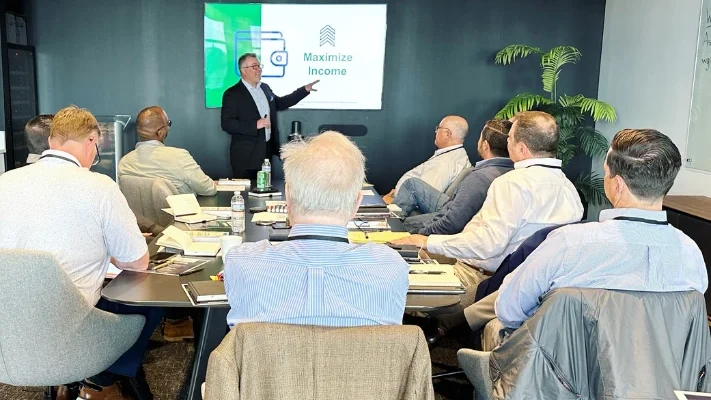
I am passionate about preparing Americans for the risk of rising taxes. And I spend a good bit of my time traveling across the country, speaking to groups of U.S. savers.
One question that keeps coming up this year goes something like this:
“Hi Becky, that was a great talk.” (Modesty, always.) “I liked what you said about Washington raising taxes in the future. But isn’t there another way? Couldn’t higher tariffs make higher taxes unnecessary?”
It’s a great question (Modesty, once again.) And one that deserves a little historical perspective.
Tariffs, of course, are those taxes on goods imported into a nation. And they’ve been a big part of President Trump’s tax policy and reforms.
Sometimes tariffs are promoted as a way to generate additional revenue from foreign sources (since overseas manufacturers must pay the tariff when bringing products into the U.S.). And sometimes tariffs are promoted as a way to increase domestic production and generate tax revenue from a growing economy (as foreign goods become more expensive, companies have an incentive to manufacture the goods here in the U.S.).
But I’m not here to debate the pros and cons of tariffs.
I’m here to look at whether — long-term — higher tariffs today could bring lower taxes in the future.
And to do that, it’s helpful to look at the past.
A few years ago, one of our Stonewood Members recommended a great book to me: Last Call: The Rise and Fall of Prohibition. And boy, am I glad he did.
Not only was it a fascinating look at a very volatile time in U.S. history, but it also had some incredible tax insights for today.
For example: Do you know what ended Prohibition?
I mean, besides the 21st Amendment.
There’s a strong argument to be made that taxes did.
When the income tax was introduced in 1913, it gave the U.S. government a brand new form of revenue. And because our nation now had income taxes coming into the government coffers, it gave politicians some breathing room to give up another important form of revenue: the liquor tax.
By the early 1900s, nearly 40 percent of our government’s revenue was being generated by the liquor tax. That made Prohibition a risky endeavor. But by the time America ratified the 18th Amendment, the new income tax had caught up. When Prohibition passed, revenue from the income tax was there to replace the revenue lost from the liquor tax.
But the nascent income tax also faced some big opponents, especially industrialists and other business leaders who were suddenly paying a lot more income tax than they’d like.
By the late 1920s, leading U.S. industrialists like Pierre du Pont and John Rockefeller began pushing for Prohibition’s repeal.
And it wasn’t because they wanted a national return to drinking.
It’s because they wanted to get rid of the income tax. And to do so, they needed the revenue back from legal liquor sales.
Of course, we all know what happened.
As America was spiraling into the Depression, Prohibition ended, and liquor sales became taxable again.
And the income tax? Well, the government just kept on collecting it.
And that, I believe, is the important lesson for today.
While America can occasionally get Administrations that work to reduce taxes, over time we tend to have more Administrations eager to get all the revenue they can. The tax policies put in place today are often changed by the governments of tomorrow.
And that means — over time — new and enhanced revenue sources often serve to deliver additional tax revenue, not replace revenue the government is already getting.
So should our clients still prepare for the risk of rising taxes?
In my opinion? Absolutely.
Close More Business with Stonewood Reports
Easy to run. Easy to present. Pick the report that fits your next client conversation and we'll send a sample to your inbox immediately.
Roth Done RightTax & IRMAA Analysis
Annuity AlphaFIA vs. Managed Account
Legacy Done RightLife Insurance Analysis
Total Tax BurdenRetirement Tax Snapshot
The Modern Parallel: Do Today’s Tariffs Replace or Supplement Taxes?
Tariff revenue has genuinely surged in the past few years, despite the Supreme Court’s ruling on the legality of some of the tariffs. Lead by Trump’s pro-tariff initiatives, the federal government collected just under $2 billion in customs duties in the last fiscal year,
But in FY25, the government spent $2 trillion more than it generated in revenue. Even if all $2 billion in new tariffs were deemed constitutional, that still leaves a $1.8 trillion deficit hole.
That doesn’t mean tariffs won’t continue to play an important role in America’s revenue generation. But it does suggest that tariffs will follow the path of the many tax reforms before it: Being an additional source of revenue, not replacing a source that’s still producing. Tariffs will be added to the revenue pile, not swapped in to replace income taxes.
The Lesson for Advisors: New Revenue Rarely Replaces Old Revenue
Both prohibition and today’s tariffs point to the same conclusion: government revenue tends to accumulate, not replace.
America’s fiscal outlook today (a $2 trillion deficit and nearly $40 trillion debt) coupled with our demographic needs in the future (record-high levels of Americans accessing Social Security and Medicare in the decades to come) paint a pretty clear picture: our government will be looking for all the revenue sources it can find.
Where Roth Done Right Fits In
If your clients are concerned about the risk of rising taxes (as, in my opinion, they should be), this is a perfect time to analyze their potential retirement tax bill.
Today’s lower tax-bracket rates (thanks, OBBBA) give us a unique planning window where clients can convert tax-deferred assets (like IRA funds) into tax-free assets (like Roth IRA funds) – all at lower rates than were available a few years ago.
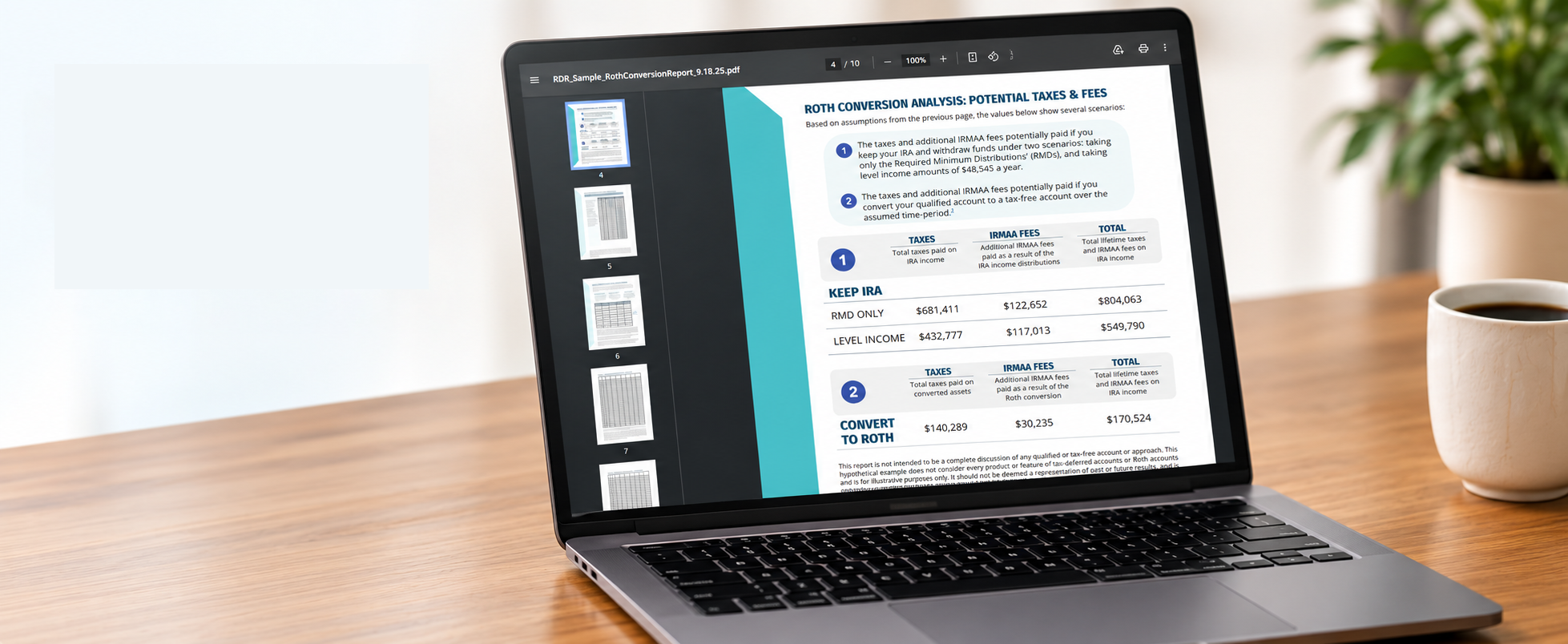
But today’s tax environment has also made Roth conversion analysis more complex. And that’s why Stonewood created Roth Done Right:
Analyzes the potential taxes and IRMAA paid during your client’s Roth conversion, and compares it to the potential taxes and IRMAA saved post-conversion
Offers an easy-to-follow break-even analysis
Shows multiple conversions structures, so your client can pick the optimal conversion timeline
Can be run in under 60 seconds – no tax return needed
Free Study Group Replay
How Stonewood Advisors Stay Ahead of the Next Planning Conversation.
Watch a recent Stonewood Study Group focused on the legacy planning conversation. You’ll see how Stonewood helps advisors break down timely planning topics, client conversation angles, and practical strategies you can put to use immediately.
Expert insights. Real strategies.
Study Group Replay
Timely planning topics
Real client conversation angles
Practical strategies you can use
Real Advisors. Real Results.
See how advisors are using Stonewood software to win larger cases and deliver better
outcomes for their clients.
An advisor was working with a prospect who was a real "do-it-yourselfer" when it came to Roth conversions.
The client was converting assets up their existing tax bracket – and hadn't considered any impact to
IRMAA.
With Roth Done Right, the advisor was able to show an alternate pattern that sped up the conversion to
6 years. The new structure offered $30,000 savings in conversion taxes – a 20% reduction on the
prospect's conversion tax bill. The report also showed hundreds of thousands of dollars in long-term
tax and IRMAA savings from the converted assets – an amount the prospect hadn't been able to quantify
on his own.
Outcome
A new client with $1M in new AUM, and a $1M FIA sale to fund the conversion process.
An advisor was working with a prospect who already had assets with Ken Fisher. Fisher's team presented a
5% systematic withdrawal projection, so the advisor needed a stronger way to frame the income
conversation.
Using the Annuity Alpha report, the advisor showed how an annuity could deliver over 8% in annual cash
flow with lifetime income, plus a long-term care doubler. The contrast was clear enough that the prospect
moved forward.
Outcome
$1.5M placed and a $100K in new business revenue.
An advisor was working with a 58-year-old couple with an established, well-funded retirement income plan,
leaving an additional $3M IRA to build out a legacy for the kids. The couple's existing advisor had no
real additional plan for this money, other than to keep it in their managed account and grow that money as
much as possible for the kids.
Using the Legacy Done Right report, the advisor showed the need for tax planning on this $3M IRA.
According to the advisor, the simple analysis "opened up the wallet" to the Roth conversion story. The
advisor then used the blended Roth/Life feature in the report to show a blend of Roth Conversion assets
with some Life Insurance to help maximize the client’s legacy.
Outcome
$3M in motion. The advisor picked up a $1.5M FIA sale that will be converted to Roth. And the advisor
also sold a 5-Pay Protection focused IUL policy at $225,000 of premium per year.
An advisor group incorporated the Total Tax Burden report into the strategy presentation for all new
prospects. They ran the tax snapshot for every new client as part of their first meeting conversation,
quantifying the growing tax burden of IRA money – and illustrating the kinds of tax savings possible
when working with their firm.
Starting in January of 2023, this simple analysis was presented to every single prospect who walked in
the door. The goal was to differentiate their practice and drive overall revenue growth through various
Roth conversion strategies.
Outcome
From 2022 to 2025, new annual AUM rose from $5M to $50M. Annual FIA sales rose from $3M to $35M.
And annual life premium rose from $50K to $1M.