Believe it or not, our government is fairly transparent when it comes to its own spending – and the impact it could have down the road.
In fact, the Congressional Budget Office regularly publishes data on U.S. government spending and revenue and analyzes how that spending could affect the nation’s fiscal stability in years to come.
Back in January, the CBO issued baseline projections for what the federal budget would look like in the current fiscal year, as well as over the next 10 years if tax and spending generally remained unchanged.
In June, they updated their projections because projected spending was now outpacing projected revenue by a larger amount.
The deficit for FY24—which is the difference between the money the government raises and the money it spends—is now projected to be $1.9 trillion, 27% higher than the CBO projected back in February.
That’s nearly $2T in deficit spending this year.
And over the next ten years, the outlook is even worse.
Why?
The CBO explains it simply: Increases in mandatory spending (Social Security, Medicare, Medicaid) will far outpace any potential reductions in discretionary spending (defense spending, Congressional appropriations, supplemental spending) AND potential growth in revenue (taxes).
… And What it Means for U.S. Savers
So we know America’s fiscal outlook is getting worse. But what does it mean for U.S. savers – especially those heading into retirement?
Here’s my key takeaway from the CBO’s updated projections:
There are three areas the government can adjust to balance spending and revenue:
Mandatory spending, which is spending codified into current law (like Social Security and Medicare)
Discretionary spending, which is all the appropriations and supplemental spending passed by Congress
And revenue, specifically in the form of taxes
The CBO has told us mandatory spending is outpacing tax revenue under current law – even if Congress reduces its own spending.
So, no matter how fiscally conservative Congress is over the next decade, our deficit (and overall public debt) will continue to rise UNLESS we have a significant increase in revenue – i.e., taxes.
And since individual income taxes are by far the single largest revenue source to the government, that’s an easy place for the government to generate the additional revenue it needs.
How Tax-Deferred Savings Could Be Impacted
Tax-deferred savings vehicles – like IRAs and 401(k)s – remain the most popular way Americans save for retirement. In fact, savers currently have trillions of dollars saved tax-deferred.
All of these savers hope to pay lower tax rates in retirement when they access these funds—after all, that’s the promise of tax-deferred saving.
But what happens when our government needs to generate more income tax revenue to offset its growing mandatory spending?
Savers may find they are paying taxes on their retirement assets at a much higher rate than planned.
And that means more of our clients’ savings could be going to the IRS, leaving them with less income to spend on their needs in retirement.
In short, savers who have deferred their taxes in an IRA or 401(k) may find they have a far bigger retirement tax bill coming than planned.
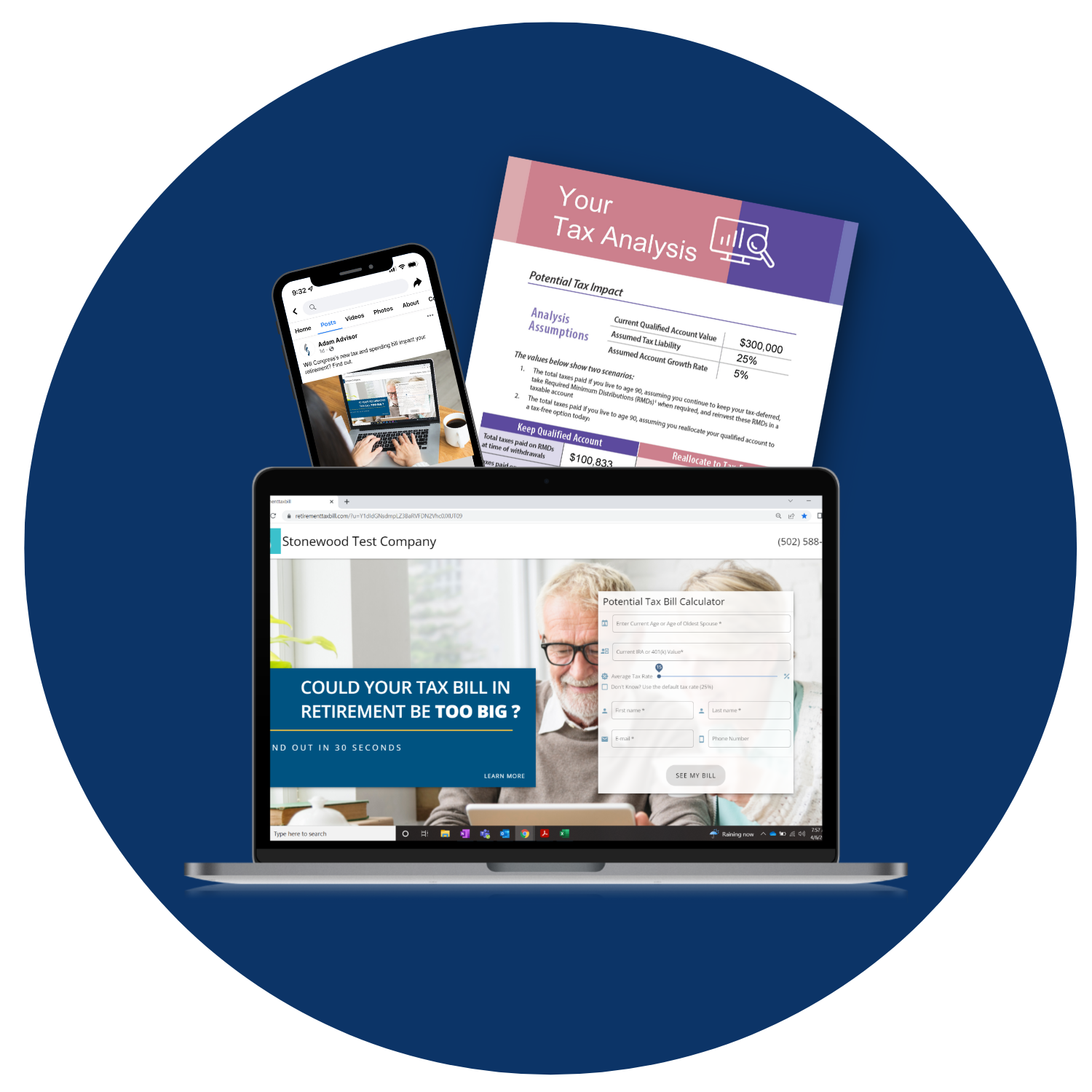
Shameless plug for one of my favorite tools to help you generate leads with the Retirement Tax Bill story – check out Stonewood Financial’s RTB Lead Generator Software.
Putting this Knowledge to Work for Your Clients
2024 is an election year, and I get asked pretty often how the election will impact U.S. savers. Many of us are looking to January for answers: who will occupy the White House? What policies might that candidate pursue?
And, of course, the election’s outcome matters. But regardless of who is in the White House come January, our nation has a spending problem—one that will likely require a tax-raising solution.
That’s because – as the CBO clearly stated last month – our required spending is far outpacing the revenue we generate as a nation.
We are likely entering an era of rising taxes on American savers. At this point, it’s more of a demographics problem and math problem than simply a political one.
So, let’s make sure our clients are prepared for the risk of rising taxes. Tax diversification is increasingly a critical component of comprehensive retirement planning—and the CBO’s latest report makes it more pressing than ever.
Free Study Group Replay
How Stonewood Advisors Stay Ahead of the Next Planning Conversation.
Watch a recent Stonewood Study Group focused on the legacy planning conversation. You’ll see how Stonewood helps advisors break down timely planning topics, client conversation angles, and practical strategies you can put to use immediately.
Expert insights. Real strategies.
Study Group Replay
Timely planning topics
Real client conversation angles
Practical strategies you can use
Real Advisors. Real Results.
See how advisors are using Stonewood software to win larger cases and deliver better
outcomes for their clients.
An advisor was working with a prospect who was a real "do-it-yourselfer" when it came to Roth conversions.
The client was converting assets up their existing tax bracket – and hadn't considered any impact to
IRMAA.
With Roth Done Right, the advisor was able to show an alternate pattern that sped up the conversion to
6 years. The new structure offered $30,000 savings in conversion taxes – a 20% reduction on the
prospect's conversion tax bill. The report also showed hundreds of thousands of dollars in long-term
tax and IRMAA savings from the converted assets – an amount the prospect hadn't been able to quantify
on his own.
Outcome
A new client with $1M in new AUM, and a $1M FIA sale to fund the conversion process.
An advisor was working with a prospect who already had assets with Ken Fisher. Fisher's team presented a
5% systematic withdrawal projection, so the advisor needed a stronger way to frame the income
conversation.
Using the Annuity Alpha report, the advisor showed how an annuity could deliver over 8% in annual cash
flow with lifetime income, plus a long-term care doubler. The contrast was clear enough that the prospect
moved forward.
Outcome
$1.5M placed and a $100K in new business revenue.
An advisor was working with a 58-year-old couple with an established, well-funded retirement income plan,
leaving an additional $3M IRA to build out a legacy for the kids. The couple's existing advisor had no
real additional plan for this money, other than to keep it in their managed account and grow that money as
much as possible for the kids.
Using the Legacy Done Right report, the advisor showed the need for tax planning on this $3M IRA.
According to the advisor, the simple analysis "opened up the wallet" to the Roth conversion story. The
advisor then used the blended Roth/Life feature in the report to show a blend of Roth Conversion assets
with some Life Insurance to help maximize the client’s legacy.
Outcome
$3M in motion. The advisor picked up a $1.5M FIA sale that will be converted to Roth. And the advisor
also sold a 5-Pay Protection focused IUL policy at $225,000 of premium per year.
An advisor group incorporated the Total Tax Burden report into the strategy presentation for all new
prospects. They ran the tax snapshot for every new client as part of their first meeting conversation,
quantifying the growing tax burden of IRA money – and illustrating the kinds of tax savings possible
when working with their firm.
Starting in January of 2023, this simple analysis was presented to every single prospect who walked in
the door. The goal was to differentiate their practice and drive overall revenue growth through various
Roth conversion strategies.
Outcome
From 2022 to 2025, new annual AUM rose from $5M to $50M. Annual FIA sales rose from $3M to $35M.
And annual life premium rose from $50K to $1M.