If you’ve been following our blog this year, you’ve noticed I’ve been sharing some of my favorite message frames.
Message frames are quick, targeted frameworks for communicating a complex topic. And they are incredibly useful in marketing for financial advisors. They can be used in multitudes of ways, from client conversations to seminar content and radio ads.
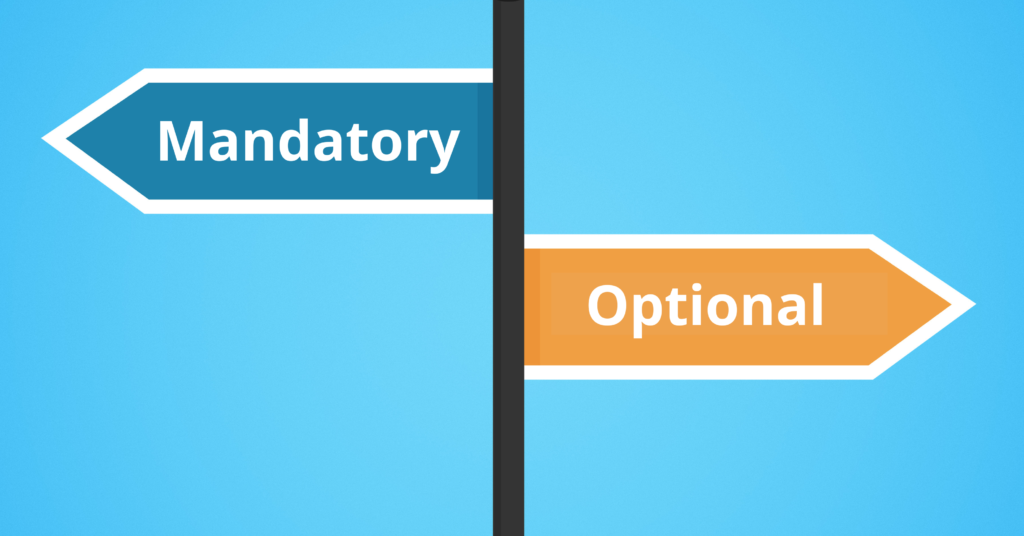
So to close out the year, I want to share one of the most effective message frames I’ve ever developed: Mandatory vs. Optional.
Let’s set it up.
You’re meeting with a client or prospect who has saved diligently in a 401(k) or IRA. They know, in theory, they have a tax bill coming due in retirement. And perhaps they have considered a Roth or other tax-free conversion to help reduce this tax bill, but just haven’t taken action yet.
How do you get them over the hump?
That’s where the Mandatory vs. Optional framework comes into play.
Let’s say you’ve done a Roth analysis for your client. For this blog post, I’ll use Stonewood Financial’s most popular client report, our Total Tax Burden.
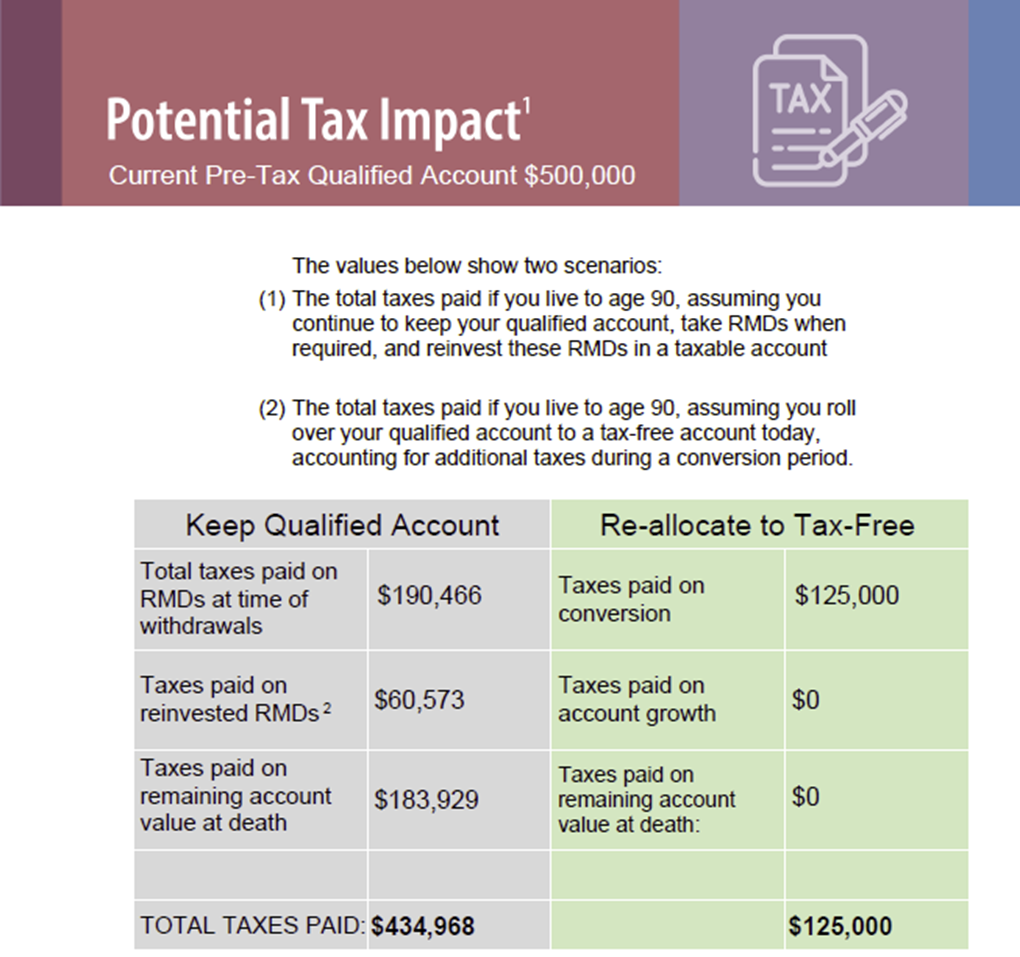
This analysis shows the potential amount of taxes a saver will pay if they keep their IRA or 401(k), and the potential amount of taxes they will pay if they convert it to a Roth.
It’s a powerful report. But I’ve found you can drive decision-making behavior even higher by coupling it with this message frame.
Here’s a recent report run on a 60-year-old client.
Once I’ve talked through the analysis, I look at the client and say:
There’s something I notice in your analysis. According to this report, your mandatory, minimum tax bill due to the IRS for this IRA is $125,000. (I motion to the right-hand column.) Essentially, if we paid the taxes you owe today, that tax bill is $125,000.
Unfortunately, there’s not much I can do to reduce this mandatory minimum tax bill. That tax bill has been built up over time based on the way you’ve saved in the past.
However, looking at this report, I see we’re projecting you could potentially pay $434,000 in taxes if you stay on the path you’re on. (I motion to the left-hand column). If I deduce your mandatory taxes from this number, I see that there’s more than $300,000 in optional taxes that you’re choosing to pay – not based on how you’ve saved in the past, but based on how you save from today going forward.
Would it make sense for us to look at some strategies to reduce or eliminate those optional taxes?
This framework is so effective for two reasons:
First, language. Nobody wants to pay optional taxes. We have reframed the difference between their current strategy and a conversion strategy using concepts that empower the saver; we’ve let them know there is something they can do proactively to reduce their optional taxes.
Second, decision-driving. As I talk to advisors, almost all of them have lost a potential client – not to another advisor or strategy, but to inaction. The truth is, even if our clients understand the risks, they are sometimes hesitant to take action. It’s simply easier to keep doing what you’re doing than to make a change. With the mandatory vs. optional framework, we’re helping our clients quantify the cost of inaction.
Sometimes, I’ll frame it up like this:
“Mr. and Mrs. Prospect, when you leave my office today, you’ll have made a choice. It will either be a choice of action to convert a portion of your retirement assets to tax-free and limit your tax bill to the minimum, mandatory taxes. Or it will be a choice of inaction, where you choose to pay more than $300,000 in optional taxes. But it’s a choice either way. I know it can be daunting to make decisions about your retirement nest egg, which is why I wanted to make sure you could quantify the potential tax bill for both paths forward.”
Heads up: Stonewood Financial is rolling out brand-new Roth Conversion software in Q1 that will help you minimize both taxes and IRMAA during your client’s conversion – so stay tuned for more on this awesome tool.
So there you have it: our final message frame for 2024. Give it a try, and let me know the kind of response you experience.
As we head into 2025, I’d love to hear your favorite message frames for taxes in retirement, too – connect with me here.
Free Study Group Replay
How Stonewood Advisors Stay Ahead of the Next Planning Conversation.
Watch a recent Stonewood Study Group focused on the legacy planning conversation. You’ll see how Stonewood helps advisors break down timely planning topics, client conversation angles, and practical strategies you can put to use immediately.
Expert insights. Real strategies.
Study Group Replay
Timely planning topics
Real client conversation angles
Practical strategies you can use
Real Advisors. Real Results.
See how advisors are using Stonewood software to win larger cases and deliver better
outcomes for their clients.
An advisor was working with a prospect who was a real "do-it-yourselfer" when it came to Roth conversions.
The client was converting assets up their existing tax bracket – and hadn't considered any impact to
IRMAA.
With Roth Done Right, the advisor was able to show an alternate pattern that sped up the conversion to
6 years. The new structure offered $30,000 savings in conversion taxes – a 20% reduction on the
prospect's conversion tax bill. The report also showed hundreds of thousands of dollars in long-term
tax and IRMAA savings from the converted assets – an amount the prospect hadn't been able to quantify
on his own.
Outcome
A new client with $1M in new AUM, and a $1M FIA sale to fund the conversion process.
An advisor was working with a prospect who already had assets with Ken Fisher. Fisher's team presented a
5% systematic withdrawal projection, so the advisor needed a stronger way to frame the income
conversation.
Using the Annuity Alpha report, the advisor showed how an annuity could deliver over 8% in annual cash
flow with lifetime income, plus a long-term care doubler. The contrast was clear enough that the prospect
moved forward.
Outcome
$1.5M placed and a $100K in new business revenue.
An advisor was working with a 58-year-old couple with an established, well-funded retirement income plan,
leaving an additional $3M IRA to build out a legacy for the kids. The couple's existing advisor had no
real additional plan for this money, other than to keep it in their managed account and grow that money as
much as possible for the kids.
Using the Legacy Done Right report, the advisor showed the need for tax planning on this $3M IRA.
According to the advisor, the simple analysis "opened up the wallet" to the Roth conversion story. The
advisor then used the blended Roth/Life feature in the report to show a blend of Roth Conversion assets
with some Life Insurance to help maximize the client’s legacy.
Outcome
$3M in motion. The advisor picked up a $1.5M FIA sale that will be converted to Roth. And the advisor
also sold a 5-Pay Protection focused IUL policy at $225,000 of premium per year.
An advisor group incorporated the Total Tax Burden report into the strategy presentation for all new
prospects. They ran the tax snapshot for every new client as part of their first meeting conversation,
quantifying the growing tax burden of IRA money – and illustrating the kinds of tax savings possible
when working with their firm.
Starting in January of 2023, this simple analysis was presented to every single prospect who walked in
the door. The goal was to differentiate their practice and drive overall revenue growth through various
Roth conversion strategies.
Outcome
From 2022 to 2025, new annual AUM rose from $5M to $50M. Annual FIA sales rose from $3M to $35M.
And annual life premium rose from $50K to $1M.