Every financial advisor has been asked this question. In fact, it’s one of the most common questions retirement advisors hear.
Alas, none of us has a magic ball and can predict the future for our clients.
So, instead, we’ve become experts in helping clients develop income plans that address the risk of outliving their assets.
But are we helping them plan for long enough?
Emerging research says… maybe not.
The Impact of Wealth on Longevity
Does your client know he’s likely to live longer simply because he did a good job saving for retirement?
Okay, that’s a slight oversimplification.
But there is truth in that statement.
A study in the Journal of the American Medical Association (JAMA) shed some light on this topic. Titled “The Association Between Income and Life Expectancy in the United States,” it looked at life expectancies at different income levels.
The study was important enough to be housed at the National Institute of Health’s U.S. National Library of Medicine.
I mention that not to impress you with my knowledge of obscure U.S. government offices, but because when the Library of Medicine catalogs a study, it includes a brief online summary of that study’s importance.
And for this study, that summary was:
“The relationship between income and mortality is well established but remains poorly understood.”
Basically, the NIH is saying: We know wealthier people live longer. But wealthier people don’t understand that they live longer, so they’re not planning for it. And that’s a problem.
This summary should be a wake-up call for our clients.
As financial advisors, we usually see wealthier clients – clients who have saved well for retirement and need help managing those savings.
But if our clients are looking at average life expectancies and trying to plan their retirement income to match it, there’s a good chance their income plans will fail.
And that’s where we can bring unique insight and guidance as advisors.
Longer, but how much longer?
If wealthier Americans are likely to live longer, the next question is obviously: How much longer?
But if that same saver is in the top 1% of earners (here in Kentucky, that’s earning about $450k), his life expectancy is much higher – 87.3 years.
Simply by being wealthy, he increased his life expectancy by nearly 10 years.
Logically, this makes sense. On average, wealthier Americans have better access to health care and a higher ability to pay for resources that contribute to a healthy lifestyle.
But many wealthier savers don’t understand the connection between their wealth and how long they might live.
(If you’re curious, the jump for women is similar: 81.9 years for the average 50-year-old woman, but 88.9 years for a 50-year-old woman in the top 1%.)
But wait, there’s more!
Research shows that wealthier Americans live longer than the average American.
So does that mean you should help your clients prepare for that longer life expectancy?
Yes… and no.
Yes – because it’s important to create an income plan that lasts longer for your clients.
No – because life expectancy shouldn’t be the planning goal.
Here’s a hard truth: Even if you craft income plans for your clients that cover them through their heightened life expectancy, your plans will still fail 50% of the time.
50% of the time!
That’s because life expectancy is an average – and 50% of people, by definition, outlive the average.
Instead, you may want to look at life span when crafting income plans.
Life expectancy is the average number of years a member of a given population lives.
Life span is the greatest age reached by any member of a given population.
By focusing on life span, we are helping our clients generate income to an age when it’s likely most people like them will no longer be living. And that’s a better measure for ensuring they don’t outlive their income.
Here at Stonewood Financial, we tend to model all of our income and tax analyses at minimum to age 95.
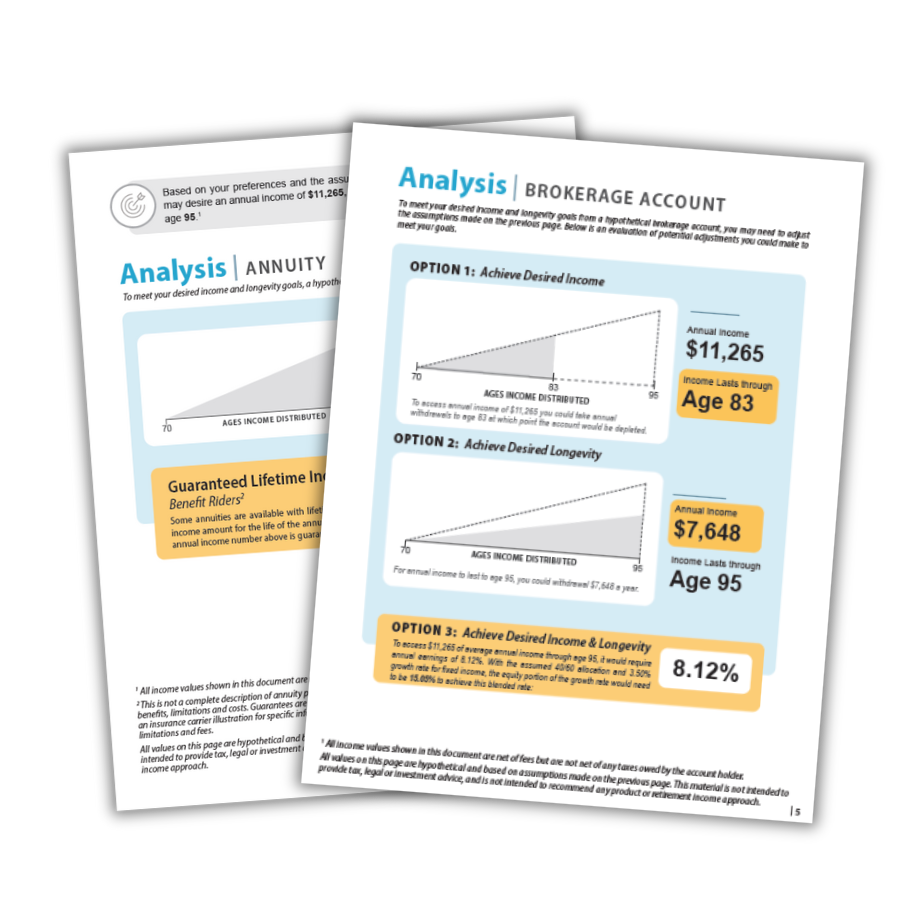
As advisors, we know there are many tools to help ensure a saver’s income lasts as long as they do. (Check out Stonewood Financial’s new Annuity Alpha software for a great way to demonstrate the power of lifetime income to your clients.)
As we build income plans for our clients, let’s make sure we’re educating these savers on how long they’re likely to live – and how to prepare their assets for what could be a very long ride.
Free Study Group Replay
How Stonewood Advisors Stay Ahead of the Next Planning Conversation.
Watch a recent Stonewood Study Group focused on the legacy planning conversation. You’ll see how Stonewood helps advisors break down timely planning topics, client conversation angles, and practical strategies you can put to use immediately.
Expert insights. Real strategies.
Study Group Replay
Timely planning topics
Real client conversation angles
Practical strategies you can use
Real Advisors. Real Results.
See how advisors are using Stonewood software to win larger cases and deliver better
outcomes for their clients.
An advisor was working with a prospect who was a real "do-it-yourselfer" when it came to Roth conversions.
The client was converting assets up their existing tax bracket – and hadn't considered any impact to
IRMAA.
With Roth Done Right, the advisor was able to show an alternate pattern that sped up the conversion to
6 years. The new structure offered $30,000 savings in conversion taxes – a 20% reduction on the
prospect's conversion tax bill. The report also showed hundreds of thousands of dollars in long-term
tax and IRMAA savings from the converted assets – an amount the prospect hadn't been able to quantify
on his own.
Outcome
A new client with $1M in new AUM, and a $1M FIA sale to fund the conversion process.
An advisor was working with a prospect who already had assets with Ken Fisher. Fisher's team presented a
5% systematic withdrawal projection, so the advisor needed a stronger way to frame the income
conversation.
Using the Annuity Alpha report, the advisor showed how an annuity could deliver over 8% in annual cash
flow with lifetime income, plus a long-term care doubler. The contrast was clear enough that the prospect
moved forward.
Outcome
$1.5M placed and a $100K in new business revenue.
An advisor was working with a 58-year-old couple with an established, well-funded retirement income plan,
leaving an additional $3M IRA to build out a legacy for the kids. The couple's existing advisor had no
real additional plan for this money, other than to keep it in their managed account and grow that money as
much as possible for the kids.
Using the Legacy Done Right report, the advisor showed the need for tax planning on this $3M IRA.
According to the advisor, the simple analysis "opened up the wallet" to the Roth conversion story. The
advisor then used the blended Roth/Life feature in the report to show a blend of Roth Conversion assets
with some Life Insurance to help maximize the client’s legacy.
Outcome
$3M in motion. The advisor picked up a $1.5M FIA sale that will be converted to Roth. And the advisor
also sold a 5-Pay Protection focused IUL policy at $225,000 of premium per year.
An advisor group incorporated the Total Tax Burden report into the strategy presentation for all new
prospects. They ran the tax snapshot for every new client as part of their first meeting conversation,
quantifying the growing tax burden of IRA money – and illustrating the kinds of tax savings possible
when working with their firm.
Starting in January of 2023, this simple analysis was presented to every single prospect who walked in
the door. The goal was to differentiate their practice and drive overall revenue growth through various
Roth conversion strategies.
Outcome
From 2022 to 2025, new annual AUM rose from $5M to $50M. Annual FIA sales rose from $3M to $35M.
And annual life premium rose from $50K to $1M.