We’re living in a digital age. Even older clients are often consuming information and making decisions online – so having a strong social media presence is no longer optional for financial advisors. It’s the fertile ground for building trust, establishing thought leadership, and attracting new clients. But navigating the quickly evolving world of social media can be daunting. So, I wanted to share some of my favorite tips for mastering social media marketing and using it to fuel your practice.
Below, I’ve listed five of my top recommendations on how to master social media marketing as a financial advisor. (Just a heads up, I couldn’t keep the list to five, so I included some bonus quick tips at the very end.)
Close More Business with Stonewood Reports
Easy to run. Easy to present. Pick the report that fits your next client conversation and we'll send a sample to your inbox immediately.
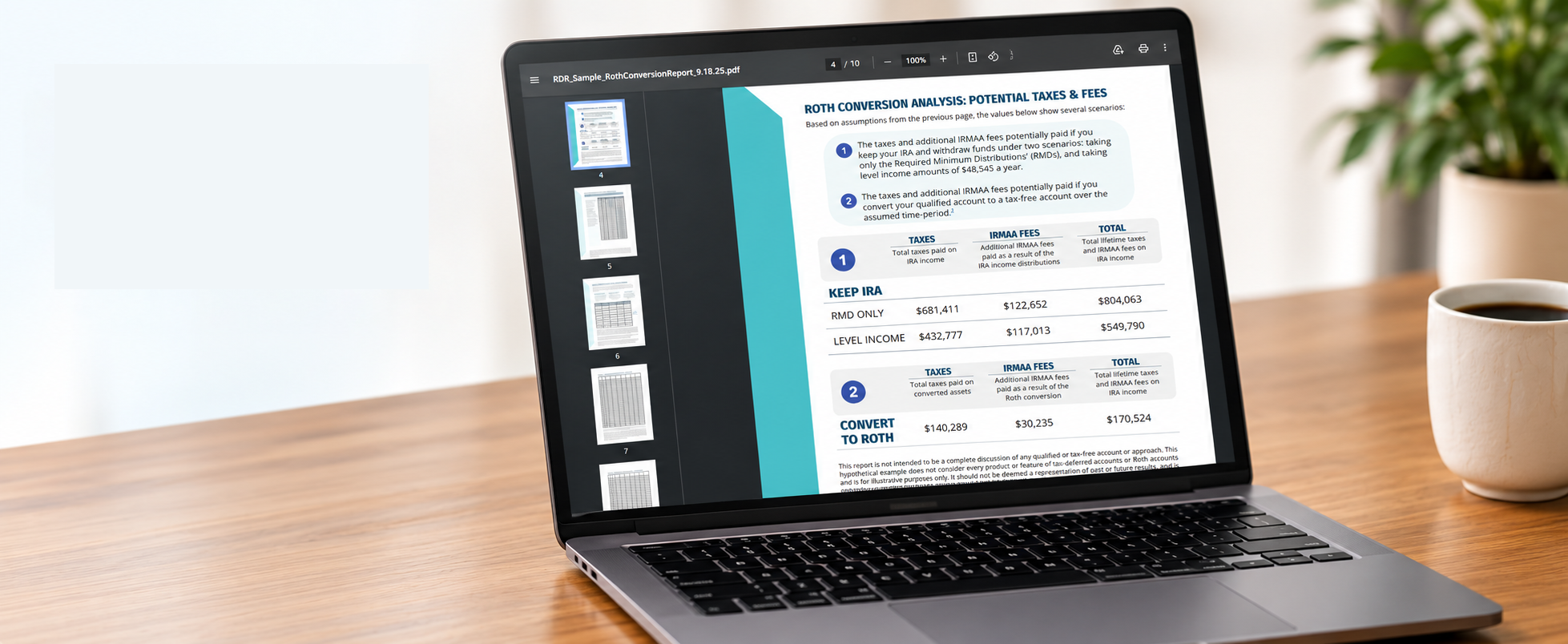
Roth Done RightTax & IRMAA Analysis
Annuity AlphaFIA vs. Managed Account
Legacy Done RightLife Insurance Analysis
Total Tax BurdenRetirement Tax Snapshot
1 | Know Your Audience & Platform Playground
Define your ideal client: Before engaging online, it’s important to understand your target audience, just as you would before inviting someone to your brick-and-mortar office. Are they young professionals saving for retirement? Baby boomers nearing retirement? Tailor your content to their specific needs and concerns.
Platform prowess: Different platforms cater to different demographics and communication styles. Master LinkedIn for professional networking, engage on Facebook with personal stories, and utilize Twitter for quick updates and industry insights. Different platforms also attract different audiences. Wanting to connect with Baby Boomers? You’ll find them on Facebook.
2 | Content is King (and Queen!)
Value reigns supreme: Once you’ve identified your audience, you need to give them something that’s valuable. While we all want to promote our practice, we also need to provide content that solves problems and informs your audience. Easy ways to do it? Offer tips on saving, explain market trends, share success stories, and link to articles that address financial woes and anxieties.
Diversify the format: This is one of my favorite tips. Use a mix of formats to keep your audience engaged. Who wants to read the same type of post all the time? Instead, share informative articles and brochures, create infographics and short videos (even recorded on your phone), host live Q&A sessions, or share personal anecdotes (trust me, prospects want to know you’re a real human with interests outside of finance).
One of my favorite resources to share on social media? Stonewood Financial’s “5 Ways Taxes Can Rise in Retirement” brochure. It’s great for lead capture with a form (build your marketing list!), or to post directly with an appointment-setting CTA.
{{cta(’18c8ddbc-3d4a-46a5-a4c0-4ae56a662088′)}}
Stay relevant & timely: Be responsive to current events and news cycles. Offer financial insights on economic changes, share your expertise on trending financial topics, and comment on relevant legislation (I have to give a plug to Stonewood Financial’s Legislative Toolkit here, which provides dozens of ways to leverage what’s happening in Washington into leads for your practice).
3 | Engage & Build Relationships
Two-way street: Social media isn’t a one-way broadcast. You or someone on your team has to interact with prospects and clients alike. Respond to comments and messages promptly and professionally.
Community counts: Encourage engagement by running contests, polls, and live chats. Clients love to share their opinions, and social media is a great place to learn what’s on the minds of your target audience.
Collaborate and connect: You don’t have to do it alone! Partner with other financial professionals or influencers for cross-promotion and reaching new audiences. Leverage professional associations or industry groups to increase your reach.
If you are looking for industry experts to leverage in your marketing and promotion, schedule a call with our team here. We’ll show you how to leverage Stonewood Financial books, automated webinar recordings and more on social media.
4 | Consistency is Key
Regular rhythm: This is a tough one because it takes commitment. But consistency really is key when it comes to social media content for financial advisors. Develop a consistent posting schedule and stick to it. Whether daily, weekly, or bi-weekly, establish a rhythm that your audience can rely on and anticipate. Here at Stonewood Financial, we use the project management platform Monday to plan out our social media content calendar.
Plan and track: Utilize social media scheduling tools to streamline your workflow and ensure consistent posting. Analyze your engagement metrics to understand what resonates and make data-driven adjustments.
Long-term commitment: Building a strong social media presence takes time and effort. Be patient and stay consistent. It’s not flashy, but it’s the path to success.
Free Advisor Training
Turn Roth Conversations Into Revenue
Watch this complimentary training to learn how leading advisors use retirement tax concerns to create urgency, open Roth conversion conversations, and uncover valuable new planning opportunities.
Video Training
Create urgency around tax planning
Open more Roth conversion conversations
Uncover new planning opportunities
5 | Measure, Analyze, and Adapt
Measure and analyze your progress: Is your social media strategy effective or ineffective? You won’t know unless you measure it. Social media marketing doesn’t exist in a vacuum. Track your progress! Which posts perform best? Which platforms generate the most leads? Use analytics to understand your audience and refine your strategy. HubSpot, a CRM and inbound content platform, has great analytics tools that my team and I rely on to evaluate how our social media posts are performing. If you’re using a social media publishing system, there’s a good chance you have data to analyze at your fingertips
Don’t be afraid of change: Adapt your content based on what resonates and what falls flat. Remember, your social media strategy will change – based on what converts AND on what’s happening in the broader world. Be patient, experiment, and learn from your data.
I told you I couldn’t limit myself to five, so here are a few more tips if you’re new to social media content for financial advisors:
Utilize relevant hashtags: Research and use relevant industry hashtags to improve your discoverability. Remember, the hashtags should be relevant to your clients, not just to our industry.
Embrace visual storytelling: High-quality images and videos can dramatically increase engagement. Explore platforms like YouTube or Vimeo to share longer-form content and showcase your expertise.
Be authentic and relatable: Let your personality shine through! Authenticity builds trust and makes your content more engaging. For example, I hope you’ve enjoyed this blog post, and have gotten to know a little about my expertise through it. But if I included a picture of my Golden Retriever, Mayla, we might connect on a more personal level, too, because you’d know I’m a dog lover and get a taste of my personality.Here is the complete list of financial advisor marketing tools
Mastering social media marketing takes time, dedication, and strategic planning. But with the right approach, it can be a powerful tool for attracting new clients, building trust, and establishing yourself as a thought leader in the financial advisory space.
If you’re looking to dip your toes into the social media waters in 2024, these tips will help you get started. Instead of a toast to the new year, I’ll offer a POST to the new year.
Free Study Group Replay
How Stonewood Advisors Stay Ahead of the Next Planning Conversation.
Watch a recent Stonewood Study Group focused on the legacy planning conversation. You’ll see how Stonewood helps advisors break down timely planning topics, client conversation angles, and practical strategies you can put to use immediately.
Expert insights. Real strategies.
Study Group Replay
Timely planning topics
Real client conversation angles
Practical strategies you can use
Real Advisors. Real Results.
See how advisors are using Stonewood software to win larger cases and deliver better
outcomes for their clients.
An advisor was working with a prospect who was a real "do-it-yourselfer" when it came to Roth conversions.
The client was converting assets up their existing tax bracket – and hadn't considered any impact to
IRMAA.
With Roth Done Right, the advisor was able to show an alternate pattern that sped up the conversion to
6 years. The new structure offered $30,000 savings in conversion taxes – a 20% reduction on the
prospect's conversion tax bill. The report also showed hundreds of thousands of dollars in long-term
tax and IRMAA savings from the converted assets – an amount the prospect hadn't been able to quantify
on his own.
Outcome
A new client with $1M in new AUM, and a $1M FIA sale to fund the conversion process.
An advisor was working with a prospect who already had assets with Ken Fisher. Fisher's team presented a
5% systematic withdrawal projection, so the advisor needed a stronger way to frame the income
conversation.
Using the Annuity Alpha report, the advisor showed how an annuity could deliver over 8% in annual cash
flow with lifetime income, plus a long-term care doubler. The contrast was clear enough that the prospect
moved forward.
Outcome
$1.5M placed and a $100K in new business revenue.
An advisor was working with a 58-year-old couple with an established, well-funded retirement income plan,
leaving an additional $3M IRA to build out a legacy for the kids. The couple's existing advisor had no
real additional plan for this money, other than to keep it in their managed account and grow that money as
much as possible for the kids.
Using the Legacy Done Right report, the advisor showed the need for tax planning on this $3M IRA.
According to the advisor, the simple analysis "opened up the wallet" to the Roth conversion story. The
advisor then used the blended Roth/Life feature in the report to show a blend of Roth Conversion assets
with some Life Insurance to help maximize the client’s legacy.
Outcome
$3M in motion. The advisor picked up a $1.5M FIA sale that will be converted to Roth. And the advisor
also sold a 5-Pay Protection focused IUL policy at $225,000 of premium per year.
An advisor group incorporated the Total Tax Burden report into the strategy presentation for all new
prospects. They ran the tax snapshot for every new client as part of their first meeting conversation,
quantifying the growing tax burden of IRA money – and illustrating the kinds of tax savings possible
when working with their firm.
Starting in January of 2023, this simple analysis was presented to every single prospect who walked in
the door. The goal was to differentiate their practice and drive overall revenue growth through various
Roth conversion strategies.
Outcome
From 2022 to 2025, new annual AUM rose from $5M to $50M. Annual FIA sales rose from $3M to $35M.
And annual life premium rose from $50K to $1M.