As legislation continues to be discussed, let’s take a closer look at the word at the heart of the discussions: fiduciary.
What does it mean?
A fiduciary is defined as a person or organization that acts on behalf of another person or persons, putting the client’s interests ahead of their own. Fiduciaries have a duty to preserve good faith and trust.
So, according to that definition, of course, we need our financial community to be fiduciaries. Of course, we want our financial professionals looking out for their clients. Of course, we want them putting their client’s best interests first. Of course.
But at some point, lawmakers have come to believe a narrative that only one business model can support a true fiduciary standard. Somewhere along the way, Congress (at the pushing of some strong industry lobbyists) has come to believe that taking a fee on assets means that you are always looking out for the best interest of your client. And that the ONLY way to look out for your clients is taking a “fee” instead of collecting a “commission.”
Somewhere along the way, Congress has come to believe that if you take a commission on the sale of a financial asset, you are only looking out for your own best interest.
On the surface, I understand how we got here.
In theory, taking an asset-based fee puts the advisor and the client on the same side of the growth equation. Meaning, higher account values for the client mean higher revenue for the advisor.
And on the surface, I can see that the word commission comes with some “sales guy” baggage.
But are these notions true?
The key determinant is not commissions or fees. It’s revenue.
Revenue.
Revenue is the lifeblood of all businesses. Whether an advisor is commission-based, fee-based, or some combination of both, they all need revenue to stay in business.
In essence, the fee-only advisor and the commission-based advisor are on the same side of the table.
The Fiduciary Equation
Clients need financial professionals who can help them meet their financial goals. True.
Advisors need revenue to keep their businesses alive. Also true.
Yes, both can be true. And yes, both commission-based advisors and fee-based advisors can be fiduciaries. Both can have their clients’ best interests in mind while also growing their business. I repeat, both can be true!
So now the business aspect is out of the way, let’s talk about the client. At the end of the day, as financial advisors, if we’re not doing what’s right for our clients, we don’t have clients.
Seems simple. Grow their assets. Protect their assets. Make their assets last. And hope there is some left over to pass on.
Others might put it a little differently: I just need to make sure my clients don’t lose money.
Either way, the concept of risk mitigation for our retirement clients has evolved.
Risk Mitigation for Today’s Savers
Being a fiduciary (aka meeting our client’s best interest) started with a plan to grow and protect assets. It was all about accumulation: Build a nice little model to grow those assets with the proper asset allocation mix to meet the client’s risk profile.
But that quickly became only part of the process. Because that approach really only addressed market risk.
As clients started to retire with large balances in 401(k)s and IRAs, the advisor community realized the risk mitigation process needed to include income planning. Then, the dot-com bubble burst, and that financial crisis brought the issue front and center. Taking distributions from deflated assets to meet retirement needs was not a recipe for success. So that meant that to be a true fiduciary and truly meet our client’s retirement needs, advisors needed to understand how to use guaranteed income solutions in client portfolios. Annuities went from a niche product to a staple in our industry.
Market risk – a fiduciary standard met through asset allocations and managed money
Income risk – a fiduciary standard met through the use of annuities and guaranteed income riders
But that’s not all. Today, simply addressing market and income risk is proving to be an incomplete approach.
Are we really meeting our clients’ needs if we are still ignoring one of our clients’ greatest, least understood risks?…the risk of rising taxes?
(Looking for a primer on why taxes could rise for many U.S. savers? Check out my partner’s analysis here.)
Most clients and advisors alike can see a path to increased taxes in the future. So if advisors and clients believe that taxes on retirement assets at some point will have to increase, and those same advisors and clients continue to defer their taxes into the future as assets continue to grow in tax-deferred instruments like IRAs and 401(k)s… Do we not have a little disconnect between our beliefs and our behavior?
This inserts a significant risk into the equation.
As fiduciaries, we must consider this tax risk and solutions that help mitigate that risk. Roth IRAs and cash-value life insurance are two powerful ways to mitigate tax risk. It doesn’t matter what your business model is, if you want to truly mitigate the risk, you should have all options on the table.
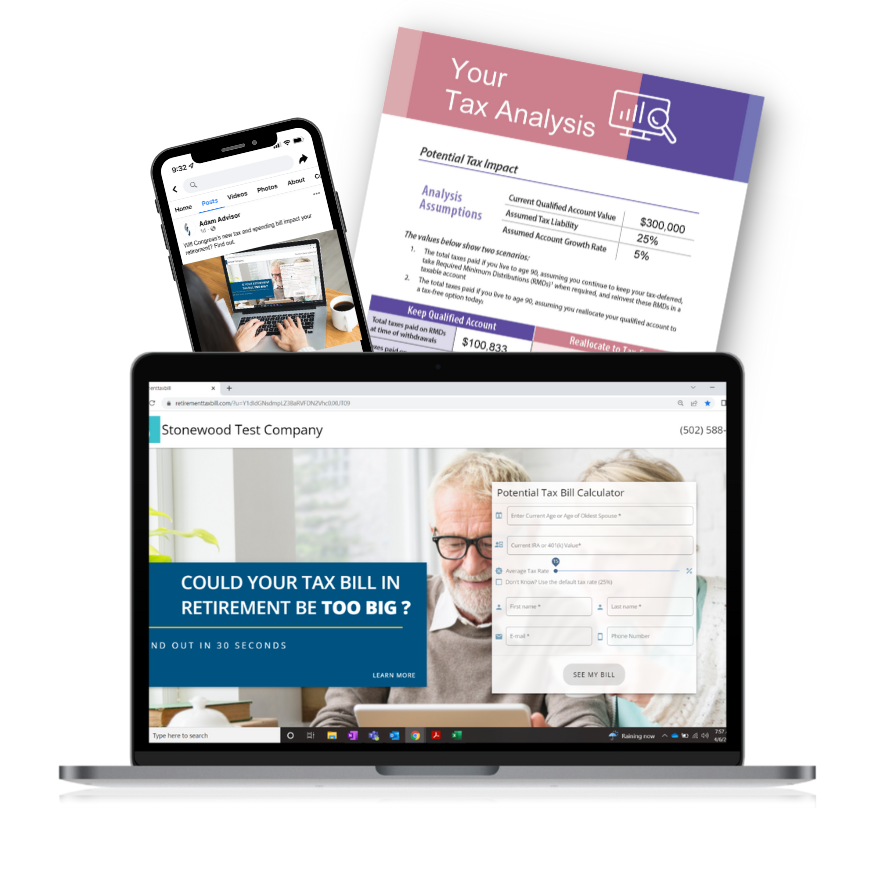
In the past, the challenge has been having the tools to understand and communicate tax and legislative risk to our clients. At Stonewood Financial, that is our specialty.
The first step is understanding the problem. Have your client calculate their Retirement Tax Bill. This is a level of analysis most retirees have never considered. The total taxes they will pay on retirement assets over their lifetime. That analysis will stop them in their tracks. It will also motivate a meeting.
In that meeting, discuss the potential impact of legislation from Washington on their retirement. Help them understand that Washington can change the rules at any time. And if their assets are being deferred into the future – through an IRA or 401(k) – help them understand their rising tax risk.
Once you’ve evaluated and quantified your client’s potential Retirement Tax Bill, you’re ready to ask: Are you happy with that bill?
And if not (and I’ll bet the answer is they’re not), you’re ready to help them chart a better path forward.
The next step is putting a reallocation plan in place over the next few years for your client. Execution of that plan can look different based on your client’s needs.
Maybe it’s a Roth Conversion within their existing managed portfolio.
Maybe it’s a Roth Conversion with an FIA with a guaranteed income benefit rider attached as the destination assets of the conversion.
Maybe your client has already gone through the Roth Conversion process and still has excess assets in their IRA. What else could they do? As a fiduciary, you have to explore other tax-free options. Some advisors consider an IRA to IUL strategy in this situation.
How does this work? Similar to a Roth conversion, your client withdraws money from the IRA over a 5 to 7-year period and uses the after-tax funds to overfund a cash-value life insurance policy.
Developing a Complete Approach
You know what I call an advisor who understands how to communicate and execute a retirement approach that addresses the complete risks a saver may face in retirement?
A fiduciary.
Not because they collect fees on AUM. Not because they use commission-based products such as FIAs or IUL.
They are fiduciaries because they address the complete list of risks their clients are facing.
Market Risk
Income Risk
Tax & Legislative Risk
A client’s best interests can clearly be met regardless of the business model the advisor has in place. Let’s just hope the regulation doesn’t prevent that from happening.
Free Study Group Replay
How Stonewood Advisors Stay Ahead of the Next Planning Conversation.
Watch a recent Stonewood Study Group focused on the legacy planning conversation. You’ll see how Stonewood helps advisors break down timely planning topics, client conversation angles, and practical strategies you can put to use immediately.
Strategy expertise and training that actually moves the needle. Neil sees the big opportunities coming - and develops tools to let you take advantage of them.
Real Advisors. Real Results.
See how advisors are using Stonewood software to win larger cases and deliver better
outcomes for their clients.
An advisor was working with a prospect who was a real "do-it-yourselfer" when it came to Roth conversions.
The client was converting assets up their existing tax bracket – and hadn't considered any impact to
IRMAA.
With Roth Done Right, the advisor was able to show an alternate pattern that sped up the conversion to
6 years. The new structure offered $30,000 savings in conversion taxes – a 20% reduction on the
prospect's conversion tax bill. The report also showed hundreds of thousands of dollars in long-term
tax and IRMAA savings from the converted assets – an amount the prospect hadn't been able to quantify
on his own.
Outcome
A new client with $1M in new AUM, and a $1M FIA sale to fund the conversion process.
An advisor was working with a prospect who already had assets with Ken Fisher. Fisher's team presented a
5% systematic withdrawal projection, so the advisor needed a stronger way to frame the income
conversation.
Using the Annuity Alpha report, the advisor showed how an annuity could deliver over 8% in annual cash
flow with lifetime income, plus a long-term care doubler. The contrast was clear enough that the prospect
moved forward.
Outcome
$1.5M placed and a $100K in new business revenue.
An advisor was working with a 58-year-old couple with an established, well-funded retirement income plan,
leaving an additional $3M IRA to build out a legacy for the kids. The couple's existing advisor had no
real additional plan for this money, other than to keep it in their managed account and grow that money as
much as possible for the kids.
Using the Legacy Done Right report, the advisor showed the need for tax planning on this $3M IRA.
According to the advisor, the simple analysis "opened up the wallet" to the Roth conversion story. The
advisor then used the blended Roth/Life feature in the report to show a blend of Roth Conversion assets
with some Life Insurance to help maximize the client’s legacy.
Outcome
$3M in motion. The advisor picked up a $1.5M FIA sale that will be converted to Roth. And the advisor
also sold a 5-Pay Protection focused IUL policy at $225,000 of premium per year.
An advisor group incorporated the Total Tax Burden report into the strategy presentation for all new
prospects. They ran the tax snapshot for every new client as part of their first meeting conversation,
quantifying the growing tax burden of IRA money – and illustrating the kinds of tax savings possible
when working with their firm.
Starting in January of 2023, this simple analysis was presented to every single prospect who walked in
the door. The goal was to differentiate their practice and drive overall revenue growth through various
Roth conversion strategies.
Outcome
From 2022 to 2025, new annual AUM rose from $5M to $50M. Annual FIA sales rose from $3M to $35M.
And annual life premium rose from $50K to $1M.