Explore this article with AI:
The best legacy IRA strategies in 2026 start with an honest admission: a traditional IRA is often the worst asset you can leave to your kids under the current rules. The 10-year rule from the SECURE Act forces most non-spouse beneficiaries to empty an inherited traditional IRA within ten years, which means they pay ordinary income tax on the whole balance – potentially during their peak earning years. For many savers, a smarter move is a Roth conversion to shrink the traditional IRA balance, charitable remainder trusts for donors who want a stretch replacement, life insurance as a tax-free wealth transfer layer, and coordinated beneficiary planning across account types. In 2026, the $15 million per-person estate tax exclusion under OBBBA may change the math, but it doesn’t change the income-tax hit on inherited IRAs.
I’ve been having the same conversation with advisors for three years now. A client walks in with a $2 million traditional IRA they built over thirty years. They’re 72, RMDs just started, and they tell their advisor a good chunk of that IRA will be left to their kids. The old advisor playbook for IRAs was to minimize current withdrawals, let the account compound, and let their heirs stretch the Inherited IRA to spread out the tax burden of inheriting money.
Now, that playbook is broken.
The SECURE Act killed the stretch IRA for most beneficiaries. The 2024 final regs made it worse by confirming annual RMDs during the 10-year window for beneficiaries inheriting from an owner who died after their required beginning date. What does this mean in plain English? The adult child who inherits a $2 million traditional IRA from a parent in 2030 is potentially going to be adding somewhere between $200,000 and $400,000 of ordinary income to their own tax return every year of the 10-year window. And if that adult child is at the peak of their career (let’s say, making $250,000 of their own salary), they just got pushed into the top federal bracket, the Net Investment Income Tax, and possibly a state tax nightmare on top of it.
I tell advisors directly: Under today’s rules, leaving a big traditional IRA to your kids is a gift that comes with a tax bill stapled to it. But I also tell advisors there is a lot we can do about it – and now’s a great time to do it.
The Old Stretch World Versus the New 10-Year World
For context, here’s what changed between the stretch IRA world and the world we live in now.
Pre-SECURE Act, a non-spouse beneficiary who inherited an IRA took annual RMDs based on their own single life expectancy starting the year after the owner’s death. For example, a 45-year-old inheriting a $1 million traditional IRA, the first-year RMD was maybe $25,000, and the rest kept growing tax-deferred. Over 40 years of stretching, the beneficiary could pull more than $2 million out of the account in real terms, most of it during their retirement years when their tax rate was probably lower than their working-years rate. That was a meaningful after-tax legacy.
Post-SECURE Act, the same 45-year-old beneficiary likely has to empty the account within ten years. If the parent had already started RMDs, the beneficiary has to take annual distributions in each of the first nine years and a final distribution in year ten. The ten distributions often hit during the beneficiary’s working years (ages 45 to 55 in this example), when their marginal rate might be the highest it’ll ever be. A substantial piece of the account ends up going to federal and state taxes instead of to the beneficiary.
The old stretch IRA math is gone.
Why Traditional IRAs Are Not Great Legacy Assets Now
This is the part where I push back on the conventional wisdom, and I know some advisors will disagree with me. The traditional IRA used to be the best inheritance asset in many portfolios because of the potential of heirs to stretch. It’s now often the worst asset in the portfolio to leave behind, and here’s why.
- Every dollar coming out of a traditional IRA is taxed as ordinary income to the beneficiary. Not long-term capital gains. Not qualified dividend rates. Ordinary income at the beneficiary’s marginal rate – or even higher if the income pushes the heir into the next tax bracket.
- The 10-year window often forces distributions during the beneficiary’s peak earning years, which is usually the highest-rate window of the beneficiary’s life.
- There’s no step-up in basis on an inherited IRA, unlike a brokerage account or a primary residence. Appreciated stocks inherited through a taxable account get a fresh basis at the owner’s date of death and can be sold tax-free immediately. But not so with an inherited IRA.
- State income taxes stack on top of federal taxes. A beneficiary in California, New York, or New Jersey can lose almost half of each distribution to combined tax.
- Required distributions during the 10-year window can push the beneficiary into higher IRMAA brackets if they’re already on Medicare, and into higher Social Security taxation brackets if they’re already collecting benefits.
Compare that to a Roth IRA, a brokerage account with appreciated stock, or a life insurance death benefit, and the traditional IRA could be the worst legacy asset on a side-by-side, after-tax comparison. Not every family is going to solve this challenge the same way, but every family should at least understand the math before they default to leaving funds to their kids through a traditional IRA.
The Roth IRA Legacy Advantage
A Roth IRA is a much better legacy asset than a traditional IRA, and the 10-year rule is actually a net positive for inherited Roth balances. Here’s why.
A Roth owner has no lifetime RMDs, which means they have no Required Beginning Date. Under the 2024 final regs, a beneficiary inheriting a Roth IRA is never in the “owner died after RMD” category, so they don’t have annual RMD requirements in years 1 through 9 of the 10-year window. The beneficiary can let the inherited Roth compound tax-free for the full ten years and take the entire balance out at the end of year 10, tax-free, assuming the 5-year rule was met by the original owner.
This is why Roth conversion urgency has gone up for clients with serious legacy goals. The conversion tax is real, but it’s often cheaper to pay the tax at the parent’s rate during the parent’s lifetime than to force the beneficiary to pay it at their own (potentially higher) rate during their working years.
Lifetime Roth Conversion Strategies to Shrink the Traditional Balance
Here’s the framework I use for Roth conversions when the planning goal is legacy optimization.
- Evaluate the tax and IRMAA cost of conversion for the IRA holder, and then evaluate the tax and IRMAA savings for the heirs. This is the clearest way to help a client evaluate the options before them. Stonewood’s Legacy Done Right software can quickly analyze after-tax wealth in all scenarios.
- If you want to compare apples to apples, be sure to model the tax payments coming from the IRA funds. Yes, less money will ultimately end up in the tax-free account, but the after-tax wealth will be appropriately compared. Very often – especially if a client is concerned taxes may rise in the future – this after-tax wealth comparison favors a tax-free conversion.
- Evaluate the impact of the conversion on IRMAA and Social Security taxation. This is not a black-and-white decision for many savers. You may find that converting funds does cause your client to pay additional taxes and IRMAA while converting. But that number only matters in comparison to the taxes and IRMAA saved by the conversion. If it costs $9,000 in extra IRMAA fees to convert, but the conversion saves $58,000 in IRMAA fees in the future, it’s clear why many clients choose to convert and pay the additional fees today.
- If possible, leverage the early retirement window before Social Security and RMDs start. The years between retirement and Social Security claiming, and between retirement and RMD starting age, are often the lowest-bracket years of a retiree’s life. That’s the Roth conversion window. Coordinate with the OBBBA senior deduction phase-out. Conversions that push MAGI above the senior deduction phase-out can erode the deduction in the conversion year. Model out converting below the phase-out threshold versus accepting the deduction loss as part of the conversion tax cost. See what the numbers say, and let your client decide.
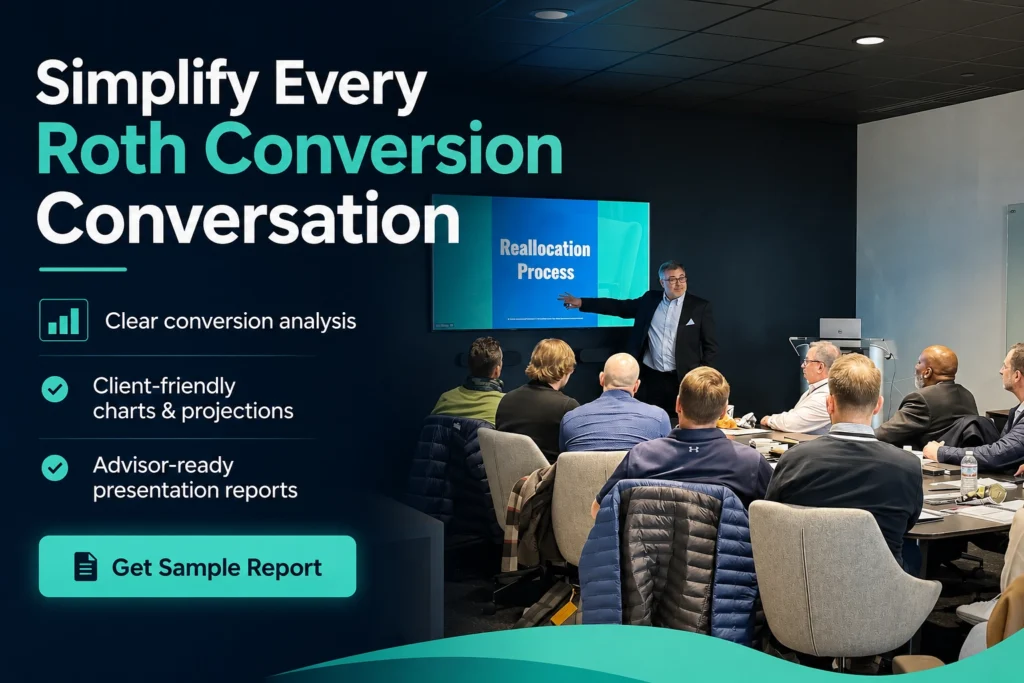
If you’re looking for an easy way to model Roth conversions for legacy assets, check out Stonewood’s Legacy Done Right software. It was built to evaluate all the scenarios above, and help your clients move forward with confidence.
Charitable Remainder Trusts as a Stretch Replacement
For clients who are charitably inclined and have large IRA balances, a Charitable Remainder Trust can function as a stretch replacement for the beneficiaries. Here’s how it works at a high level.
The IRA owner names a CRT as the beneficiary of some or all of the IRA. At the owner’s death, the IRA balance transfers to the CRT without creating immediate income tax because the CRT is a tax-exempt entity. The CRT then pays a unitrust or annuity income stream to named individual beneficiaries (typically the donor’s children) for a term of years or for life. At the end of the income term, whatever’s left in the CRT passes to a qualified charitable beneficiary.
The effect is that the children get a stretched income stream from the IRA dollars, the charity eventually gets the remainder, and the donor satisfies a legacy plus charitable intent at the same time. The rules around CRTs are technical (the charitable remainder has to pass a present-value test, the payout rate has limits, and the trust documents have to be drafted correctly), so this move requires a tax attorney who knows CRTs specifically. Done well, it’s one of the cleanest stretch replacements in the code.
CRTs aren’t the only charitable tool worth a conversation. For clients who are charitably inclined but don’t need a full trust structure, a Donor Advised Fund (DAF) can absorb a large IRA distribution or year-end gift and let the client direct grants to charities over time, while still capturing the deduction in the year it’s most valuable. And for clients already taking RMDs, Qualified Charitable Distributions (QCDs) let them send IRA dollars directly to a qualified charity, satisfying some or all of the RMD without adding a dime to taxable income. DAFs and QCDs won’t replicate a multi-decade stretch the way a CRT can, but for clients with smaller charitable goals or who simply want to offset RMD income every year, they’re often the simpler starting point.
Life Insurance as a Tax-Free Wealth Transfer Layer
Some clients use part of their IRA during their lifetime to fund life insurance. The RMDs or other withdrawals come out of the IRA, get taxed, and the after-tax proceeds are used as premiums for a permanent life insurance policy. The policy can be owned by an irrevocable life insurance trust (ILIT) or directly by the client. At the client’s death, the life insurance death benefit passes to the beneficiaries income-tax-free under IRC Section 101.
Over time, the IRA balance shrinks (the client is deliberately spending down the IRA during their lifetime through policy funding) and the life insurance death benefit can even potentially grow. The beneficiaries end up inheriting fewer traditional IRA dollars (which would have been taxed under the 10-year rule) and more life insurance dollars (which pass tax-free). For the right client profile, the after-tax legacy math is significantly better. And some life insurance policies come with long-term care or chronic care benefits that can be helpful to the policy owner in situations of need.
For some clients, it may even make sense to blend the life insurance and Roth IRA strategies. In these cases, the client converts a portion of their IRA to a Roth, and uses a portion of their IRA as withdrawals to fund a life insurance policy. The result can have a “best of both worlds” outcome for the right client: an immediate death benefit and the value of Roth account growth over time.
For a deeper dive on this strategy, watch the webinar recording linked on our resources page.
The 2026 $15 Million Estate Exclusion Under OBBBA
The One Big Beautiful Bill Act made the higher estate and gift tax exclusion permanent at $15 million per person starting in 2026 under IRC Section 2010. For higher-net-worth families, this means the federal estate tax may no longer be the concern it used to be. A married couple can pass roughly $30 million through combined exclusions without triggering federal estate tax.
What this changes for legacy IRA planning is the motivation. The old planning framework was worried about estate tax reducing the inheritance. The new planning framework is worried about income tax reducing the inheritance when heirs distribute from an inherited IRA under the 10-year rule. Different problems, but we can leverage some of the same solutions. Clients with estates under $15 million who used to focus on estate tax moves should now focus on income tax moves, and tax-free conversions are often the highest-value tool.
Five Legacy Planning Conversations Advisors Should Have This Year
Here’s my short list of five legacy conversations advisors can have with clients in 2026.
- Project the after-tax value of the current IRA under the 10-year rule using realistic beneficiary tax rates. Show the client the number. Nothing focuses a client faster than seeing the beneficiary’s likely tax bill in writing.
- Evaluate a potential Roth conversion over multiple time periods. Help your client understand that it’s not just the decision to convert but the decision how to convert that can drive success. Discuss the benefits and drawbacks of a 3-year, 5-year, and 7-year conversion – or whatever conversion period meets your client’s needs.
- Review beneficiary designations across all account types. Traditional IRAs, Roth IRAs, brokerage accounts, and life insurance should be coordinated, not defaulted.
- For charitably inclined clients, model the CRT option and the QCD option side by side. QCDs satisfy RMDs without tax, and CRTs can potentially create stretched income streams that the 10-year rule can’t.
- Start the life insurance conversation with clients who have a real desire for a tax-free death benefit. When it comes to leaving a legacy, life insurance is often perfectly poised to meet your client’s needs.
For the full technical breakdown of the 10-year rule, read our stretch IRA rules SECURE Act guide. For the complete map of SECURE 2.0 IRA changes in effect in 2026, see our SECURE Act 2.0 IRA changes rundown. For the broader 2026 retirement tax picture, read our tax changes retirement 2026 overview, and for the legislative risk factors that keep me up at night, see our legislative risk retirement guide.
If you want to run these scenarios inside software built for advisor-client conversations, schedule a Stonewood demo and we’ll show you how our Legacy Done Right module handles beneficiary coordination, conversion sequencing, and legacy projection side by side. Doing this work by hand is a losing battle. Doing it inside a tool that runs the numbers correctly every time is the difference between a plan that holds up under scrutiny and one that doesn’t.
This article does not constitute tax, legal, or financial planning advice. Stonewood Financial is not a securities-licensed firm. Legacy planning and inherited IRA decisions should be made in consultation with a qualified tax advisor, estate attorney, and financial professional based on your specific situation.
Frequently Asked Questions
Is a traditional IRA still a good asset to leave to my children?
Under the SECURE Act 10-year rule, a traditional IRA is often a poor asset to leave to non-spouse beneficiaries because the entire balance has to come out within ten years and every distribution is taxed as ordinary income to the beneficiary during what are usually their peak earning years. Roth IRAs, life insurance, and appreciated brokerage assets with a step-up in basis are generally better legacy assets under current rules.
What’s the best strategy to minimize the legacy tax hit on a traditional IRA?
Lifetime Roth conversions are usually the highest-value move. Filling up the owner’s current tax brackets each year and shifting balances to Roth reduces the future traditional IRA balance that will hit the 10-year rule and builds a Roth balance that passes more efficiently. Conversions should respect IRMAA cliffs, OBBBA senior deduction phase-outs, and Social Security taxation thresholds.
How does the 2026 $15 million estate exclusion affect IRA legacy planning?
The permanent $15 million per-person estate exclusion under OBBBA removes federal estate tax from the planning equation for most families. The remaining concern is income tax on inherited IRAs under the 10-year rule, which is a different problem solved primarily through lifetime Roth conversions and coordinated beneficiary planning.
Can a charitable remainder trust replace the old stretch IRA?
For charitably inclined clients, a Charitable Remainder Trust named as IRA beneficiary can function as a stretch replacement. The CRT receives the IRA balance tax-free at the owner’s death, pays an income stream to individual beneficiaries for a term of years or for life, and passes the remainder to a charitable beneficiary. The rules are technical and require a tax attorney to draft correctly.
Should I use life insurance as part of a legacy plan alongside my IRA?
For clients with a legitimate need for permanent life insurance and the cash flow to fund it, life insurance can layer a tax-free death benefit under IRC Section 101 alongside an IRA legacy plan. It’s a tax-treatment trade, not a performance comparison. Advisors need to be honest about the costs of permanent insurance and the specific situations where the after-tax legacy math improves.
What’s the difference between inheriting a Roth IRA and a traditional IRA?
An inherited Roth IRA is subject to the 10-year rule but has no annual RMD requirement in years 1 through 9 because Roth owners have no lifetime Required Beginning Date. Beneficiaries can let the Roth compound tax-free for the full ten years and take the whole balance out tax-free at the end. Inherited traditional IRAs are taxed as ordinary income on each distribution and typically require annual RMDs in years 1 through 9 when the owner had already started RMDs.
Sources and References
- SECURE Act of 2019, Public Law 116-94, Section 401, modifications to required minimum distribution rules for designated beneficiaries. congress.gov.
- Internal Revenue Service, Final Regulations T.D. 10001, Required Minimum Distributions, July 2024. irs.gov.
- Internal Revenue Service, Publication 590-B, Distributions from Individual Retirement Arrangements (IRAs). irs.gov.
- Internal Revenue Code Section 401(a)(9), required minimum distribution rules for qualified plans and IRAs. law.cornell.edu.
- One Big Beautiful Bill Act, Public Law 119-21 (2025), senior deduction and estate exclusion provisions. congress.gov.
- Internal Revenue Code Section 101, exclusion of life insurance proceeds from gross income. law.cornell.edu.
- Internal Revenue Code Section 2010, unified estate and gift tax credit. law.cornell.edu.
- Tax Foundation, analysis of OBBBA estate and income tax provisions, August 2025. taxfoundation.org.
- Internal Revenue Service, Publication 559, Survivors, Executors, and Administrators. irs.gov.
About the Author
Strategy expertise and training that actually moves the needle. Neil sees the big opportunities coming - and develops tools to let you take advantage of them.