Your clients have one advantage many retirees squander: time to plan.
Once a client retires, the window to implement tax-saving strategies narrows fast. RMDs start in your 70s. Medicare surcharges kick in. Estate taxes loom. The difference between a retiree who optimizes taxes and one who doesn’t costs thousands, sometimes hundreds of thousands, of dollars over the next 20 years.
Here’s what most advisors miss: retirees often don’t even know about the tax-saving strategies that are most important as they approach retirement. The math can be different. The rules can be different. The window to act can definitely be different. In this article, I’ll cover seven tax strategies that could serve your clients – and show you the real numbers, 2026 tax brackets, and specific action steps you can take with your clients today.
Why Tax Planning Matters More in Retirement Than During Working Years
Your clients spent 40 years in the accumulation business. For many of them, tax planning was straightforward: max out their 401(k), get the match, let it grow. Simple. But in retirement, the game changes completely.
The Window to Act Shrinks
In your working years, you have time to recover from tax inefficiencies. If you didn’t save your earn $200K, pay too much in taxes, and you earn another $200K next year to make it up. In retirement, there’s no next paycheck. The assets you have are the assets you get. A bad tax decision in year one of retirement compounds across two decades.
RMDs Force Taxable Income
Starting in your 70s under SECURE 2.0, your clients face required minimum distributions from traditional IRAs and 401(k)s. As the name suggests, they’re not optional. The IRS mandates a distribution percentage based on their age and account balance. For someone with $1.2M in IRAs, the first RMD at 75 is roughly $45,000. That income might push them into a higher tax bracket, trigger Medicare surcharges, or both. Many retirees haven’t planned for this.
Medicare IRMAA Fees Start
Modified adjusted gross income above roughly $106,000 single or $212,000 married triggers Income-Related Monthly Adjustment Amounts (IRMAA) fees once your client elects Medicare. These surcharges add to Medicare Part B and Part D premiums. Many savers have never even heard of IRMAA until they are hit with that fee in retirement. A $50,000 Roth conversion might seem smart until you realize it adds $960 per year in Medicare surcharges for two years due to the lookback rule.
Estate Tax Exemptions Sunset
The TCJA estate tax exemption sits around $13.61M per person in 2025, but that’s temporary. Without Congressional action, the exemption drops roughly in half starting 2026. For clients with $5M or more in assets, this creates urgency around legacy planning they may have ignored for years.
Tax planning in retirement differs fundamentally from working years because retirees have a fixed asset pool, mandatory RMDs, Medicare income restrictions, and a compressed planning window. Most advisors address 2-3 tax strategies. The comprehensive approach uses 7.
Strategy 1: Tax Bracket Management (The Foundation of Retirement Tax Planning)
Your client retires at 62. Their pension and Social Security start in a few years. Until they do, they have a window where their income is artificially low. That window exists for a reason: to fill the lower tax brackets before mandatory income arrives.
How It Works
2026 federal tax brackets for single filers are 10% up to $11,600, then 12% from $11,601 to $47,150, then 22% from $47,151 to $100,525, and so on. For a married couple, the 12% bracket extends to $47,150, the 22% bracket to $100,525. That’s real tax-free space if your client is retired, not yet taking Social Security, and has discretionary income to deploy.
A 62-year-old with $800K in a traditional IRA and no current income can strategically withdraw money to fill these lower brackets every year until age 70. At age 70, when Social Security starts ($3,600 per month) and pension arrives ($2,400 per month), they have $72K in annual income. They can’t fill brackets anymore. But from 62 to 70, they can.
Real Example
62-year-old, single, retiring with $800K in a traditional IRA. No other income until age 70. 2026 single filer 22% bracket threshold is $100,525. Standard deduction is roughly $15,700. That means our client can withdraw up to $85K per year from age 62 to 70 and stay in the 12% bracket. At 12% instead of 22%, that’s $8,000 in taxes saved per year, or $80,000 over eight years. That’s not a strategy most advisors mention. That’s money on the table.
Free Retirement Tax Guide
The 5 Retirement Tax Surprises Your Prospects Won't See Coming
Download 5 Ways Taxes Can Rise in Retirement and uncover the often-overlooked tax risks that can reduce retirement income. It's a simple, powerful resource for starting more meaningful tax conversations with prospects and clients.
Free Advisor Training
Turn Roth Conversations Into Revenue
Watch this complimentary training to learn how leading advisors use retirement tax concerns to create urgency, open Roth conversion conversations, and uncover valuable new planning opportunities.
Video Training
Create urgency around tax planning
Open more Roth conversion conversations
Uncover new planning opportunities
Get Your Free Copy
The Roth Conversion Connection
When your client is filling lower brackets, that’s the same window to execute Roth conversions cheaply. Convert at 12% today, and that money grows tax-free forever. Don’t convert at 22% or 24% in future years when Social Security and pensions push bracket up. The math always favors filling brackets first, then converting.
For a client in a 12% bracket with significant IRA assets, filling lower brackets is often cheaper than waiting until RMDs force higher brackets. This is the overlooked foundation of retirement tax planning.
Strategy 2: Roth Conversions in Early Retirement (The Gap Years)
Your client retires at 60. They’ll take Social Security at 70. RMDs don’t start until 75. That’s a 15-year window where the IRS doesn’t force income, but the IRS will allow them to convert at will. This gap is the most powerful tax opportunity in retirement.
Why Gap Years Matter
Starting at age 75, RMDs are mandatory. The IRS wants its taxes. If your client waits until 75 and then tries to convert, they’re converting at the worst possible time: when RMDs are already forcing them into a high bracket. Conversion at 22% is expensive. Conversion at 32% or 35% is brutal.
The gap years from 60 to 75 are the window to convert at low brackets before mandatory distributions arrive. Most retirees waste this window.
Real Scenario
55-year-old retires with $1.2M in a traditional IRA and $800K in taxable savings. Takes no income until 70. Can convert $50K per year from the IRA, pay tax at 12% bracket rate ($6,000 per year), and over 15 years converts $750K to Roth at an average tax cost of 12%. That $750K in Roth grows tax-free forever. At age 75, no RMD is ever due on that $750K. No IRMAA impact. No estate tax on that growth.
Compare that to the retiree who converts nothing. At 75, they have a $1.2M IRA, RMDs force distributions, and that money comes out at 22%, 24%, or higher brackets. The difference in lifetime taxes: $150,000 to $200,000.
Medicare IRMAA Consideration
Conversions trigger IRMAA surcharges due to the two-year lookback rule. A $50K conversion in 2026 increases MAGI for 2028 Medicare premiums. Your client might pay an extra $480 in surcharges that year. Net cost of conversion: $6,480 in tax plus $480 in surcharges. The long-term Roth benefit still outweighs the short-term surcharge cost, but the client needs to know both numbers.
Gap years from early retirement to RMD age (75) are the optimal window for Roth conversions at low tax brackets. Most retirees never exploit this window.
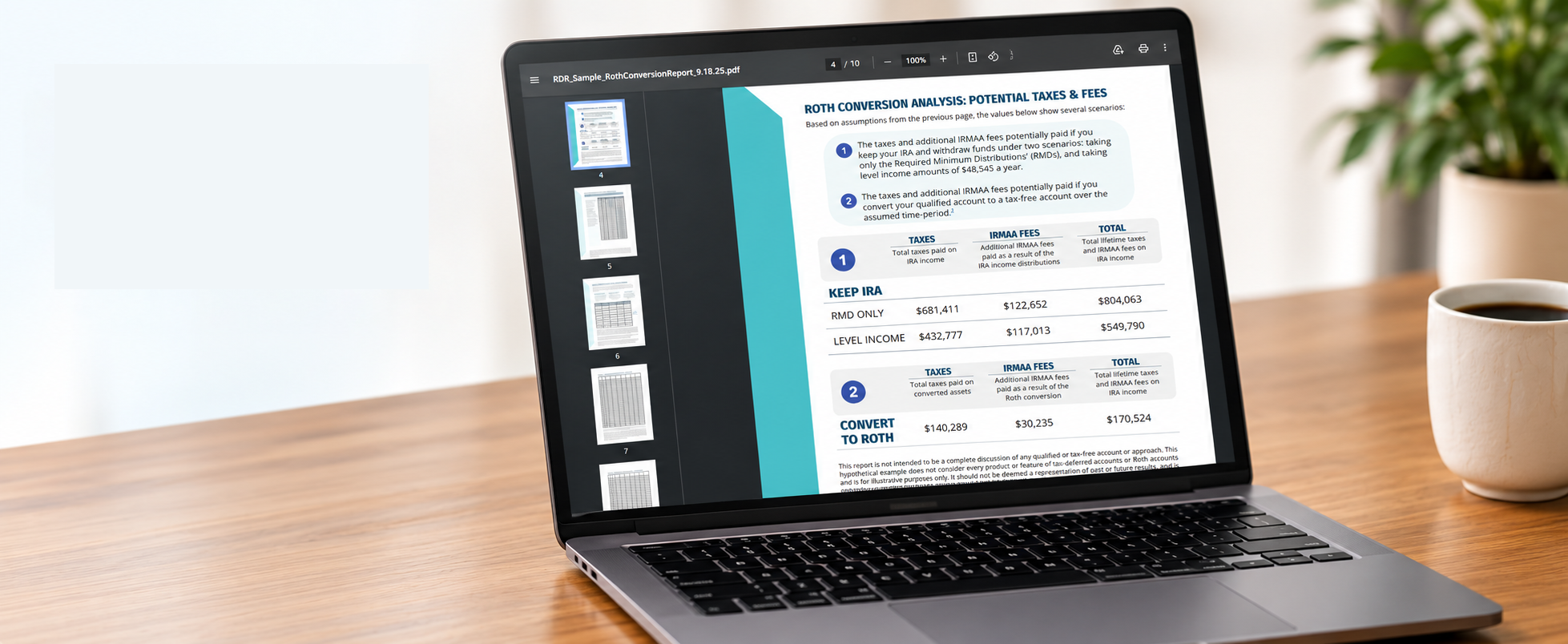
Show your client the exact conversion timeline and tax bracket impact with Roth Analysis Software.
Strategy 3: RMD Optimization (Using SECURE 2.0 Changes to Your Client’s Advantage)
SECURE 2.0 pushed RMD start age from 72 to 75. Your older clients got a few extra years. But most advisors stop there. The real strategy is using the delay to reshape the entire RMD stream.
How SECURE 2.0 Changed the Game
Under the old rules, your client had to start withdrawing at 72. The first RMD was roughly 3.7% of the prior year-end balance. That’s mandatory income hitting the tax return whether they need it or not.
Under SECURE 2.0, RMDs don’t start until 75. That gives your client three extra years to let assets grow, to execute Roth conversions, and to strategically position their accounts.
The RMD Optimization Strategy
From 60 to 75, your client converts strategically to Roth. This reduces the traditional IRA balance. At 75, when RMDs finally start, the balance is smaller. The mandatory distribution percentage (roughly 4.3% at age 75) applies to a lower base. Result: smaller RMDs for life.
Example: $1.2M IRA at age 60. If your client never converts and waits until 75, RMD at 75 is roughly $51,600 per year. If your client converts $50K per year from 60 to 75 (costing roughly $6K per year in taxes), the IRA balance at 75 is $450K, and RMD is $19,350. That’s $32,250 less in mandatory taxable income every single year. Over 20 years of retirement, that’s $645,000 in lower taxable income.
Using gap years to convert strategically before RMDs start can reduce future RMD amounts by 30%, 40%, or even 50%. This is the hidden benefit of SECURE 2.0 that most advisors never explain.
Your client wants to give to charity. Without a QCD, they withdraw $10,000 from their IRA, pay tax on it, and donate it. Tax bill: $1,200 at a 12% rate. Net to charity: $8,800.
With a QCD, the $10,000 goes directly from their IRA to the charity. Tax bill: $0. Net to charity: $10,000. Same donation, $1,200 saved.
The Numbers
QCDs allow retirees age 70 and older to distribute up to $105,000 per year directly from their IRA to a qualified charity (adjusted for inflation annually). The distribution doesn’t count as taxable income, doesn’t trigger IRMAA surcharges, and doesn’t force the client to itemize deductions.
For a 75-year-old charitably inclined client with a $1.5M IRA, QCDs can move $105K per year to charity with zero tax consequence. Over 10 years, that’s $1.05M in charitable giving with no income tax. For comparison, withdrawing $1.05M to donate it would cost $200K to $300K in taxes depending on brackets and IRMAA impacts.
The Strategy Positioning
QCDs should be the first move for your client’s RMD. If they’re going to receive an RMD anyway, and they give to charity, the optimal strategy is QCD to charity first (up to $105K), then take remaining RMD in taxable cash if needed. This minimizes the total taxable income hitting the return.
For charitably inclined retirees over 70, QCDs are the tax-free way to make gifts and reduce RMDs simultaneously. Most advisors mention QCDs once and move on. Make it a standard strategy for your generous clients.
Strategy 5: Tax-Loss Harvesting in Retirement (The Overlooked Strategy)
Your clients think tax-loss harvesting is a wealth-management strategy for 35-year-olds with $1M portfolios. They’re wrong. Retirees benefit more from tax-loss harvesting than anyone.
How It Works in Retirement
Your client has a taxable brokerage account with $300K. It’s down $40K from highs due to market volatility. They need to withdraw $15K for living expenses. They can either sell winners (triggering capital gains) or harvest losses and offset gains elsewhere.
Harvest the $40K loss, offset any capital gains in the account, and if losses exceed gains, up to $3,000 of excess loss can offset ordinary income (interest, dividends, RMD, Social Security taxation). Carry forward remaining losses to future years.
Real Impact
Retiree, age 72, receiving $40K RMD, $15K in pension, $20K in dividends, $2K in interest. That’s $77K in ordinary income. If they harvest $30K in losses from their account, they offset gains and ordinary income, potentially reducing taxable income to $50K. At a 22% bracket, that’s $5,940 in tax savings, plus the retiree still has the $30K in harvested positions immediately available to reinvest (just in a slightly different security to avoid wash-sale issues).
Tax-loss harvesting is not just for young accumulators. Retirees with taxable accounts should harvest losses annually to offset RMDs, dividends, and ordinary income.
Strategy 6: Medicare IRMAA Planning (The Two-Year Lookback Weapon)
Your client’s income in 2024 determines their Medicare premiums in 2026. That two-year lag is the window to plan. Most retirees don’t know their 2024 income affects their 2026 Medicare bill until the bill arrives.
How IRMAA Thresholds Work
In 2026, Medicare Part B standard premiums are roughly $185 per month. But if MAGI exceeds $106,000 (single) or $212,000 (married), surcharges apply. The surcharge starts at $65/month and escalates by income tier. At $160K MAGI, surcharge jumps to $195/month. At $210K, it’s $325/month.
That’s not a tax. That’s a de facto income cap built into Medicare. Your client can’t earn beyond $106K without paying more. Except: they can plan around it.
The Strategy
In years where you’re planning a Roth conversion or taking discretionary income, model the MAGI impact two years forward. If a $50K conversion in 2026 pushes MAGI above $106K, surcharges hit in 2028. Cost of conversion: $6,000 in tax plus $480-$960 in surcharges. Is it worth it? Usually yes. But your client needs to know the full cost before committing.
For clients near the IRMAA threshold, the two-year lookback means you can time income strategically. Skip the $30K conversion in a year where you already hit the surcharge threshold. Do it the next year when the high-income year ages out of the lookback window.
IRMAA surcharges are income-triggered penalties that retirees can plan around using the two-year lookback rule. Model conversions and distributions two years forward to calculate true after-surcharge cost.
Strategy 7: Asset Location and Withdrawal Sequencing (Which Accounts to Draw From First)
Your client has $400K in a taxable account, $800K in a traditional IRA, and $200K in a Roth IRA. They need $60K per year for living expenses. Which account do they draw from first? Most retirees guess wrong.
The Hierarchy
The tax-efficient withdrawal sequence is: taxable account first (no tax consequences, just cap gains on the appreciated portion), then traditional IRA/401(k) (entire withdrawal is taxable), then Roth (never taxable, preserves tax-free growth).
The reasoning: draw taxable accounts while the client is still in a low bracket before RMDs force high brackets. Preserve Roth for later years when brackets are higher. Let traditional IRAs grow longer (if possible) before RMDs force them out.
Real Math
62-year-old needing $60K per year from age 62 to 75 (14 years, $840K total). At 62, they’re in a 12% bracket. At 75, RMDs force them to 24% bracket. Drawing from taxable first (ages 62-70) while in low brackets, then traditional IRA (ages 71-75), then Roth (ages 75+) preserves Roth growth and minimizes overall tax.
If they reverse the order and draw Roth first, they waste the tax-free growth power of Roth in years when they had access to lower-taxed alternatives. Sequence matters.
Withdrawal sequencing should prioritize taxable accounts first, traditional accounts second, and Roth last. This preserves tax-free growth and aligns withdrawals with evolving tax brackets.
How Advisors Present Tax Planning to Clients (The Conversation Framework)
You’ve got seven strategies. Your client has a glazed look. Here’s how to walk through tax planning without overwhelming them.
Start with the Problem, Not the Solution
Don’t open with ‘I want to discuss tax planning strategies.’ Open with: ‘If we do nothing, here’s what your tax bill will look like in 10 years.’ Show them the number. A client facing a $280K tax bill over 10 years suddenly cares about tax strategy.
Show the Biggest Win First
For most retirees, bracket-filling and Roth conversions in early retirement solve 60% of the tax problem. Lead with those two. After the client sees the magnitude of that win, they’re ready for the nuanced strategies.
Use Real Numbers from Their Situation
Generic examples are forgettable. Custom examples are powerful. ‘You have $1.1M in IRAs, $400K in taxables, and $50K in Roth. If we fill your 12% bracket every year until 70, and convert $50K per year, here’s what that looks like.’ Now you’re talking about their money, their situation, their future.
Address Objections Head-On
Objection: ‘I don’t want to pay taxes now to save taxes later.’ Response: ‘You’re not choosing between paying tax now or later. You’re choosing between paying 12% now or 24% later. Same dollar, different bracket. The math is simple.’
Objection: ‘I want to minimize RMDs.’ Response: ‘We do that by converting strategically before RMDs arrive. That’s the entire point of Strategy 3. Let me show you the model.’
Tax planning conversations win when you show real numbers, start with the problem, and address objections directly. Avoid the temptation to present all seven strategies at once.
Comparison Table: 7 Strategies at a Glance
Strategy
Who Benefits
Tax Savings Potential
Implementation Complexity
Tax Bracket Management
Early retirees (60-70) with discretionary IRA access
$8K-15K/year per client
Low
Roth Conversions in Gap Years
Age 60-75, before RMDs start
$100K-300K lifetime
Medium (tax & Medicare modeling)
RMD Optimization
Any retiree with large IRAs
$30K-100K+ lifetime
Low
Qualified Charitable Distributions
Age 70+, charitably inclined
$1K-20K/year per client
Very Low
Tax-Loss Harvesting
Retirees with taxable accounts
$2K-8K/year per client
Low
Medicare IRMAA Planning
Age 65+, high income retirees
$500-2K/year per client
Medium (lookback modeling)
Asset Location & Withdrawal Sequencing
All retirees with multiple account types
$5K-50K/year per client
Low
Frequently Asked Questions
When should a retiree start thinking about tax planning?
The moment they retire. Ideally, you’re planning tax strategy in the year before retirement, modeling whether it’s better to retire in December or January, whether to take a partial-year RMD, and so on. Tax planning in retirement starts before retirement ends.
Does tax-bracket filling work if the client has significant Social Security?
Yes, but the math changes. Social Security doesn’t count fully as income (only 85% is taxable, and even that depends on income thresholds), but pension and Roth conversion income do. The key is calculating the true MAGI after Social Security taxation rules. You fill available bracket space after accounting for Social Security.
What if my client is already past 75 and hasn’t done any Roth conversions?
You’ve missed the gap-year window, but you still have strategies. Implement QCDs if charitably inclined, optimize the withdrawal sequence to minimize IRMAA, and ensure RMDs are withdrawn efficiently. The loss of gap-year conversion opportunity is significant, but it doesn’t eliminate every tax strategy.
Can my client still do a Roth conversion if they’re already taking RMDs?
Yes. They can convert and take an RMD from the same traditional IRA. The RMD is required, and conversions are separate and voluntary. This is the strategy for clients aged 75+ who weren’t able to convert earlier. The conversion still happens at their highest bracket, which is less optimal, but it still happens.
What’s the difference between an IRMAA surcharge and a tax?
IRMAA surcharges are Medicare premium surcharges, not income tax. They’re added to your Part B and Part D premiums if your MAGI exceeds threshold. They’re de facto income restrictions, but they’re not IRS taxes. You can strategically manage them with two-year planning because they’re based on lagged income.
If my client donates $100K to charity, should they do it through a QCD or regular withdrawal?
QCD every time if they’re 70+. QCD is $100K to charity, zero income tax, zero IRMAA impact. Regular withdrawal is $100K to charity, but $100K of income tax exposure (at their marginal bracket, likely $22K-32K in taxes), plus two-year IRMAA surcharge impact. QCD is always superior for qualified clients and qualified charities.
Key Takeaways for Advisors
Most retirees have access to seven tax strategies. Most advisors use two. The gap is where you differentiate.
Tax bracket management and Roth conversions in early retirement solve 60% of the retirement tax problem. These should be your starting point.
SECURE 2.0 RMD changes (pushing start age to 75) created a 15-year conversion window. Clients who exploit it save six figures. Clients who don’t waste it.
Medicare IRMAA surcharges create a de facto income cap around $106K-$160K. Clients need to model conversions and distributions two years forward to know the true after-surcharge cost.
QCDs are the most underused high-impact strategy. For clients over 70 who give to charity, QCDs are automatic.
Withdrawal sequencing matters at every stage of retirement. Taxable first, traditional second, Roth last preserves tax-free growth power.
Free Study Group Replay
How Stonewood Advisors Stay Ahead of the Next Planning Conversation.
Watch a recent Stonewood Study Group focused on the legacy planning conversation. You’ll see how Stonewood helps advisors break down timely planning topics, client conversation angles, and practical strategies you can put to use immediately.
Strategy expertise and training that actually moves the needle. Neil sees the big opportunities coming - and develops tools to let you take advantage of them.
Real Advisors. Real Results.
See how advisors are using Stonewood software to win larger cases and deliver better
outcomes for their clients.
An advisor was working with a prospect who was a real "do-it-yourselfer" when it came to Roth conversions.
The client was converting assets up their existing tax bracket – and hadn't considered any impact to
IRMAA.
With Roth Done Right, the advisor was able to show an alternate pattern that sped up the conversion to
6 years. The new structure offered $30,000 savings in conversion taxes – a 20% reduction on the
prospect's conversion tax bill. The report also showed hundreds of thousands of dollars in long-term
tax and IRMAA savings from the converted assets – an amount the prospect hadn't been able to quantify
on his own.
Outcome
A new client with $1M in new AUM, and a $1M FIA sale to fund the conversion process.
An advisor was working with a prospect who already had assets with Ken Fisher. Fisher's team presented a
5% systematic withdrawal projection, so the advisor needed a stronger way to frame the income
conversation.
Using the Annuity Alpha report, the advisor showed how an annuity could deliver over 8% in annual cash
flow with lifetime income, plus a long-term care doubler. The contrast was clear enough that the prospect
moved forward.
Outcome
$1.5M placed and a $100K in new business revenue.
An advisor was working with a 58-year-old couple with an established, well-funded retirement income plan,
leaving an additional $3M IRA to build out a legacy for the kids. The couple's existing advisor had no
real additional plan for this money, other than to keep it in their managed account and grow that money as
much as possible for the kids.
Using the Legacy Done Right report, the advisor showed the need for tax planning on this $3M IRA.
According to the advisor, the simple analysis "opened up the wallet" to the Roth conversion story. The
advisor then used the blended Roth/Life feature in the report to show a blend of Roth Conversion assets
with some Life Insurance to help maximize the client’s legacy.
Outcome
$3M in motion. The advisor picked up a $1.5M FIA sale that will be converted to Roth. And the advisor
also sold a 5-Pay Protection focused IUL policy at $225,000 of premium per year.
An advisor group incorporated the Total Tax Burden report into the strategy presentation for all new
prospects. They ran the tax snapshot for every new client as part of their first meeting conversation,
quantifying the growing tax burden of IRA money – and illustrating the kinds of tax savings possible
when working with their firm.
Starting in January of 2023, this simple analysis was presented to every single prospect who walked in
the door. The goal was to differentiate their practice and drive overall revenue growth through various
Roth conversion strategies.
Outcome
From 2022 to 2025, new annual AUM rose from $5M to $50M. Annual FIA sales rose from $3M to $35M.
And annual life premium rose from $50K to $1M.