A backdoor Roth IRA is a legal strategy that lets higher-income earners fund a Roth IRA even when they’re above the direct Roth contribution limits. The client contributes after-tax money to a traditional IRA, then converts that balance to a Roth. The contribution isn’t deductible, but once inside the Roth the money grows tax-free. The strategy remains legal in 2026. What trips most advisors up isn’t the steps, it’s the pro-rata rule and the timing. This guide walks through how the strategy works, who it fits, and where the tax traps hide.
Quick note before we dig in: Stonewood builds tax analysis software for financial advisors. We’re not CPAs, and nothing in this article is tax advice for an individual client. This article is sharing generally-available knowledge only. Every backdoor Roth conversation should eventually land on the desk of a qualified tax professional who knows the client’s full situation.
With that out of the way, here’s how to think about the backdoor Roth in 2026.
Close More Business with Stonewood Reports
Easy to run. Easy to present. Pick the report that fits your next client conversation and we'll send a sample to your inbox immediately.
Roth Done RightTax & IRMAA Analysis
Annuity AlphaFIA vs. Managed Account
Legacy Done RightLife Insurance Analysis
Total Tax BurdenRetirement Tax Snapshot
How the Backdoor Roth Works
The strategy itself is simple. The IRS rules around it are precise. For the sequence to work cleanly, the client has to follow the steps in order and finish the conversion before the calendar year closes.
Step 1: Contribute after-tax money to a traditional IRA.
The client opens (or uses) a traditional IRA and contributes up to the annual IRA contribution limit. Confirm the exact limit on the IRS website each year, since it adjusts for inflation. This contribution is made with after-tax dollars. The client does not deduct it.
Some advisors worry this step creates a tax bill – it doesn’t. The money simply sits in the traditional IRA as a non-deductible basis.
Step 2: Convert to a Roth IRA.
Within days, the client instructs the custodian to convert the traditional IRA balance to a Roth IRA. Most custodians process conversions in 3 to 5 business days. The sooner the better. Delays between the contribution and the conversion open the door to small gains or losses, and can muddy the pro-rata math if other IRA balances shift.
Step 3: Report the conversion on the tax return.
File Form 8606 with the tax return to report the non-deductible contribution and the Roth conversion. This form establishes the basis (the after-tax amount) that moved into the Roth. Without it, the IRS may have no record that the money was non-deductible, which can create audit risk and potential tax liability down the road.
Free Advisor Training
Turn Roth Conversations Into Revenue
Watch this complimentary training to learn how leading advisors use retirement tax concerns to create urgency, open Roth conversion conversations, and uncover valuable new planning opportunities.
Video Training
Create urgency around tax planning
Open more Roth conversion conversations
Uncover new planning opportunities
Step 4: Let the Roth grow tax-free.
Once the money is in the Roth, it grows tax-free. The client can withdraw earnings tax-free after age 59½ if they’ve held the Roth for at least 5 years. The original contribution itself can be withdrawn any time without penalty. Read our full 2026 guide on Roth conversion rules .
Timing principle: the entire backdoor Roth sequence should wrap up inside the same calendar year. Pro-rata is calculated against the traditional IRA balance as of December 31.
Who the Backdoor Roth Actually Fits
The backdoor Roth exists because the IRS limits who can make direct Roth contributions. Once income crosses the phase-out, the front door closes. The backdoor is the workaround.
2026 Roth IRA income limits.
Direct Roth contributions phase out above certain income thresholds for single filers and married joint filers. The exact numbers adjust each year. Pull the current phase-out ranges from IRS Publication 590-A or the IRS Roth IRA contribution limits page before advising a client on eligibility.
If your client’s income is above the upper phase-out, they can’t contribute directly to a Roth. The backdoor is their path.
Ideal candidates.
The clients who tend to benefit most from a backdoor Roth share a few features:
Higher-income earners with little or no traditional IRA balance.
Business owners and consultants who max solo 401(k) contributions and keep their IRA balance low on purpose.
Younger professionals in their accumulation phase who want to build a Roth foundation early.
Employees at companies that don’t offer a Roth 401(k) option, or offer one with limited contribution room.
Who should think twice.
Clients with large pre-tax IRA balances should run the math carefully. If a client has $400,000 in a traditional IRA and attempts a backdoor Roth, the pro-rata rule can create an unexpected tax bill. That doesn’t mean the strategy is off the table. It means you need to deal with the pre-tax balance first.
The Pro-Rata Rule (Where the Trouble Usually Starts)
The pro-rata rule is the part of the backdoor Roth that some people misunderstand, and it’s where the biggest client surprises can potentially hide.
What the rule actually does.
When a client converts any amount from a traditional IRA to a Roth IRA, the IRS treats all of their traditional IRAs as one combined pool. It then calculates what percentage of that pool is pre-tax (deductible basis) and what percentage is after-tax (non-deductible basis). The client owes income tax on the pre-tax percentage of whatever they convert.
The pro-rata rule applies across traditional IRAs, SEP-IRAs, and SIMPLE IRAs. It does not apply to 401(k) balances, and that’s where the workaround lives.
A worked example.
Here’s what pro-rata can do to a straightforward backdoor attempt.
Say a client has $93,000 in a traditional IRA from an old 401(k) rollover. That balance is entirely pre-tax. They contribute $7,000 in after-tax money to a traditional IRA (a separate contribution), then immediately convert just that $7,000 to a Roth.
They expect the $7,000 conversion to be tax-free. The pro-rata rule says otherwise. Total IRA balance is $100,000. Pre-tax portion is 93 percent. So 93 percent of the $7,000 conversion, or roughly $6,510, counts as taxable income. At a 24 percent federal bracket, that’s around $1,562 in federal tax on what the client thought was a tax-free move.
The math gets worse in a higher bracket. It also gets worse if state income tax applies. Most clients don’t discover any of this until April 15.
Pro-rata in one line: if the client has any meaningful pre-tax IRA balance, the backdoor Roth is not tax-free. The only way to make it tax-free is to clear that pre-tax balance out first.
Pro-rata uses the December 31 balance.
The pro-rata calculation uses the total balance across all traditional IRAs as of December 31 of the conversion year. That’s important. If the client converts in January but the calendar-year-end balance hasn’t been captured, the advisor is flying blind. Many experienced advisors pull December 31 statements from the client’s prior-year IRAs before touching a backdoor Roth strategy.
How to Avoid Pro-Rata Trouble: The 401(k) Rollover Move
If the client has a meaningful pre-tax IRA balance and wants to run a backdoor Roth, there’s a relatively clean workaround: roll the pre-tax IRA balance into the client’s employer 401(k) plan.
The consolidation move.
Many 401(k) plans accept incoming rollovers from traditional IRAs. The client rolls the $93,000 traditional IRA into their employer plan, which brings the traditional IRA balance to $0. From there, a fresh $7,000 non-deductible contribution and immediate conversion runs clean, because there’s no pre-tax IRA balance to trigger the pro-rata rule.
Check the plan documents first.
Not every 401(k) plan accepts incoming rollovers. Some do, some don’t. Self-employed clients with solo 401(k) plans especially need to check plan language. Before recommending the consolidation step, confirm the client’s plan actually allows it.
Mega Backdoor Roth: When Standard Limits Aren’t Enough
For some higher-income clients, the standard backdoor Roth contribution feels small.
Certain employer 401(k) plans offer what’s become known as a “mega backdoor Roth” option that allows after-tax contributions above the standard employee deferral limit. Some plans then permit in-service distributions or in-plan Roth conversions of that after-tax money.
The mechanics are plan-specific. The total amount an employee can funnel into a mega backdoor Roth depends entirely on the plan design, employer match, and whether the plan allows in-service distributions. This strategy is complex enough that we cover it in a dedicated guide. If a client’s plan offers both after-tax contributions and in-service distributions, there may be much larger Roth funding capacity on the table than the standard backdoor allows.
When a client brings up the backdoor Roth, they’ve often heard it from a podcast, a finance blog, or a friend at work. A good financial professional will ask the right questions to show them where the strategy could fit and where it doesn’t.
Here’s a sample conversation flow:
Open with: Do you have any traditional IRAs?
Ask directly about the full IRA portfolio. SEP-IRAs, SIMPLE IRAs, and rollover IRAs all count toward the pro-rata rule. If the client has a large balance, you already know the backdoor Roth comes with real tax complexity. If the client has zero traditional IRA balances, the path is clean.
Next: Has your income actually exceeded the Roth limits?
Confirm the client’s income really does exceed the Roth phase-out. It’s not uncommon for clients to overestimate their income or misremember the limits. If they’re under the phase-out, they can skip the backdoor entirely and contribute directly.
If they qualify: Walk through the steps.
Don’t just say “Do you want to do a backdoor Roth?” Explain the four steps. Tell them it takes about a week. Let them know Form 8606 is required to avoid audit risk. Make clear that you’ll be involved in the process (not just the initial conversation), and help them understand the importance of also working with a qualified tax professional.
The pro-rata warning.
If the client has pre-tax IRAs, the conversation sounds something like: “You have about $93,000 in a traditional IRA. If we run a backdoor Roth without dealing with that balance first, the IRS will tax most of the conversion. Let me show you the options we have to address this.” That move demonstrates you’ve thought through complications they don’t know about yet.
The IRMAA conversation.
Roth conversions can push up modified adjusted gross income (MAGI), and MAGI feeds into Medicare Part B and Part D premium surcharges through a two-year lookback. This matters most for clients close to age 63. The 2026 IRMAA thresholds start around $109,000 MAGI for single filers and $218,000 for married filing jointly for Part B, per the Centers for Medicare & Medicaid Services (CMS). Clients should verify current thresholds directly on the CMS site before running conversion math.
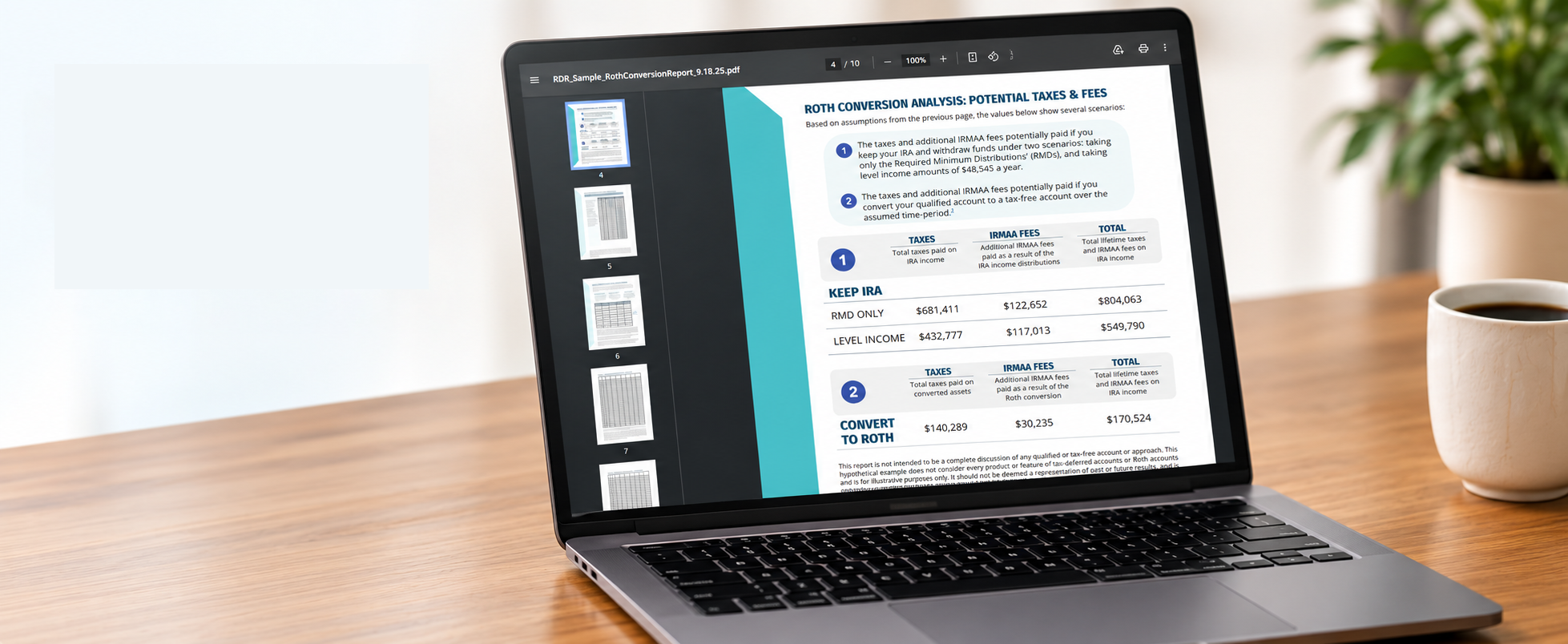
If the client is approaching Medicare eligibility, it’s worth modeling whether the conversion is better this year, next year, or spread across a few tax years. Stonewood’s Roth Done Right software makes these calculations, and can model the short-term IRMAA cost during conversion, and long-term IRMAA cost throughout retirement. In some cases, based on client preference, it may be worth paying additional surcharges now to avoid higher potential surcharge responsibility for years in retirement.
The timing of the conversation.
Backdoor Roth contributions can work best when they’re front-loaded early in lower-income years. A 58-year-old client who retires early has a few years of relatively low taxable income before Social Security and required distributions pick up. Those lower-bracket years are often prime time for conversions.
Frequently Asked Questions
Is the backdoor Roth legal in 2026?
Yes. The backdoor Roth remains legal in 2026. No legislation has eliminated it, despite periodic proposals. The One Big Beautiful Bill Act (OBBBA), signed in July 2025, includes Roth-related provisions but did not impact the backdoor Roth.
What if a saver executes a backdoor Roth and then inherits a pre-tax IRA?
Pro-rata applies to the client’s entire IRA portfolio as of December 31 of the conversion year. Inherited IRAs held in the beneficiary’s name may be treated differently depending on the structure. This is one of several places where a CPA or tax attorney needs to be involved before any action is taken.
Can savers convert just part of my traditional IRA?
Yes, but the pro-rata rule applies to the full balance, not just the slice being converted. If a client has $100,000 across traditional IRAs and converts $30,000, the pro-rata ratio is based on the full $100,000. The client still owes tax on the pro-rata percentage of the $30,000 converted.
How long should the client wait between contributing and converting?
The IRS doesn’t specify a required waiting period. To minimize gain or loss between contribution and conversion, many advisors recommend converting within the same week. Don’t let the contribution sit in the traditional IRA for months.
Does a spouse need a separate backdoor Roth?
If the spouse also exceeds the Roth income limits, yes. Each spouse can contribute up to the annual IRA limit. Each spouse files their own Form 8606. The pro-rata rule applies to each spouse’s own IRA balances, not jointly.
Will a backdoor Roth trigger the alternative minimum tax?
The backdoor Roth itself doesn’t directly trigger AMT, but a large conversion can push income into AMT territory for some clients. If the client is already close to AMT thresholds, model the conversion impact with a qualified tax professional.
What if the custodian is slow to process the conversion?
Market movements between contribution and conversion can create small gains or losses. Keep the contribution and conversion as close together as possible to reduce that noise.
Where Stonewood Fits
The backdoor Roth is straightforward in concept but can have execution risks in practice.
Roth Done Right, Stonewood’s Roth conversion analysis software, can help model the tax impact of conversions based on client beliefs and preferences – and importantly analyzes Medicare surcharges, too.
If you want to see how the software creates more informed client conversations, schedule a demo or request a sample.
Sources and References
Compliance note: This article is educational and is not tax, legal, or investment advice. Stonewood Financial is not a CPA firm or registered investment advisor. All information in this article is general knowledge and widely available. Backdoor Roth conversions involve complex tax rules that vary by individual circumstance. The pro-rata rule, IRMAA implications, and state tax treatment should be reviewed by a qualified tax professional before any client executes the strategy. IRS rules change. Confirm current limits and thresholds directly on irs.gov and cms.gov.
Free Study Group Replay
How Stonewood Advisors Stay Ahead of the Next Planning Conversation.
Watch a recent Stonewood Study Group focused on the legacy planning conversation. You’ll see how Stonewood helps advisors break down timely planning topics, client conversation angles, and practical strategies you can put to use immediately.
Strategy expertise and training that actually moves the needle. Neil sees the big opportunities coming - and develops tools to let you take advantage of them.
Real Advisors. Real Results.
See how advisors are using Stonewood software to win larger cases and deliver better
outcomes for their clients.
An advisor was working with a prospect who was a real "do-it-yourselfer" when it came to Roth conversions.
The client was converting assets up their existing tax bracket – and hadn't considered any impact to
IRMAA.
With Roth Done Right, the advisor was able to show an alternate pattern that sped up the conversion to
6 years. The new structure offered $30,000 savings in conversion taxes – a 20% reduction on the
prospect's conversion tax bill. The report also showed hundreds of thousands of dollars in long-term
tax and IRMAA savings from the converted assets – an amount the prospect hadn't been able to quantify
on his own.
Outcome
A new client with $1M in new AUM, and a $1M FIA sale to fund the conversion process.
An advisor was working with a prospect who already had assets with Ken Fisher. Fisher's team presented a
5% systematic withdrawal projection, so the advisor needed a stronger way to frame the income
conversation.
Using the Annuity Alpha report, the advisor showed how an annuity could deliver over 8% in annual cash
flow with lifetime income, plus a long-term care doubler. The contrast was clear enough that the prospect
moved forward.
Outcome
$1.5M placed and a $100K in new business revenue.
An advisor was working with a 58-year-old couple with an established, well-funded retirement income plan,
leaving an additional $3M IRA to build out a legacy for the kids. The couple's existing advisor had no
real additional plan for this money, other than to keep it in their managed account and grow that money as
much as possible for the kids.
Using the Legacy Done Right report, the advisor showed the need for tax planning on this $3M IRA.
According to the advisor, the simple analysis "opened up the wallet" to the Roth conversion story. The
advisor then used the blended Roth/Life feature in the report to show a blend of Roth Conversion assets
with some Life Insurance to help maximize the client’s legacy.
Outcome
$3M in motion. The advisor picked up a $1.5M FIA sale that will be converted to Roth. And the advisor
also sold a 5-Pay Protection focused IUL policy at $225,000 of premium per year.
An advisor group incorporated the Total Tax Burden report into the strategy presentation for all new
prospects. They ran the tax snapshot for every new client as part of their first meeting conversation,
quantifying the growing tax burden of IRA money – and illustrating the kinds of tax savings possible
when working with their firm.
Starting in January of 2023, this simple analysis was presented to every single prospect who walked in
the door. The goal was to differentiate their practice and drive overall revenue growth through various
Roth conversion strategies.
Outcome
From 2022 to 2025, new annual AUM rose from $5M to $50M. Annual FIA sales rose from $3M to $35M.
And annual life premium rose from $50K to $1M.