The government sure gets creative when it needs more revenue.
And guess where that additional revenue often comes from? That’s right: higher earners and good savers… like our clients.
For years, the Medicare program has been in dire need of additional funds. Congress attempted to address this need in 2003, when, as part of the Medicare Modernization Act, they created IRMAA.
For the uninitiated, IRMAA, or the Income-Related Monthly Adjustment Amount, is an additional surcharge placed on Medicare Part B and Part D premiums for certain higher-earning Americans.
The idea behind IRMAA? An easy way to support the financial solvency of Medicare is by having higher-income Americans pay more for their coverage.
So how has IRMAA impacted savers – and why should you be talking to your clients about it?
Why IRMAA Matters
IRMAA is important to your clients for two reasons – one practical and one philosophical:
Practical: Many of our clients will be subject to IRMAA once they elect their Medicare coverage. IRMAA surcharges start with about $218,000 of income (MAGI) for couples and $109,000 of income (MAGI) for individual filers. Our clients may have income needs that immediately subject them to IRMAA, or our clients may avoid IRMAA while filing jointly, but become subject to IRMAA once one spouse passes away and the surviving spouse is subject to a lower income threshold.
Philosophical: IRMAA has been a tremendous triumph for the Medicare program. This “stealth” new fee is raising significant revenue and keeping the Medicare Part B and D trust funds solvent. IRMAA represents, in my opinion, a new wave of government revenue generation. Congress has found a way to generate additional funding for government programs without changing tax bracket rates! I believe we’ll see more income-related fees and taxes created in IRMAA’s image going forward.
So where are IRMAA rates headed – and how should our clients prepare?
A Little Historical Perspective
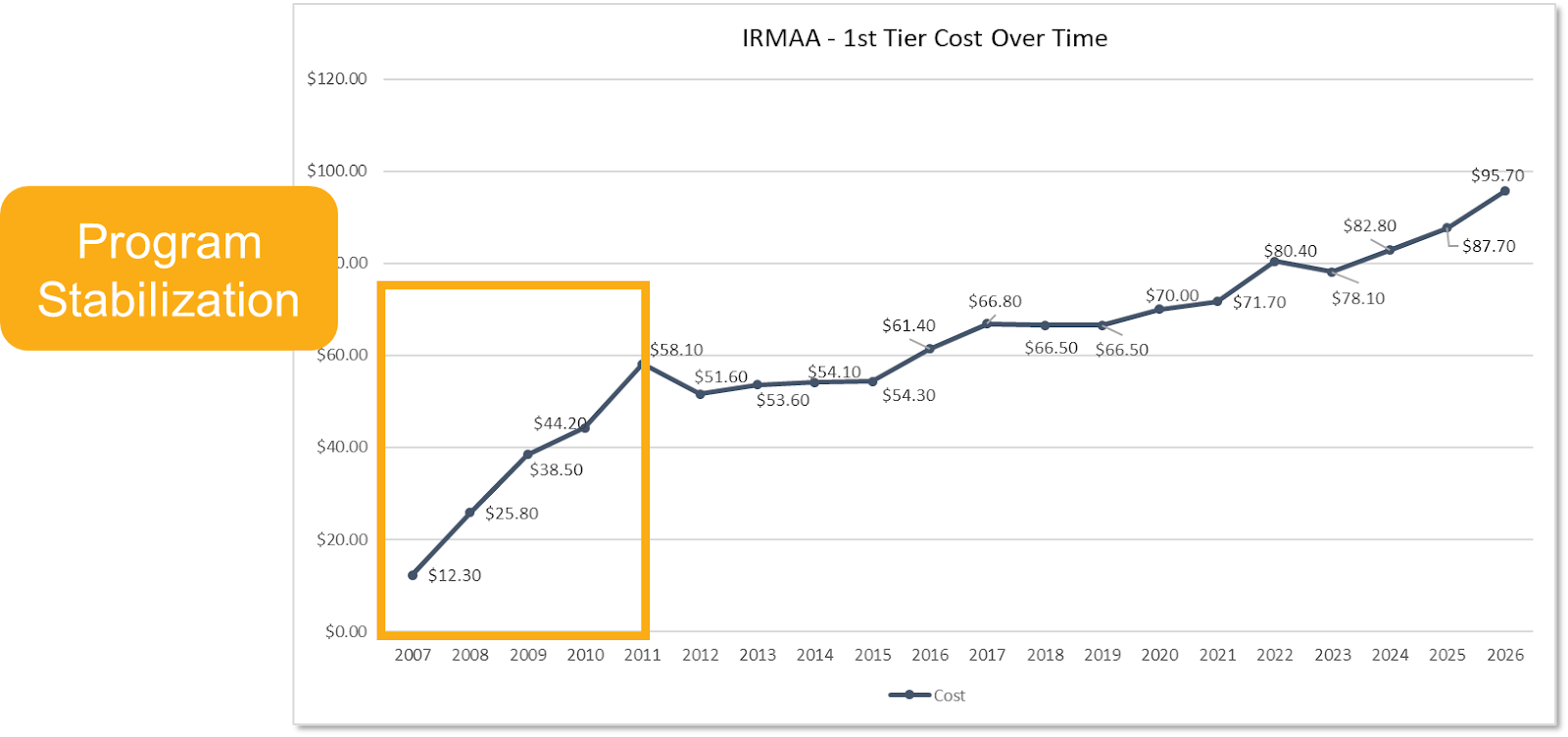
IRMAA rates have risen pretty steadily since the program’s inception.
This isn’t surprising – once the government finds a new revenue source, they want to maximize the revenue it generates. The Medicare program continues to need more money, so the government continues to increase IRMAA fees.
(Fun fact – or not so fun if you’re paying IRMAA. Congress doesn’t even need to vote for your client’s IRMAA rates to rise. In fact, the Centers for Medicare & Medicaid Services (CMS) just adjusts the IRMAA brackets and rates each year, based on the percentage movement of the Consumer Price Index and the experience and needs of the Medicare program.)
I wish I had a magic ball to see what IRMAA rates will be in the future for our clients. But lacking that kind of magic, instead I’ve been looking at historical IRMAA trends and seeing what insights they might provide.
There are two trends that are apparent in the data. (For simplicity’s sake, I’ll base all these numbers off the first tier of IRMAA surcharges.)
IRMAA surcharges first went into effect in 2007. And for the first few years of the program, those rates ramped up significantly as the government got a handle on the new revenue and how to set rates to match program needs.
I like to look at 2012 as the program’s first stabilized year. Since 2012, we’ve seen many years where increases were implemented (some significantly – more on that in a moment). We’ve also seen some years (like 2012 and 2023) where IRMAA rates were flat or actually decreased.
Overall, for the first IRMAA tier, rates have increased by about 4.6% since 2012. So over time, we’re seeing program costs steadily rise.
Those rate increases have been coming more aggressively in recent years. Since 2019, IRMAA fees in the first tier have risen around 7.1% a year. And over the last three years, they’ve risen steadily, too: 6% (2024), 5.9% (2025) and 9.1% (2026).
What Lies Ahead
Unfortunately for our clients, there’s a good chance the historical trends will continue and IRMAA surcharges will keep on rising.
We know the Medicare program will require significantly more funding in the years ahead. The Centers for Medicare and Medicaid Services (CMS) projects that through 2033, the government’s Medicare spending will grow at more than 7% annually. The government will need additional revenue to meet this growth in outlays.
In fact, the government has already warned U.S. savers that premiums and surcharges over the next decade will amount to approximately 25% of a saver’s overall Social Security benefit.
So it’s very reasonable to project an increasing impact from IRMAA on our clients.
How to Help Our Clients Prepare
That’s a lot of different data points. So what does it all mean for our clients?
First, we have to educate clients about IRMAA and its potential impact on their retirement income.
This discussion becomes particularly important as savers consider Roth conversions. The reason is twofold:
First, over time, a Roth conversion can help a saver lower their MAGI and, therefore, their IRMAA surcharges. For the purposes of IRMAA, the SSA calculates a saver’s MAGI based on taxable income from 401(k)s, IRAs, working income, and the taxable portion of their Social Security benefit. However, income from Roth accounts do not count toward MAGI for the IRMAA calculation. By accessing retirement funds from a Roth account in the future, your client can potentially lower or eliminate their IRMAA surcharges.
Second, IRMAA is an important consideration as you structure a client’s Roth conversion. As we know, clients often like to spread out a Roth conversion over a number of years to avoid an inflated tax bill in a given year. So advisors need to analyze not only tax drift (or the potential for pushing a saver into a higher tax bracket during the conversion) but also IRMAA drift (analyzing if the additional income from the conversion pushes the saver into a higher IRMAA bracket during those conversion years).
At Stonewood Financial, we feel so passionately about helping savers minimize both taxes and IRMAA in retirement that we created our Roth Done Right software to analyze these scenarios for your clients. If you haven’t checked it out, we’re happy to send you a sample report for one of your clients so you can see how powerful the IRMAA analysis can be. Also go through complete guide on provisional income.
IRMAA will continue to be a hot topic as Congress debates how to stabilize the Medicare program. Smart advisors will help their clients get ahead of the debate.
Free Study Group Replay
How Stonewood Advisors Stay Ahead of the Next Planning Conversation.
Watch a recent Stonewood Study Group focused on the legacy planning conversation. You’ll see how Stonewood helps advisors break down timely planning topics, client conversation angles, and practical strategies you can put to use immediately.
Expert insights. Real strategies.
Study Group Replay
Timely planning topics
Real client conversation angles
Practical strategies you can use
Real Advisors. Real Results.
See how advisors are using Stonewood software to win larger cases and deliver better
outcomes for their clients.
An advisor was working with a prospect who was a real "do-it-yourselfer" when it came to Roth conversions.
The client was converting assets up their existing tax bracket – and hadn't considered any impact to
IRMAA.
With Roth Done Right, the advisor was able to show an alternate pattern that sped up the conversion to
6 years. The new structure offered $30,000 savings in conversion taxes – a 20% reduction on the
prospect's conversion tax bill. The report also showed hundreds of thousands of dollars in long-term
tax and IRMAA savings from the converted assets – an amount the prospect hadn't been able to quantify
on his own.
Outcome
A new client with $1M in new AUM, and a $1M FIA sale to fund the conversion process.
An advisor was working with a prospect who already had assets with Ken Fisher. Fisher's team presented a
5% systematic withdrawal projection, so the advisor needed a stronger way to frame the income
conversation.
Using the Annuity Alpha report, the advisor showed how an annuity could deliver over 8% in annual cash
flow with lifetime income, plus a long-term care doubler. The contrast was clear enough that the prospect
moved forward.
Outcome
$1.5M placed and a $100K in new business revenue.
An advisor was working with a 58-year-old couple with an established, well-funded retirement income plan,
leaving an additional $3M IRA to build out a legacy for the kids. The couple's existing advisor had no
real additional plan for this money, other than to keep it in their managed account and grow that money as
much as possible for the kids.
Using the Legacy Done Right report, the advisor showed the need for tax planning on this $3M IRA.
According to the advisor, the simple analysis "opened up the wallet" to the Roth conversion story. The
advisor then used the blended Roth/Life feature in the report to show a blend of Roth Conversion assets
with some Life Insurance to help maximize the client’s legacy.
Outcome
$3M in motion. The advisor picked up a $1.5M FIA sale that will be converted to Roth. And the advisor
also sold a 5-Pay Protection focused IUL policy at $225,000 of premium per year.
An advisor group incorporated the Total Tax Burden report into the strategy presentation for all new
prospects. They ran the tax snapshot for every new client as part of their first meeting conversation,
quantifying the growing tax burden of IRA money – and illustrating the kinds of tax savings possible
when working with their firm.
Starting in January of 2023, this simple analysis was presented to every single prospect who walked in
the door. The goal was to differentiate their practice and drive overall revenue growth through various
Roth conversion strategies.
Outcome
From 2022 to 2025, new annual AUM rose from $5M to $50M. Annual FIA sales rose from $3M to $35M.
And annual life premium rose from $50K to $1M.