Who? The Centers for Medicare & Medicaid Services (CMS).
What did they declare? The IRMAA surcharge amounts for 2026.
Congress created IRMAA in 2003 as part of the Medicare Modernization Act. It was created to increase the values in the trust fund that supports Medicare by having higher-income Americans pay additional surcharges above and beyond their Medicare Part B and D premiums.
Congress also gave the CMS authority to adjust the brackets annually based on CPI movement. But here’s the real kicker…CMS also has the authority to adjust the surcharge itself, which is the actual amount Americans pay. And that authority is what makes the trust fund that supports Medicare Part B and D programs one of the most financially sustainable and funded programs around. Because they can, without passing a new law, declare higher surcharges.
Historically, based on the IRMAA charts on CMS.gov from previous years, the declared surcharge increases for the new year have been 4-8% higher than the previous year. Since 2019, the surcharges have risen at an annual compounded rate of 7.1%. Last year, the increase was 5.9%.
So that leads me to 2026.
Preliminary projections suggested that this year’s IRMAA surcharge increase would be a modest 1% for Part B and 6% for Part D.
But boy did those projections miss the mark.
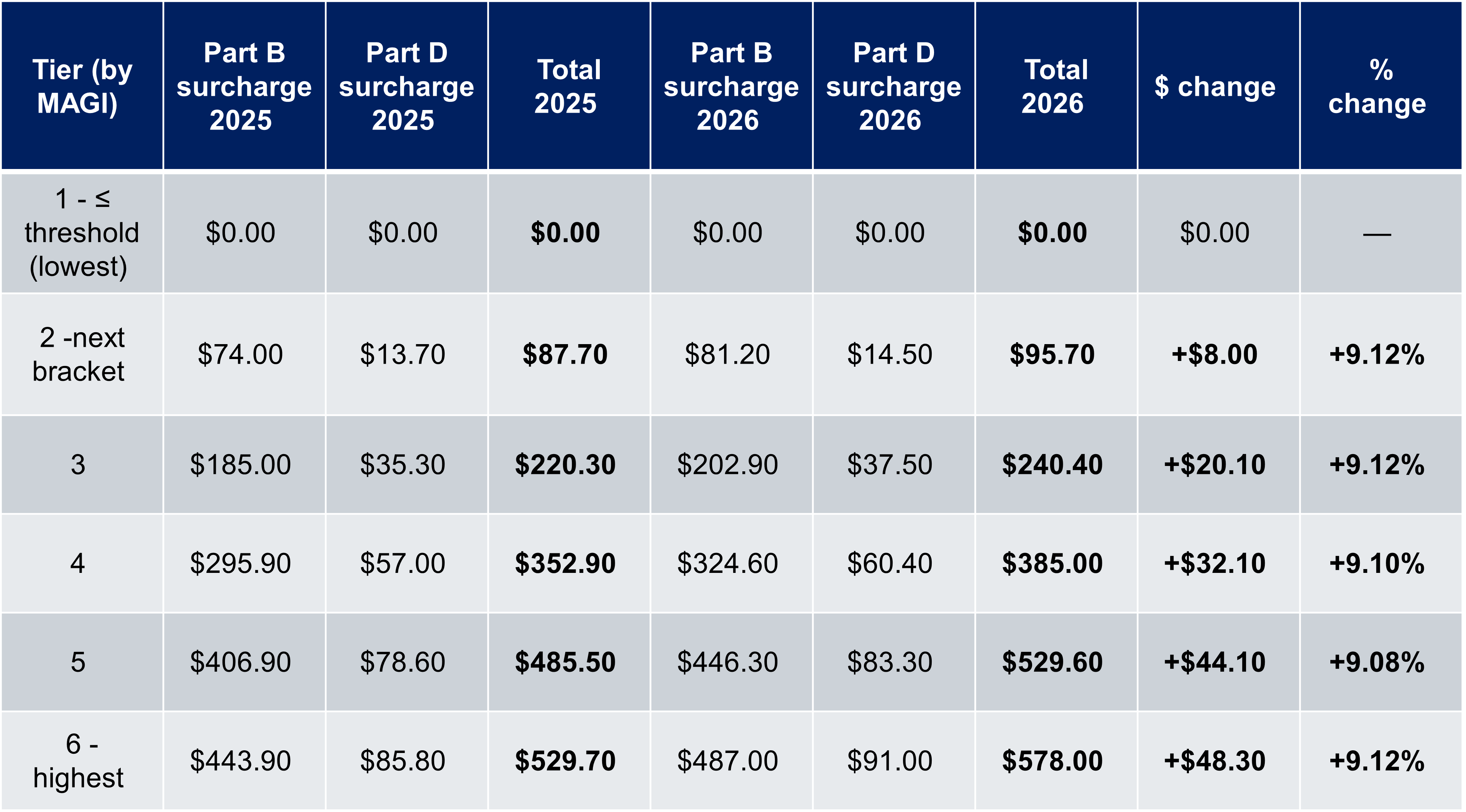
I pulled the official CMS tables for both 2025 and 2026 to compare the tables. I combined the Part B IRMAA surcharge + the Part D IRMAA amount for each income tier. I then calculated the dollar and percent change from 2025 to 2026. The results blew me away. And not in a good way.
The average combined surcharge will rise by 9.1% in 2026! That’s right. A historic increase.
The dollar amount increases range from just under $8/month for the lowest surcharge tier to over $48/month for the highest tier. Per month. Per person.
To be fair, the MAGI thresholds will also change slightly. For example, the lower threshold moved from $106k to $109k for single filers. So, it does take slightly more income to qualify for the surcharge. But if you qualify, it’s for a historically higher amount.
Here is what the table looks like with a year-by-year analysis of each tier.
How Stonewood Advisors Stay Ahead of the Next Planning Conversation.
Watch a recent Stonewood Study Group focused on the legacy planning conversation. You’ll see how Stonewood helps advisors break down timely planning topics, client conversation angles, and practical strategies you can put to use immediately.
Strategy expertise and training that actually moves the needle. Neil sees the big opportunities coming - and develops tools to let you take advantage of them.
Real Advisors. Real Results.
See how advisors are using Stonewood software to win larger cases and deliver better
outcomes for their clients.
An advisor was working with a prospect who was a real "do-it-yourselfer" when it came to Roth conversions.
The client was converting assets up their existing tax bracket – and hadn't considered any impact to
IRMAA.
With Roth Done Right, the advisor was able to show an alternate pattern that sped up the conversion to
6 years. The new structure offered $30,000 savings in conversion taxes – a 20% reduction on the
prospect's conversion tax bill. The report also showed hundreds of thousands of dollars in long-term
tax and IRMAA savings from the converted assets – an amount the prospect hadn't been able to quantify
on his own.
Outcome
A new client with $1M in new AUM, and a $1M FIA sale to fund the conversion process.
An advisor was working with a prospect who already had assets with Ken Fisher. Fisher's team presented a
5% systematic withdrawal projection, so the advisor needed a stronger way to frame the income
conversation.
Using the Annuity Alpha report, the advisor showed how an annuity could deliver over 8% in annual cash
flow with lifetime income, plus a long-term care doubler. The contrast was clear enough that the prospect
moved forward.
Outcome
$1.5M placed and a $100K in new business revenue.
An advisor was working with a 58-year-old couple with an established, well-funded retirement income plan,
leaving an additional $3M IRA to build out a legacy for the kids. The couple's existing advisor had no
real additional plan for this money, other than to keep it in their managed account and grow that money as
much as possible for the kids.
Using the Legacy Done Right report, the advisor showed the need for tax planning on this $3M IRA.
According to the advisor, the simple analysis "opened up the wallet" to the Roth conversion story. The
advisor then used the blended Roth/Life feature in the report to show a blend of Roth Conversion assets
with some Life Insurance to help maximize the client’s legacy.
Outcome
$3M in motion. The advisor picked up a $1.5M FIA sale that will be converted to Roth. And the advisor
also sold a 5-Pay Protection focused IUL policy at $225,000 of premium per year.
An advisor group incorporated the Total Tax Burden report into the strategy presentation for all new
prospects. They ran the tax snapshot for every new client as part of their first meeting conversation,
quantifying the growing tax burden of IRA money – and illustrating the kinds of tax savings possible
when working with their firm.
Starting in January of 2023, this simple analysis was presented to every single prospect who walked in
the door. The goal was to differentiate their practice and drive overall revenue growth through various
Roth conversion strategies.
Outcome
From 2022 to 2025, new annual AUM rose from $5M to $50M. Annual FIA sales rose from $3M to $35M.
And annual life premium rose from $50K to $1M.