Another day, another headline. We see them throughout the industry. Especially in the years following the passing of the Secure Act. I will paraphrase and summarize for you as directly as I can… IRAs are terrible financial instruments to pass wealth to the next generation.
Why?
Our clients come to us seeking controlled outcomes in volatile situations. They seek protection from the market. They seek predictable income. And increasingly lately, they seek shelter from Washington. Specifically, they want protection from tax risk.
And with legacy assets, risk is all around. When assets are passed to a spouse, the surviving spouse must now file on a new form. And that new form has a new table. And the tax rates on that new table are much higher than the previous table in the previous form. We call that the Widow’s Penalty. And for many savers, depending on their income levels, this can represent a 27-42% increase in their effective tax rate. Wow.
Even if the money is going to the kids, you still have situational tax risk. It just comes in a different way. When the kids inherit money, they often do so at their peak earning years. Now, with the Secure Act, they must assume taxation of that money within 10 years. With an established effective tax rate, this additional money all comes at the margins. So, when weighing the potential tax burden for heirs, I tend to use their marginal tax rate. Or in some cases, higher. We call this one the Kiddo’s Penalty.
As you can see, this tax risk has nothing to do with Washington. This is just a case of paying higher taxes because of their specific situation.
Of course, Washington can play a role too. We call that “legislative risk.” This is the risk that Congress changes the rules on taxation, and those rule changes lead to much higher taxes for our heirs. With our deficit spending adding trillions of dollars every year to the national debt, at some point, WE will have to pay.
For legacy assets specifically, this presents an opportunity for some planning. Especially for those assets sitting in IRAs and continuing to grow, but also compounding the inherent tax problem. With RMDs set to wreak havoc on tax rates and those dreaded income-related taxes like IRMAA, Social Security taxation, and capital gains and dividend taxes.
Many retirees who have a portion of their retirement savings earmarked for legacy are now considering some advanced tax planning strategies like Roth conversions and life insurance.
Those retirees are faced with choices:
Convert a portion of their IRA money to a Roth.
Take distributions from their IRA and use those distributions to fund a life insurance policy.
Keep their heads in the sand; keep deferring those taxes as long as possible until the inevitable RMDs come.
Let’s take a quick look at each option:
Option 1 | Roth Conversion:
Pros: Long-term savings on taxes, IRMAA and other income-related taxes.
Cons: The expense of paying those conversion taxes and additional IRMAA surcharges during the conversion. For some clients, it may take years to “break even” on the conversion. Meaning, it may take years to recoup the lost buying power of the money spent on taxes. Leaving many savers begging the question, “Are Roth conversions worth it?”
Option 2 | Life Insurance: Wait, what? I thought life insurance was only for younger savers. Actually, many retirees now see the most efficient way to pass wealth to the next generation is to use the financial instrument that was designed specifically for this purpose.
Pros: The death benefit provides an immediate legacy multiplier, making break-even on the cost of conversion on Day 1.
Cons: if the client lives a long, healthy life, over time, with moderate returns, the account value of the IRA or Roth could grow higher than the death benefit of the life policy.
Option 3 | Keep the IRA:
Some savers just can’t stomach paying the taxes on a conversion.
Pros: No cost of conversion.
Cons: From both a financial and emotional standpoint, rarely is this the best option, as tax risk, legislative risk, IRMAA, and other pressures continue to mount.
So, how do we help our clients decide what to do? This is where Stonewood Financial’s Legacy Done Right software comes into play. This analysis will help you calculate, based on your clients’ specific income situation and their heirs’ specific tax rates, a year-by-year analysis of three things:
Total taxes paid in conversion compared to the total tax burden of keeping the IRA
Total IRMAA surcharges paid in conversion compared to the total IRMAA surcharges of keeping the IRA
Year-by-year analysis of the total wealth generated in each situation. Values are calculated for keeping the IRA, converting to Roth, and comparing those values to the wealth generated by a life policy passing to heirs.
With this analysis, you get a picture of the cost of conversion and can compare that to the cost of deferral. And then the year-by-year analysis gives you an annual look at what the total wealth generated would be in each scenario, based on whether that money was passed to the heirs in that given year. Thus, a true picture of which instrument would deliver the greatest after-tax legacy.
Let’s take a look at the options clients face with legacy planning, with a hypothetical example of a 75-year-old widow with $1M in an IRA. She has her income needs taken care of through Social Security and an annuity that provides guaranteed lifetime income. The IRA is going to her kids.
Let’s say her effective tax rate is just over 14%. And she lives in Florida, so there is no state income tax. Her only child, currently at a 20% effective tax rate, lives back in Kentucky, which has a 3.5% income tax.
Like many savers, let’s assume she fears taxes could be on the rise. So her advisor would like to model a tax increase in 7 years that gets tax rates back to their pre-TCJA rates. It’s going to take a 30% increase in taxes to get us there. A net 6% growth rate was assumed on all IRA and Roth money.
Using Legacy Done Right, we looked at three options:
Keep the IRA
Convert to Roth over 5 years, converting $200,000 each year
Withdraw $200,000 from the policy each year, paying the tax and IRMAA, and then using the remaining funds to purchase a life policy.
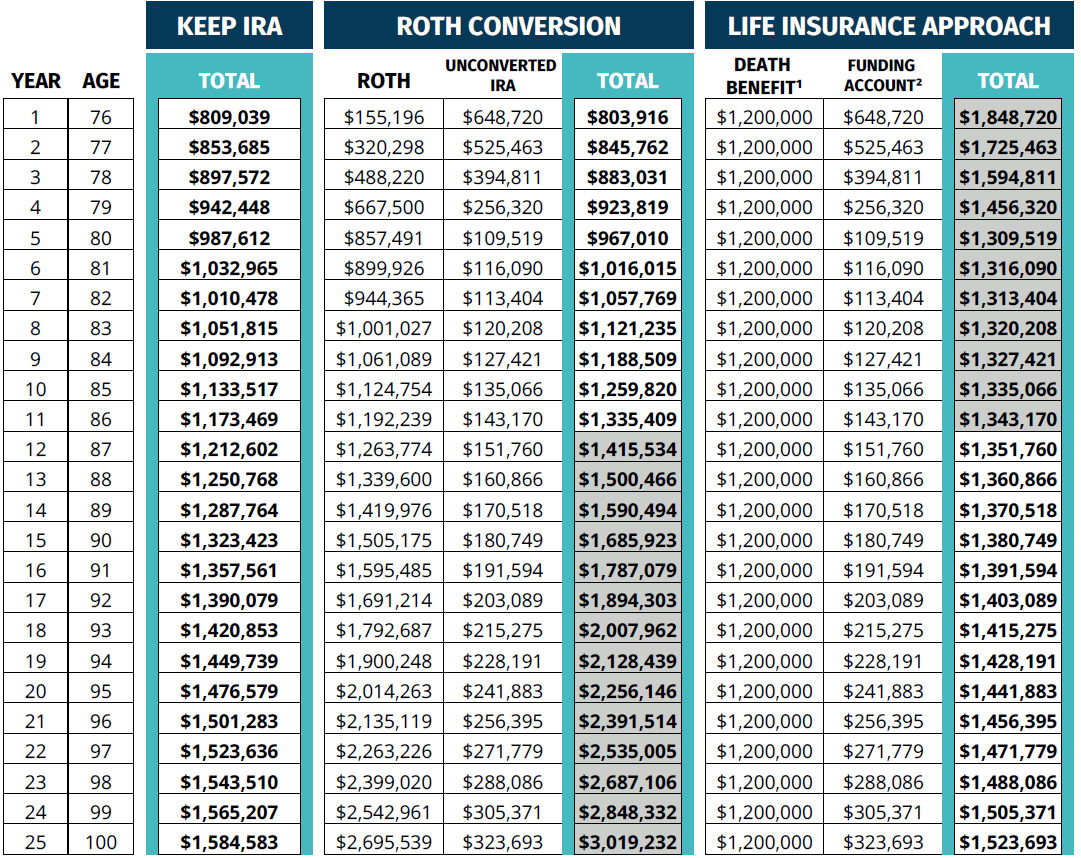
In this hypothetical example, the cost of conversion would be about $260,000 of income taxes and another $40,000 of IRMAA surcharges. This leaves $700,000 to fund the life insurance policy over 5 years. I ran sample illustrations with multiple carriers, and most protection-focused IUL illustrations with long-term care riders showed about $1.2M in death benefit in a scenario like this. And projected accumulation from the indexing strategy would keep that death benefit in place through age 100.
As you can see from the chart below, the comparison from IRA to Roth to life insurance is an intriguing one.
Analysis generated by Stonewood Financial Legacy Done Right software. For the complete report, including assumptions used, please contact our office.
So, let’s unpack the results:
As expected, the life insurance death benefit provides that immediate legacy multiplier. In this example, if the client passed away in year one, the IRA would be worth $810k, the Roth $803k, and the strategy involving life insurance would be over $1.8M (when you include all converted and unconverted funds).
The Roth conversion option becomes the better option once the client nears life expectancy. At age 87, the growth of the Roth IRA pushes values above what the client would get from the life solution.
Regardless of age, one of the two tax-free solutions wins. In the early years, the life solution wins. In the later years, the Roth catches up. And the keep your head in the sand option never wins. Regardless.
Results like this get me thinking. What if we changed the conversation?
Instead of pitting the three financial instruments against each other, what if we instead compared the decision to convert or not convert? The decision to take action vs. not take action. What if the solution were a BLEND of both a Roth conversion and life insurance?
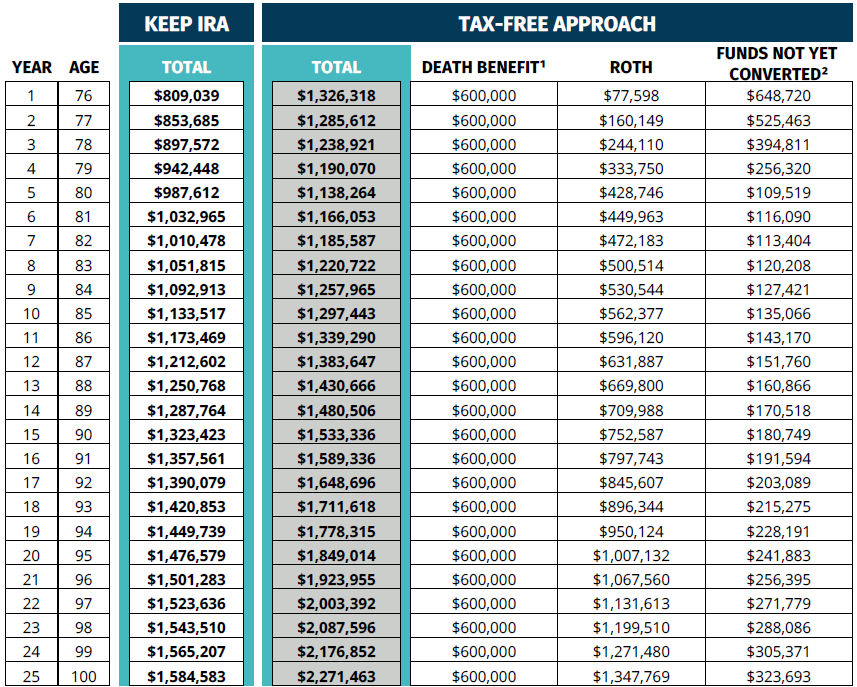
For this example, let’s assume a 50/50 blended rate. That means half of the conversion assets end up in a Roth IRA, and the other half funds a life policy. The life insurance death benefit in this case would be about half the previous amount: around $600k.
Here are the results from this blended approach:
Analysis generated by Stonewood Financial Legacy Done Right software. For the complete report, including assumptions used, please contact our office.
The results are staggering. No longer do we have to defend the expense of conversion. No longer do we have to defend IRA performance, catching up to the life insurance death benefit value.
Suddenly, we now have a completely compelling case for action. In all scenarios, the benefit of conversion is immediately shown and continues throughout. Thanks to Legacy Done Right, you as an advisor can deliver a checklist of value to your clients. For this saver:
She saves hundreds of thousands of dollars in taxes
She lowers her lifetime IRMAA
She maximizes the after-tax legacy values in all years
She potentially accesses long-term care protection with the life policy, depending on the carrier you choose
She has upside potential with the market performance of the Roth Conversion assets
She has additional control of the assets that can be used for unforeseen expenses
And finally, she minimizes the impact of situational and legislative tax risk, both for her and her heir.
How Stonewood Advisors Stay Ahead of the Next Planning Conversation.
Watch a recent Stonewood Study Group focused on the legacy planning conversation. You’ll see how Stonewood helps advisors break down timely planning topics, client conversation angles, and practical strategies you can put to use immediately.
Strategy expertise and training that actually moves the needle. Neil sees the big opportunities coming - and develops tools to let you take advantage of them.
Real Advisors. Real Results.
See how advisors are using Stonewood software to win larger cases and deliver better
outcomes for their clients.
An advisor was working with a prospect who was a real "do-it-yourselfer" when it came to Roth conversions.
The client was converting assets up their existing tax bracket – and hadn't considered any impact to
IRMAA.
With Roth Done Right, the advisor was able to show an alternate pattern that sped up the conversion to
6 years. The new structure offered $30,000 savings in conversion taxes – a 20% reduction on the
prospect's conversion tax bill. The report also showed hundreds of thousands of dollars in long-term
tax and IRMAA savings from the converted assets – an amount the prospect hadn't been able to quantify
on his own.
Outcome
A new client with $1M in new AUM, and a $1M FIA sale to fund the conversion process.
An advisor was working with a prospect who already had assets with Ken Fisher. Fisher's team presented a
5% systematic withdrawal projection, so the advisor needed a stronger way to frame the income
conversation.
Using the Annuity Alpha report, the advisor showed how an annuity could deliver over 8% in annual cash
flow with lifetime income, plus a long-term care doubler. The contrast was clear enough that the prospect
moved forward.
Outcome
$1.5M placed and a $100K in new business revenue.
An advisor was working with a 58-year-old couple with an established, well-funded retirement income plan,
leaving an additional $3M IRA to build out a legacy for the kids. The couple's existing advisor had no
real additional plan for this money, other than to keep it in their managed account and grow that money as
much as possible for the kids.
Using the Legacy Done Right report, the advisor showed the need for tax planning on this $3M IRA.
According to the advisor, the simple analysis "opened up the wallet" to the Roth conversion story. The
advisor then used the blended Roth/Life feature in the report to show a blend of Roth Conversion assets
with some Life Insurance to help maximize the client’s legacy.
Outcome
$3M in motion. The advisor picked up a $1.5M FIA sale that will be converted to Roth. And the advisor
also sold a 5-Pay Protection focused IUL policy at $225,000 of premium per year.
An advisor group incorporated the Total Tax Burden report into the strategy presentation for all new
prospects. They ran the tax snapshot for every new client as part of their first meeting conversation,
quantifying the growing tax burden of IRA money – and illustrating the kinds of tax savings possible
when working with their firm.
Starting in January of 2023, this simple analysis was presented to every single prospect who walked in
the door. The goal was to differentiate their practice and drive overall revenue growth through various
Roth conversion strategies.
Outcome
From 2022 to 2025, new annual AUM rose from $5M to $50M. Annual FIA sales rose from $3M to $35M.
And annual life premium rose from $50K to $1M.