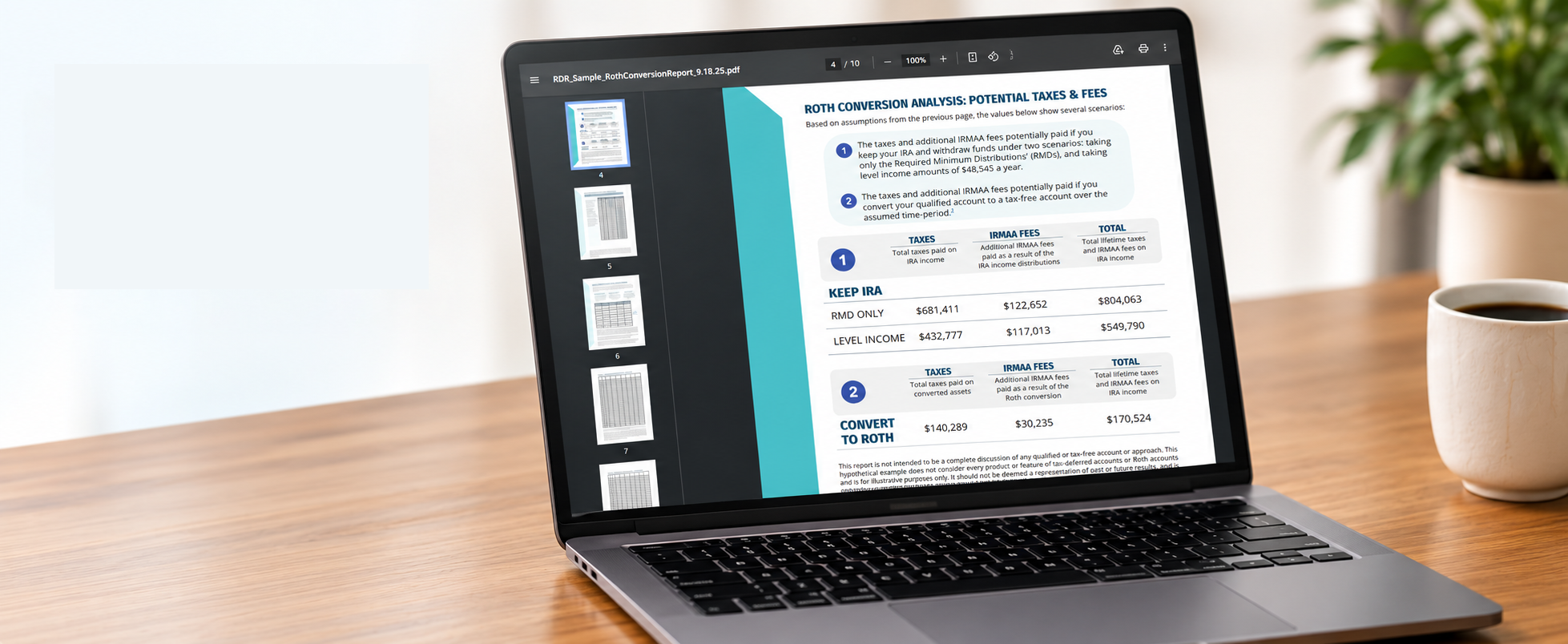
The One Big Beautiful Bill Act (OBBBA) permanently extended the individual income tax bracket rates and standard deduction from the 2017 Tax Cuts and Jobs Act, which were otherwise set to expire at the end of 2025. It also impacted the estate and gift tax exemption, the SALT deduction cap, and the child tax credit, and created a new temporary deduction for savers age 65 and older.
Congress has passed – and the President has signed into law – the One Big Beautiful Bill Act (OBBBA)1, which includes some important tax changes with the potential to impact most U.S. savers.
Chief among the provisions impacting your clients will be the permanent extension of individual income tax bracket reductions first established in the 2017 Tax Cuts and Jobs Act.
What do these changes mean for your clients – and how can we leverage this legislation to plan for a more successful retirement?
Close More Business with Stonewood Reports
Easy to run. Easy to present. Pick the report that fits your next client conversation and we'll send a sample to your inbox immediately.
Roth Done RightTax & IRMAA Analysis
Annuity AlphaFIA vs. Managed Account
Legacy Done RightLife Insurance Analysis
Total Tax BurdenRetirement Tax Snapshot
Evaluating Taxes in Retirement
There are two distinct ways we need to evaluate this legislation – and taxes more generally – for our clients.
The first is the near-term impact: What this legislation means for tax rates in the near term, and how savers may want to adjust their retirement strategies accordingly.
Of course, none of our clients plan only to live in retirement for the next few years. Because retirement is a long-term endeavor, the long-term impact of this legislation and other economic, demographic and fiscal trends are equally critical to evaluate and address.
By understanding both short-term impacts and long-term pressures, we can help clients develop a retirement approach that offers better protection across their lifetime in retirement.
OBBBA Tax Changes: Near-Term Impact
Let’s start with the near-term impact of OBBBA.
There are many changes in this legislation with the potential to positively impact our clients – from a permanent extension of the higher estate tax exemptions to a new tax deduction for older savers offsetting the taxation of Social Security benefits. In this article, I’m going to focus on the permanent extension of the individual income tax bracket rates that were passed as part of the Tax Cuts and Jobs Act in 2017. Previously, these tax bracket rate reductions were set to expire at the end of 2025. Now, today’s current (lower) bracket rates will continue indefinitely into the future.
This is extremely important for clients considering changing the tax status of any of their retirement assets, particularly from tax-deferred vehicles (like 401(k)s and IRAs) to tax-free vehicles (like Roth accounts or Roth alternatives like cash-value life insurance). The tax “cost” of conversion is lower today (and into the future) than it was pre-reform.
How much lower?
For middle-income Americans, I’ve analyzed that individual income tax bracket rates are about 30% lower today than they were pre-reform (for example, a middle quintile single filer pays at a 22% rate today, versus a 28% rate in the year 2000).
This means today’s tax bracket rates for many Americans are significantly lower than near-term historical averages – a big potential savings for clients interested in converting funds to tax-free vehicles.
But the passage of OBBBA has raised a different question in the minds of many U.S. savers (and often the advisors that serve them):
Since Congress has passed a permanent extension of these bracket reductions, are Roth conversions still valuable?
After all, we no longer have to worry about brackets reverting to their older, higher rates. So is there still a need to convert?
In my evaluation, the answer is a resounding: Yes.
In fact, OBBBA has given us a unique opportunity to help clients convert assets at lower rates before taxes potentially rise – dramatically – in the future.
What drives my answer is less about the near-term impact of this legislation, and more about a long-term analysis of both OBBBA and other economic, fiscal and demographic pressures the U.S. faces – today and in the years to come.
Before we turn to the long-term impacts of the bill, I want to emphasize: OBBBA includes tax provisions that will help U.S. savers maintain lower tax rates in the years to come, and that should be celebrated with our clients.
Within that celebration, we need to leverage today’s lower tax rates to prepare for what likely lies ahead. For most of our clients, retirement is not about the next five or ten years; it’s about the next twenty, thirty or even forty years in the future. So when we look at lifetime retirement taxes, we need to evaluate not only the near-term rates but also what could happen to taxes over the next several decades ahead.
And that’s why it’s critical we help our clients understand the long-term outlook for U.S. taxes.
OBBBA Tax Changes: The Long-Term Outlook
First, let’s look at the “permanent” extension of the tax bracket rate reductions.
I’ve put “permanent” in quotation marks because nothing in Washington is ever truly permanent. A permanent extension just means that bracket rates will not automatically rise in the future – they will only rise if Congress votes for them to do so.
How likely is that?
As our clients evaluate various tax opportunities in today’s lower-rate environment, the question they’ll need help answering is: What is the likelihood of Congress voting to raise taxes – and when?
I don’t have a magic ball. But when I look at tax reform efforts in the U.S. going back to the Reagan cuts in the 1980s, I find that most low-tax-bracket rate environments last an average of 12 years. We are currently in year 9 of today’s lower bracket taxes. One of the constants of the tax code is that it’s never constant for long – so we can expect tax rates to rise at some point in the future.
Why am I so confident higher rates are coming?
Here are the top indicators I’m watching:
U.S. Spending | In the last fiscal year, our country brought in $5 trillion in revenue – and spent $5.1 trillion on mandatory (non-Congressional) spending alone. That means expenditures like Social Security, Medicare and servicing our federal debt used up every single dollar the government generated through taxes and other fees. Of course, as a nation, we still have to fund priorities outside of these mandatory government programs. And that meant every single dollar Congress appropriated for things like defense spending, military needs and transportation funding was deficit spending. This is not sustainable.
Demographics | The reason our government’s budget is so imbalanced is not primarily because of Congressional spending. It is because of demographics. The two largest areas of expenditure for our government are Social Security and government health programs like Medicare. Our aging population will put increasing pressure on the Social Security and Medicare programs, driving program costs far higher than today. In fact, the CBO reports that by 2035, current taxes will only cover 75% of scheduled Social Security benefits. The outlook for Medicare isn’t any better. Program spending is expected to grow at nearly 8% every year over the next decade.
Debts and Deficits | The Congressional Budget Office (CBO) projects that over the next decade, the annual budget deficit will range from $1.7 trillion to $2.9 trillion. That makes one thing very clear: Americans are underpaying for the government we currently have. And while certainly our government could reduce spending in numerous places, as we can see in the indicators above the problem runs much deeper than any new bills the President and Congress may pass. Alas, we can’t just look at our nation’s deficit (about $1.9 trillion in the last fiscal year). Our national debt stands at a historical record-high – $38 trillion – costing our government nearly $1 trillion in debt service last year alone. Layer on top of that the trillions of dollars of unfunded Social Security and Medicare obligations we’ll incur as a nation in the years ahead, and a clear picture emerges: we have a growing hole between the money our government takes in and the money it sends out.
When we take these indicators as a whole, one thing is clear: Sooner rather than later, the government will need more revenue. And that means more taxes. At this point, it’s primarily a demographic and debt problem, not simply a political one. And that means while control of the White House and Congress can slow or accelerate the likelihood of rising taxes, it can’t solve the math challenge America faces.
Other Ways Taxes Can Change Beyond OBBBA
Tax bracket rates aren’t the only thing these trends could impact. Congress could raise additional revenue by lowering the amount of income subject to each bracket, thereby generating more revenue as more income is taxed at higher brackets. Congress could adjust deductions to create more taxable income for Americans.
But in my analysis, one of the biggest tax risks our clients face in the future might not be found in the tax code at all. It will be from Congress finding new, creative ways of generating revenue from U.S. savers based on their income.
And we’re already seeing it happen.
Take, for example, IRMAA – the surcharge some Americans pay on top of their Medicare premiums based on that saver’s income level.
In 2003, as part of the Medicare Modernization Act, Congress created a new fee for American savers, called the Income-Related Monthly Adjustment Amount (or IRMAA). Essentially, the government looks at a taxpayer’s income from previous years, and if certain thresholds are met, a new fee is assessed – on top of that taxpayer’s regular income taxes and Medicare premiums.
Essentially, IRMAA was a way to generate new revenue without having to adjust tax bracket rates. And it worked. IRMAA surcharges have helped the Medicare Parts B and D trust funds maintain fiscal soundness even as other government trust funds are floundering.
And so the government has been leaning on IRMAA to generate increasing revenue for the Medicare program. In fact, since 2019, IRMAA surcharge rates for the lowest bracket have risen more than 7% annually – year after year. And the government isn’t done. A CMS report from last year outlined that these Medicare trust funds would be adequately financed into the future only because the government can raise IRMAA fees (and premiums) to match any expected shortfalls.
IRMAA fees – and other creative revenue-generating initiatives Congress is considering – have the same effect as rising tax-bracket rates: They raise the amount of your client’s retirement income going to the government, and reduce the amount going into your client’s bank account.
In summary, the long-term tax outlook on both bracket and additional fees and surcharges is grim.
But it’s not hopeless. In fact, there are important ways we can help our clients prepare – leveraging today’s lower bracket rates to protect them from what may lie ahead.
Free Advisor Training
Turn Roth Conversations Into Revenue
Watch this complimentary training to learn how leading advisors use retirement tax concerns to create urgency, open Roth conversion conversations, and uncover valuable new planning opportunities.
Video Training
Create urgency around tax planning
Open more Roth conversion conversations
Uncover new planning opportunities
How OBBBA Impacts Roth Conversion Planning
Tax diversification is an increasingly critical component of comprehensive retirement planning. And the passage of OBBBA doesn’t change that.
In fact, the extension of today’s lower tax bracket rates makes the case for tax-free conversions as strong as ever for many Americans. Here’s why:
Today’s tax rates are significantly lower than the rates we’ve seen in recent history.
The benefit is savers can convert funds at today’s lower rates. A Roth conversion or other tax-free reallocation simply “costs” less in taxes today than when rates were higher.
The drawback is that – over time – taxes have nowhere to go but up. It’s hard to argue that future taxes will be lower than they are today, for all the reasons mentioned above. That means many savers may find themselves facing higher taxes at some point in retirement.
But OBBBA has given us a powerful tool to help our clients combat future taxes. Because the extension is “permanent,” there’s no current expiration date for these lower tax bracket rates. And we can expect them to continue into the near future. That gives advisors greater flexibility in structuring Roth conversions to meet client preferences and needs – whether the client wants to convert over 3 years, 5 years or more.
Additionally, because Roth income and supplemental income generated from tax-free alternatives like cash value life insurance aren’t included in income calculations for IRMAA, tax-free strategies can help address a more complete assessment of ways taxes can rise for our clients.
What OBBBA Means for U.S. Savers
A lot has changed with the passage of OBBBA. But what hasn’t changed is this:
Retirement is a long-term endeavor. And long-term, our country needs more revenue.
A key goal of retirement planning is often to help savers address financial risks in retirement. And asset diversification is a powerful tool we have to help mitigate these unknowable future conditions. Future taxes are one of today’s great unknowns – and American savers deserve protection against this risk. I believe they can’t achieve an adequate level of protection if all or the majority of their retirement funds are saved exclusively in tax-deferred vehicles like 401(k)s and IRAs. The case for tax diversification is as strong as ever.
Higher taxes are coming. And while we don’t know the exact timing of when they’ll go up, we do know the exact timing of when our clients need to prepare: Now.
It all comes down to legislative risk: The risk that Washington changes the rules, and those changes negatively impact our clients and their retirement approach. It’s on us as financial professionals to help our clients understand what is – in my opinion – one of our era’s core truths: The biggest driver of legislative risk in retirement is not whether Republicans or Democrats are in control in Washington. It’s our nation’s two-year election cycle. Nothing in Washington stays constant for long.
Into this uncertainty, we can help our clients protect their retirement assets from the legislative changes of future Presidents and Congresses. Successful advisors can help their clients prepare both for the tax code we have today and for the volatility that could change the tax code we have in the future.
Becky Ruby Swansburg
Becky Ruby Swansburg is CEO of Stonewood Financial, a noted public speaker, and co-author of several industry-leading books including The New Holistic Retirement. She has built a career in communication and policy, working in the White House under George W. Bush, and on Capitol Hill for the Speaker of the House and other Members of Congress.
Disclosures:
This article represents the author’s opinion only and is not to be construed as a prediction of future events. This document is not intended to provide tax, legal or investment advice. Please consult with qualified professionals about your client’s individual situation.
Quick Reference: What OBBBA Actually Changed
This memo focuses on the bracket extension because of what it means for Roth conversion timing, but OBBBA’s tax changes reach further. Here’s the fuller picture of what moved from scheduled expiration to permanent (or newly created) law:
Provision
Pre-OBBBA (scheduled)
Under OBBBA (2026)
Individual tax brackets
Reverts to pre-2018 rates (top rate 39.6%)
Permanent at 10–37%
Standard deduction
Reverts to roughly half the TCJA level
Permanent at $16,100 single / $32,200 joint
Estate & gift tax exemption
Reverts to roughly $7M per person
Permanent at $15M per person / $30M joint
SALT deduction cap
Reverts to unlimited
Raised to about $40,000, through 2029, then back to $10,000 in 2030
Child tax credit
Reverts to $1,000 per child
Permanent at $2,200 per child
Senior deduction (age 65+)
N/A, new provision
Up to $6,000 single / $12,000 joint, 2025–2028 only
Business bonus depreciation
Phased down to 0% by 2027
Permanent at 100%
Roth Conversions for 2026 and Beyond
Stonewood’s Roth Done Right software was designed to help advisors like you model the short-term and long-term tax and IRMAA impacts of Roth conversions. In under 60 seconds, clients can see how to optimize their Roth conversion to reduce lifetime taxes and fees.Request a sample report to see the analysis in action.
OBBBA Tax Changes: Frequently Asked Questions
What are the main OBBBA tax changes for 2026?
OBBBA permanently extended the individual income tax brackets, standard deduction, and higher estate and gift tax exemption from the 2017 Tax Cuts and Jobs Act. It also raised the SALT deduction cap, increased the child tax credit, and created a new temporary deduction for savers age 65 and older.
Does ‘permanent’ mean tax rates can never rise again?
No. A permanent extension means the lower rates don’t automatically expire on a set date the way the original TCJA provisions did. Congress can still vote to raise rates at any point; permanence removes the scheduled sunset, not the possibility of future legislative change.
Do OBBBA’s tax changes reduce the case for Roth conversions?
No. Lower brackets make converting less costly today, but long-term fiscal and demographic pressure on federal spending still points toward higher taxes over a client’s retirement. The case for tax diversification hasn’t changed.
How does IRMAA fit into the OBBBA tax changes conversation?
While IRMAA isn’t part of OBBBA, it’s still an important part of the Roth conversion conversation. The Medicare surcharge is a reminder that legislative risk to retirement income isn’t limited to bracket rates alone.
What is the SALT deduction cap under OBBBA?
OBBBA raised the SALT deduction cap to roughly $40,000 for tax years 2025 through 2029, up from the $10,000 cap under the original TCJA. The cap is scheduled to revert to $10,000 in 2030 absent further legislation.
19 Business bonus depreciation figures are from: “Key 2026 Tax Changes,” Obermayer Rebmann Maxwell & Hippel LLP, October 23, 2025. Available online atwww.obermayer.com/key-2026-tax-changes/
Free Study Group Replay
How Stonewood Advisors Stay Ahead of the Next Planning Conversation.
Watch a recent Stonewood Study Group focused on the legacy planning conversation. You’ll see how Stonewood helps advisors break down timely planning topics, client conversation angles, and practical strategies you can put to use immediately.
Expert insights. Real strategies.
Study Group Replay
Timely planning topics
Real client conversation angles
Practical strategies you can use
Real Advisors. Real Results.
See how advisors are using Stonewood software to win larger cases and deliver better
outcomes for their clients.
An advisor was working with a prospect who was a real "do-it-yourselfer" when it came to Roth conversions.
The client was converting assets up their existing tax bracket – and hadn't considered any impact to
IRMAA.
With Roth Done Right, the advisor was able to show an alternate pattern that sped up the conversion to
6 years. The new structure offered $30,000 savings in conversion taxes – a 20% reduction on the
prospect's conversion tax bill. The report also showed hundreds of thousands of dollars in long-term
tax and IRMAA savings from the converted assets – an amount the prospect hadn't been able to quantify
on his own.
Outcome
A new client with $1M in new AUM, and a $1M FIA sale to fund the conversion process.
An advisor was working with a prospect who already had assets with Ken Fisher. Fisher's team presented a
5% systematic withdrawal projection, so the advisor needed a stronger way to frame the income
conversation.
Using the Annuity Alpha report, the advisor showed how an annuity could deliver over 8% in annual cash
flow with lifetime income, plus a long-term care doubler. The contrast was clear enough that the prospect
moved forward.
Outcome
$1.5M placed and a $100K in new business revenue.
An advisor was working with a 58-year-old couple with an established, well-funded retirement income plan,
leaving an additional $3M IRA to build out a legacy for the kids. The couple's existing advisor had no
real additional plan for this money, other than to keep it in their managed account and grow that money as
much as possible for the kids.
Using the Legacy Done Right report, the advisor showed the need for tax planning on this $3M IRA.
According to the advisor, the simple analysis "opened up the wallet" to the Roth conversion story. The
advisor then used the blended Roth/Life feature in the report to show a blend of Roth Conversion assets
with some Life Insurance to help maximize the client’s legacy.
Outcome
$3M in motion. The advisor picked up a $1.5M FIA sale that will be converted to Roth. And the advisor
also sold a 5-Pay Protection focused IUL policy at $225,000 of premium per year.
An advisor group incorporated the Total Tax Burden report into the strategy presentation for all new
prospects. They ran the tax snapshot for every new client as part of their first meeting conversation,
quantifying the growing tax burden of IRA money – and illustrating the kinds of tax savings possible
when working with their firm.
Starting in January of 2023, this simple analysis was presented to every single prospect who walked in
the door. The goal was to differentiate their practice and drive overall revenue growth through various
Roth conversion strategies.
Outcome
From 2022 to 2025, new annual AUM rose from $5M to $50M. Annual FIA sales rose from $3M to $35M.
And annual life premium rose from $50K to $1M.