Quick Answer: Will AI Replace Financial Advisors? No, for several reasons. Current evidence points to AI changing how advisors work rather than replacing them. The U.S. Bureau of Labor Statistics projects advisor employment to grow 10% from 2024 to 2034, and most AI adoption among advisors today is concentrated in administrative tasks like notetaking and email drafting, not client-facing advice. The bigger shift is competitive: advisors who use AI to free up time for deeper client conversations are likely to pull ahead of those who don’t.
You’re talking with a client about a strategy. Maybe a Roth conversion. Maybe Social Security timing. And after hearing your guidance, the client says those words many advisors have come to dread: “Well, I asked ChatGPT about it, and it said…”
With widespread access to AI on the rise, some advisors are wondering: do my clients even need me anymore?
It’s a fair thing to consider. Generative AI tools can now produce a financial plan, run a retirement projection, and explain a tax concept in plain language – all in seconds.
Here at Stonewood, we’ve spent years building software to help advisors have better client conversations, so we’ve been watching the growth in AI closely. While the data doesn’t support a wholesale replacement of human advisors, it does support a widening gap between advisors who adopt AI as a tool and advisors who don’t. AI can provide data, content and content. But it’s still the advisor who makes clients care.
In this article, I want to provide a quick overview of AI adoption rates in our industry, what AI is and isn’t doing in the advisory relationship today, and what independent advisors can do to come out ahead of the shift rather than behind it.
Close More Business with Stonewood Reports
Easy to run. Easy to present. Pick the report that fits your next client conversation and we'll send a sample to your inbox immediately.
Roth Done RightTax & IRMAA Analysis
Annuity AlphaFIA vs. Managed Account
Legacy Done RightLife Insurance Analysis
Total Tax BurdenRetirement Tax Snapshot
What AI Adoption Data Actually Says
According to Charles Schwab’s 2026 Advisor AI in Action study, AI adoption among independent registered investment advisors has more than doubled since 2023, with 63% of RIAs now using AI tools in some capacity.1 If that sounds like a significant shift, it is. But the same study found that much of the usage is concentrated in administrative tasks: notetaking, email drafting, and meeting prep.1 Among advisors using AI, only one in ten have fully integrated it into their broader business strategy.1
As of today, most advisors aren’t handing the actual planning conversation over to AI. They’re using it to clear the administrative work off their desk so they have more time for the parts of the job that still require a person in the room.
The expectations are shifting faster than the current usage, though. Nearly six in ten advisors surveyed (59%) believe AI will have a direct, measurable impact on client relationships within the next year, and more than two-thirds (68%) expect AI to be a major force in the future of financial advice within three years.1
On the client side, trust in AI hasn’t caught up to trust in their advisor. A February 2026 Cerulli Associates report found that only 38% of affluent savers say they’re comfortable with AI playing a role in their financial advice.2
So as advisors and the clients they serve navigate the new world of AI, both parties are still finding their footing, their comfort levels, and their concerns.
Why Financial Advisors Won’t Disappear
So is AI coming for your job as a financial advisor?
Not anytime soon.
The Bureau of Labor Statistics still projects employment of personal financial advisors to grow 10% from 2024 to 2034, about three times faster than the 3% average growth rate projected across all occupations.3
In its detailed industry outlook, the BLS specifically addressed the AI question. The agency noted that AI-powered robo-advisors have emerged as an alternative to human advisors, but concluded this is expected to have only a mild effect on employment, because savers with more complex planning needs are unlikely to trust fully automated recommendations for those situations.4
Beyond complex planning needs, AI still can’t do the one thing savers depend on their advisor to deliver: giving them confidence someone is looking out for their needs and will be there to connect personally when needed. In short, for many of today’s savers AI can provide more data, but it can’t personally connect with their fears, concerns and needs.
Financial decisions are complex, and a wrong move today can have dire consequences for tomorrow. Most Americans still want humans involved in the process.
Where AI Changes the Advisor’s Job
None of this means advisors can ignore AI. While AI isn’t replacing the advisor relationship, and it is reshaping the work around it.
Administrative time is shrinking. The fastest-growing AI use case in advisory practices right now is the AI notetaker, software that listens to a client meeting and produces a summary, follow-up tasks, and CRM updates automatically.
Research and prep are faster. Generative AI tools can pull together background information on a planning topic, draft a first version of client communication, or summarize a complex tax change in minutes. This means an advisor’s value increasingly sits in judgment and context, not in being the only source of information.
Client expectations are rising. When a client can ask a chatbot a basic planning question and get a reasonable answer, the bar for what they expect from a paid advisor moves up. Generic answers don’t differentiate anymore. Advisors increasingly have to bring new insights to their clients, supported by custom, personalized analysis.
I often see this in the Roth conversion conversation. A client thinks ChatGPT has set up a solid Roth conversion strategy. An advisor starts asking about IRMAA optimization, conversion timing, the new tax deduction for seniors age 65+, or alternate tax-free strategies. Suddenly the client realizes they have a plan, but it might not be the best plan. And the advisor’s value becomes clear.
Common Mistakes Advisors Make With AI
A few patterns show up repeatedly when advisors think through how AI affects their practice, so it’s worth pointing out a couple potential roadblocks as you implement AI into your practice:
Treating AI as all-or-nothing. Some advisors avoid AI tools entirely out of concern they’ll cheapen the relationship. Others lean on AI to do work that still needs a human judgment call. Find the right lane for AI, and use it there.
Underestimating how informed prospects already are. Increasingly, prospects have already asked a chatbot a few questions and arrived in your office with a rough framework in mind. Advisors who assume a blank slate can come across as behind the conversation rather than ahead of it. So be sure to ask what research your client has already done.
Waiting too long to adopt the administrative tools. The advisors seeing the clearest early returns from AI are using it for the unglamorous parts of the job: meeting notes, follow-up drafts, CRM updates. Even if you are hesitant to allow AI into your analysis process, there are tools that could be helping you and your team optimize daily tasks around it.
Free Advisor Training
Turn Roth Conversations Into Revenue
Watch this complimentary training to learn how leading advisors use retirement tax concerns to create urgency, open Roth conversion conversations, and uncover valuable new planning opportunities.
Video Training
Create urgency around tax planning
Open more Roth conversion conversations
Uncover new planning opportunities
Tools to Fit This Shift
If you’re looking for analysis that can open conversations around the tax strategies AI often misses, Stonewood has built tools for you.
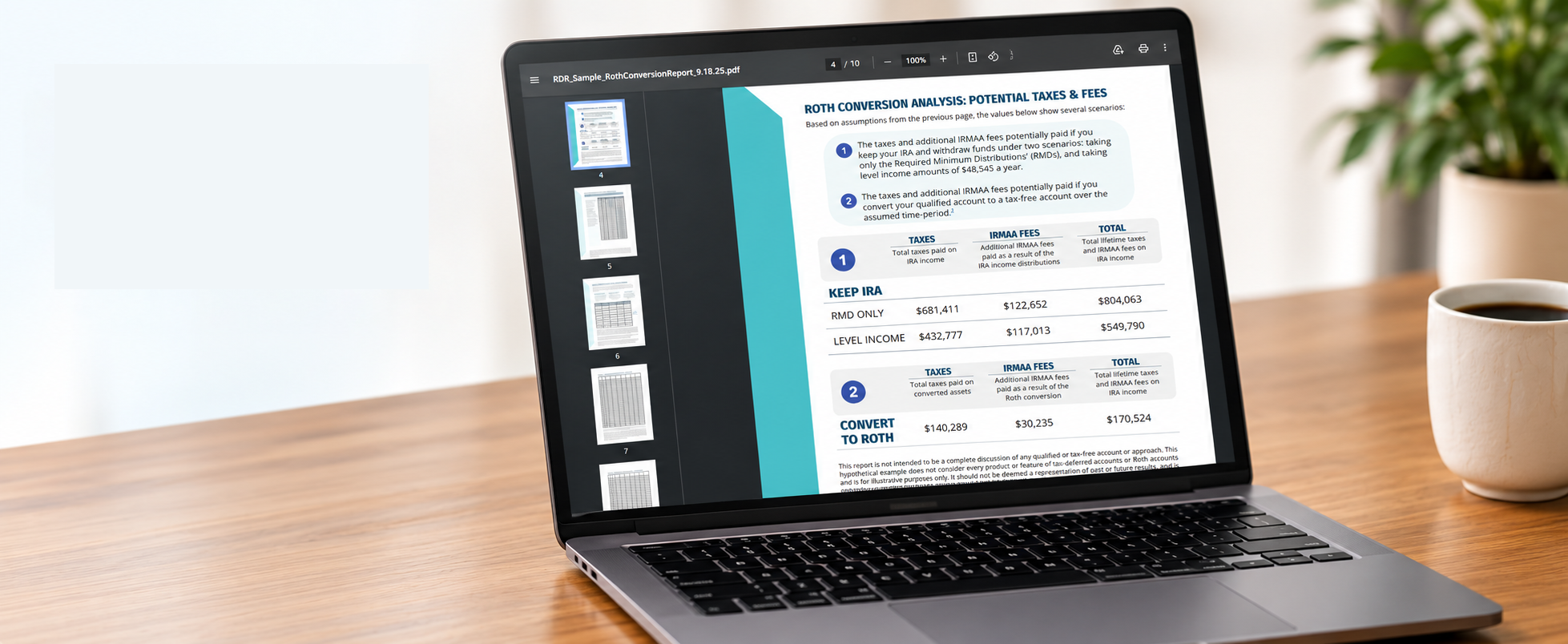
Clients coming to you with AI Roth recommendations? Use our Roth Done Right software to model multi-year Roth conversion scenarios, maximizing tax and IRMAA savings over the client’s lifetime. Incorporate annuities or life insurance to give the client additional options. And do it all in under 60- seconds – no tax return needed.
Our software is built to highlight the one area AI hasn’t touched: a client-specific analysis, modeled for the risks ahead, by someone who understands their full picture and has insights into all the levers that can be pulled.
Thousands of the nation’s top independent financial advisors rely on Stonewood software to guide their client meetings and conversations. See why here.
Frequently Asked Questions
Current evidence does not support a complete replacement. The BLS projects employment of advisors to grow 10% from 2024 to 2034, faster than average, and says savers with complex planning needs are not likely to fully trust automated recommendations.3,4 AI is changing the administrative part of the job more than it’s changing the advisory relationship.
According to Schwab's 2026 Advisor AI in Action study, 63% of independent RIAs say they are using AI tools in some capacity, more than double the 2023 adoption rate.1 Much of that use is for administrative tasks such as notetaking and email drafting rather than client-facing advice.
Today, the best use of AI tools is in administrative and prep work: taking on meeting notes, follow-up drafts, document summaries, etc. Only 1 in 10 advisors using AI say they have fully embedded it into their business strategy, with most still using it in a task-specific way rather than as core to client advice.1
According to Schwab’s 2026 Advisor AI in Action study, 63% of independent RIAs report using AI tools in some capacity, more than double the adoption rate in 2023.1 Much of that usage centers on administrative tasks like notetaking and email drafting rather than client-facing advice.
Not widely, not yet. According to a study by Cerulli Associates in February 2026, only 38% of affluent savers said they were comfortable with AI playing a role in their financial advice.2 Cerulli said current AI applications are centred on tasks that don’t directly impact the client relationship.
The data suggests the bigger risk isn’t AI itself, it’s falling behind advisors who adopt it for administrative efficiency while still leading client conversations personally. BLS projects continued strong demand for advisors handling complex retirement and estate planning needs that automated tools aren’t positioned to fully replace.3,4
Sources and References
All information in this article is general knowledge and widely available.
“Schwab Study Reveals RIA AI Adoption More Than Doubles, But Most Firms Still in Early Stages.” Charles Schwab & Co., Inc. 2026. Available online: https://pressroom.aboutschwab.com/press-releases/press-release/2026/Schwab-Study-Reveals-RIA-AI-Adoption-More-Than-Doubles—But-Most-Firms-Still-in-Early-Stages/default.aspx
“Investor Skepticism of AI in Financial Advice Persists.” Cerulli Associates, The Cerulli Edge, U.S. Retail Investor Edition, 1Q 2026 Issue. February 24, 2026. Available online: https://www.cerulli.com/press-releases/investor-skepticism-of-ai-in-financial-advice-persists
“Personal Financial Advisors.” Occupational Outlook Handbook, U.S. Bureau of Labor Statistics. Accessed June 2026. Available online: https://www.bls.gov/ooh/business-and-financial/personal-financial-advisors.htm
“Industry and Occupational Employment Projections Overview and Highlights, 2024-34.” Monthly Labor Review, U.S. Bureau of Labor Statistics. 2026. Available online: https://www.bls.gov/opub/mlr/2026/article/industry-and-occupational-employment-projections-overview.htm
“AI Notetakers & Agentic OS for Financial Advisors: The 2026 Strategic Buyer’s Guide.” Ezra Group. May 13, 2026. Available online: https://wealthtechtoday.com/2026/05/08/ai-notetakers-financial-advisors-2026/
Free Study Group Replay
How Stonewood Advisors Stay Ahead of the Next Planning Conversation.
Watch a recent Stonewood Study Group focused on the legacy planning conversation. You’ll see how Stonewood helps advisors break down timely planning topics, client conversation angles, and practical strategies you can put to use immediately.
Expert insights. Real strategies.
Study Group Replay
Timely planning topics
Real client conversation angles
Practical strategies you can use
Real Advisors. Real Results.
See how advisors are using Stonewood software to win larger cases and deliver better
outcomes for their clients.
An advisor was working with a prospect who was a real "do-it-yourselfer" when it came to Roth conversions.
The client was converting assets up their existing tax bracket – and hadn't considered any impact to
IRMAA.
With Roth Done Right, the advisor was able to show an alternate pattern that sped up the conversion to
6 years. The new structure offered $30,000 savings in conversion taxes – a 20% reduction on the
prospect's conversion tax bill. The report also showed hundreds of thousands of dollars in long-term
tax and IRMAA savings from the converted assets – an amount the prospect hadn't been able to quantify
on his own.
Outcome
A new client with $1M in new AUM, and a $1M FIA sale to fund the conversion process.
An advisor was working with a prospect who already had assets with Ken Fisher. Fisher's team presented a
5% systematic withdrawal projection, so the advisor needed a stronger way to frame the income
conversation.
Using the Annuity Alpha report, the advisor showed how an annuity could deliver over 8% in annual cash
flow with lifetime income, plus a long-term care doubler. The contrast was clear enough that the prospect
moved forward.
Outcome
$1.5M placed and a $100K in new business revenue.
An advisor was working with a 58-year-old couple with an established, well-funded retirement income plan,
leaving an additional $3M IRA to build out a legacy for the kids. The couple's existing advisor had no
real additional plan for this money, other than to keep it in their managed account and grow that money as
much as possible for the kids.
Using the Legacy Done Right report, the advisor showed the need for tax planning on this $3M IRA.
According to the advisor, the simple analysis "opened up the wallet" to the Roth conversion story. The
advisor then used the blended Roth/Life feature in the report to show a blend of Roth Conversion assets
with some Life Insurance to help maximize the client’s legacy.
Outcome
$3M in motion. The advisor picked up a $1.5M FIA sale that will be converted to Roth. And the advisor
also sold a 5-Pay Protection focused IUL policy at $225,000 of premium per year.
An advisor group incorporated the Total Tax Burden report into the strategy presentation for all new
prospects. They ran the tax snapshot for every new client as part of their first meeting conversation,
quantifying the growing tax burden of IRA money – and illustrating the kinds of tax savings possible
when working with their firm.
Starting in January of 2023, this simple analysis was presented to every single prospect who walked in
the door. The goal was to differentiate their practice and drive overall revenue growth through various
Roth conversion strategies.
Outcome
From 2022 to 2025, new annual AUM rose from $5M to $50M. Annual FIA sales rose from $3M to $35M.
And annual life premium rose from $50K to $1M.